No Minimum Order PCB Assembly: What OEM Buyers Should Know
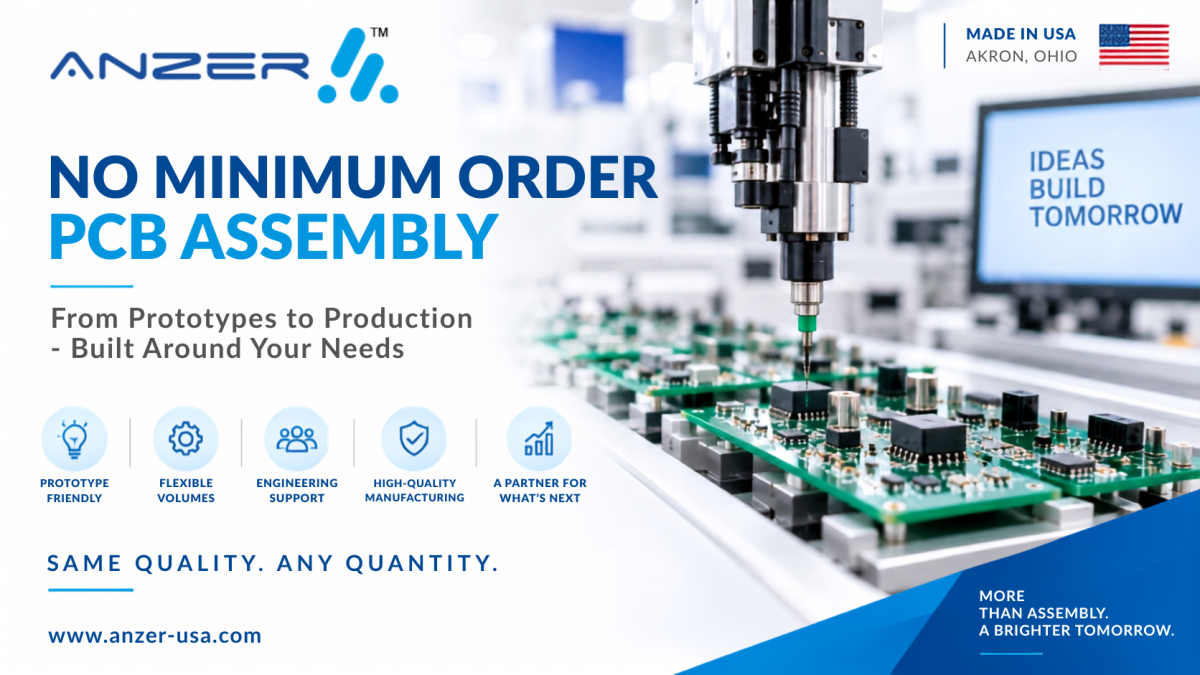
Yes, no minimum order PCB assembly is available for OEMs that need prototype, low-volume, or production PCB assemblies without committing to a large quantity. ANZER supports PCB assembly from prototypes through production, with no minimum order quantity, a dedicated prototype production line, SMT and through-hole assembly, DFM support, inspection, testing, and U.S.-based manufacturing in Akron, Ohio.
For an engineering or procurement team, however, “no MOQ” should mean more than simply accepting a small purchase order. The important questions are what happens during the build, how the design is reviewed, how the boards are inspected and tested, and whether the manufacturing partner can support the product when it moves from prototype to production.
What Does No Minimum Order PCB Assembly Mean?
Minimum order quantity, or MOQ, is the smallest quantity a manufacturer requires a customer to order.
A manufacturer with a 500-board MOQ, for example, may require an OEM to purchase 500 assemblies even when the immediate engineering requirement is only 20 boards.
A no MOQ PCB assembly provider removes that quantity requirement. This can be particularly useful when a product is still moving through:
- Engineering prototypes
- Design validation
- Functional testing
- R&D evaluation
- Pilot builds
- Pre-production
- Early production
ANZER’s verified manufacturing model supports prototype, pre-production, and production work without a minimum order quantity.
Why OEMs Need No MOQ PCB Assembly
The quantity required by engineering is not always the quantity required for commercial production.
An R&D team may need only a small number of assemblies to:
- Validate the circuit.
- Test firmware and hardware interaction.
- Identify PCB layout problems.
- Perform environmental or functional testing.
- Make engineering changes.
- Prepare for a pilot build.
- Release the design for production.
A high MOQ can force a company to buy more boards before the design is fully validated.
No MOQ assembly provides another path. The OEM can build the quantity appropriate for the current development stage and increase production as the design matures.
This is particularly useful for:
- New product development
- Industrial electronics
- Medical electronics
- Aerospace electronics
- Automation equipment
- Custom OEM products
- R&D programs
- Engineering validation
- Low-volume specialty products
- Prototype development
ANZER serves industries including medical, aerospace, automotive, agriculture, industrial automation, lighting, and other custom electronics programs.
No MOQ Does Not Mean No Manufacturing Costs
This distinction matters when comparing PCB assembly quotations.
“No minimum order” means the manufacturer does not impose a minimum quantity requirement. It does not mean that a one-board assembly will have the same per-unit economics as a 1,000-board production run.
A small PCB assembly project can still involve costs associated with:
| Cost factor | Why it matters |
|---|---|
| PCB fabrication | Boards must still be fabricated to the required specifications |
| Components | Parts may have distributor or packaging quantities |
| Stencil | SMT assembly may require a solder-paste stencil |
| Machine setup | Production equipment must be prepared for the job |
| Programming | Assembly equipment requires the appropriate production data |
| Inspection | AOI, X-ray, or other inspection may be required |
| Testing | ICT, flying probe, functional testing, or burn-in may apply |
| Engineering review | DFM/DFA work can be needed before assembly |
| Special processes | Coating or potting can add manufacturing steps |
This is why an OEM should evaluate the total manufacturing requirement, not simply look for the supplier with the lowest advertised MOQ.
No MOQ PCB Assembly Is Especially Valuable for Prototypes
Prototype manufacturing is where minimum order requirements can become especially restrictive.
A prototype exists to answer engineering questions. The objective is not necessarily to manufacture the largest possible quantity.
ANZER maintains a dedicated prototype production line, allowing prototype work to be separated from high-volume production operations. The company’s verified prototype process includes DFM/DFA review, component sourcing, PCB fabrication, SMT/THT assembly, testing, and engineering feedback.
That creates a more practical path:
Design → DFM/DFA → Prototype → Test → Revise → Pre-production → Production
The same manufacturing partner can remain involved as the product progresses.
What Should a No MOQ PCB Assembly Provider Offer?
No MOQ by itself is not enough.
Before selecting an EMS or PCB assembly partner, OEM buyers should evaluate the complete manufacturing capability.
1. SMT and Through-Hole Assembly
Your supplier should be able to match the assembly technology to the product.
ANZER supports:
- Surface Mount Technology (SMT)
- Through-Hole Technology (THT)
- Mixed-technology PCB assembly
- Reflow soldering
- Wave soldering
- Hand soldering
This is important because many real-world PCBAs contain both surface-mount and through-hole components.
2. Design for Manufacturability Review
A small build is still an opportunity to identify manufacturing problems before they become production problems.
A DFM review can examine issues such as:
- Component clearances
- PCB layout
- Assembly feasibility
- Component availability
- BOM concerns
- Manufacturing constraints
- Test requirements
ANZER provides DFM and DFA support as part of its engineering capabilities.
For buyers, this can be more valuable than simply finding a supplier willing to build a very small quantity.
3. Inspection and Testing
A prototype should produce useful engineering information.
Depending on the project requirements, PCB assembly inspection and testing may include:
- Automated Optical Inspection (AOI)
- X-ray inspection
- In-Circuit Testing (ICT)
- Flying probe testing
- Functional testing
- Burn-in testing
The correct test strategy depends on the design, risk, application, and customer requirements.
For regulated or high-reliability products, buyers should define inspection, testing, documentation, and traceability expectations before the RFQ.
4. Quality Standards That Match the Application
The right PCB assembly supplier depends partly on where the finished electronics will be used.
ANZER’s verified quality capabilities include:
- ISO 9001:2015
- ISO 13485:2016
- AS9100D
- IPC-A-610 capability
- IPC Class 2 and Class 3 manufacturing
- ESD control
- RoHS compliance
- REACH compliance
For example, medical electronics programs can require a manufacturing partner with an appropriate quality management system, while aerospace programs can have different quality and traceability requirements.
5. A Path From Prototype to Production
One of the biggest questions an engineering team should ask is:
What happens after the prototype works?
Changing manufacturers between prototype and production can introduce another round of:
- Supplier qualification
- Documentation review
- DFM review
- Process validation
- Communication
- Test development
- Supply-chain coordination
A PCB assembly partner capable of supporting prototype, pre-production, and production can provide continuity as the product matures.
ANZER’s manufacturing model supports prototype through production, with a dedicated prototype line and broader PCB assembly, testing, box build, coating, potting, and wire harness capabilities.
No MOQ vs. Low MOQ: What Is the Difference?
These terms are sometimes used interchangeably, but buyers should distinguish them.
| Model | Meaning |
|---|---|
| High MOQ | Supplier requires a relatively large minimum quantity |
| Low MOQ | Supplier accepts smaller quantities but still has a minimum |
| No MOQ | Supplier does not impose a minimum quantity requirement |
| Prototype-focused | Supplier is structured to support early-stage development |
| Prototype-to-production | Supplier can support development and later manufacturing stages |
For an OEM, the most useful combination is not necessarily just “no MOQ.”
A stronger supplier profile is:
No MOQ + prototype capability + engineering support + quality controls + testing + production scalability.
How to Prepare an RFQ for No MOQ PCB Assembly
Before requesting a quotation, provide as much manufacturing information as possible.
A useful RFQ package may include:
- Gerber files
- Bill of Materials (BOM)
- Pick-and-place files
- Assembly drawings
- PCB fabrication specifications
- Revision information
- Approved component manufacturers
- Component alternates
- Test requirements
- Programming requirements
- Required IPC Class
- Coating or potting requirements
- Packaging requirements
- Serialization requirements
- Prototype or production quantity
- Required documentation
- Traceability requirements
For additional guidance, see ANZER’s DFM checklist for PCB and its resources on PCB component traceability.
Questions to Ask Before Choosing a No MOQ PCB Assembly Partner
Procurement and engineering teams should ask:
- Is there genuinely no minimum order quantity?
- Can you build a single prototype if required?
- Do you support both SMT and through-hole assembly?
- Is DFM/DFA review available?
- What inspection methods are available?
- Can you perform functional testing?
- Can you support prototype, pre-production, and production?
- What quality standard applies to the assembly?
- How is component and production traceability managed?
- Can additional manufacturing operations be handled by the same supplier?
These questions help separate a simple assembly transaction from a longer-term manufacturing relationship.
When No MOQ PCB Assembly Makes the Most Sense
No MOQ PCB assembly is particularly useful when:
You are developing a new product
You may not know the final production quantity yet. Starting with a small build lets engineering validate the design before committing to larger production volumes.
You are modifying an existing PCB
A small build can support engineering verification before releasing a revised design to production.
You are developing regulated electronics
Medical and aerospace development can involve extensive validation. Small production quantities may be appropriate during early stages, while documentation and quality requirements remain important.
You need a pilot or pre-production build
A pre-production run can help validate the manufacturing process before larger production commitments.
You manufacture specialized equipment
Industrial and custom electronics programs may not require thousands of identical boards. A flexible PCB assembly partner can better match production quantity to actual demand.
No MOQ PCB Assembly in the USA
For U.S.-based OEMs, manufacturing location can also be part of the supplier decision.
ANZER manufactures in Akron, Ohio, with all manufacturing conducted in the United States. The company has more than 33 years of manufacturing history through the WRC-to-ANZER legacy and has completed more than 4,000 projects.
For buyers who need domestic manufacturing, the evaluation should still focus on the complete supplier capability:
- Quality system
- Engineering support
- Manufacturing process
- Testing
- Traceability
- Production flexibility
- Documentation
- Supply-chain requirements
- Product application
- Prototype-to-production support
Location alone does not determine manufacturing quality. It is one part of the supplier evaluation.
Why ANZER Supports No Minimum Order PCB Assembly
ANZER’s no-MOQ model is designed to support different stages of an OEM electronics program.
The verified capabilities include:
- No minimum order quantity
- Dedicated prototype production line
- SMT assembly
- Through-hole assembly
- Mixed-technology assembly
- DFM and DFA support
- PCB fabrication
- AOI
- X-ray inspection
- ICT
- Flying probe
- Functional testing
- Burn-in testing
- Conformal coating
- Potting
- Wire harness and cable assembly
- Box build assembly
- Prototype, pre-production, and production support
That broader capability matters because PCB assembly is often only one part of the finished electronics manufacturing requirement.
A Practical Buyer Checklist
Before sending your next PCB assembly RFQ, confirm:
- Required build quantity is defined
- Prototype, pilot, or production stage is identified
- BOM is revision-controlled
- Gerber files are available
- Pick-and-place data is available
- Assembly drawings are included
- Component alternates are identified
- Required IPC Class is known
- Inspection requirements are defined
- Functional test requirements are defined
- Programming requirements are documented
- Coating or potting requirements are identified
- Traceability requirements are documented
- Packaging and labeling requirements are defined
- Supplier’s MOQ policy has been confirmed
- Prototype-to-production capability has been evaluated
Frequently Asked Questions
Does ANZER have a minimum order quantity for PCB assembly?
No. ANZER has no minimum order quantity requirements, including support for prototype and low-volume PCB assembly.
Can I order a single PCB assembly?
ANZER’s verified no-MOQ policy means there is no minimum quantity requirement. Whether a particular one-board build is practical depends on the PCB, components, process requirements, and requested testing.
Is no MOQ PCB assembly cheaper?
Not necessarily. No MOQ removes a quantity requirement, but small builds can still have setup, fabrication, component, engineering, inspection, and testing costs. Larger production quantities may provide better unit economics.
Is no MOQ useful for prototype PCB assembly?
Yes. No MOQ can be particularly useful during product development because engineering teams can build the quantity required for validation without committing to a larger production run. ANZER also has a dedicated prototype production line.
Can ANZER move from prototype PCB assembly to production?
Yes. ANZER supports prototype, pre-production, and production PCB assembly, allowing an OEM to continue with the same manufacturing partner as the product moves through development.
Conclusion
No minimum order PCB assembly gives OEMs more flexibility during product development, but the best supplier decision should go beyond MOQ.
Look for a manufacturing partner that can support the complete process: DFM review, PCB fabrication, SMT and THT assembly, inspection, testing, documentation, traceability, prototype builds, pre-production, and production.
ANZER provides no-MOQ PCB assembly from its Akron, Ohio manufacturing facility, with a dedicated prototype production line and capabilities spanning PCB assembly, testing, coating, potting, wire harness, box build, and production support.
For an upcoming prototype, low-volume build, or production program, request a PCB assembly quote from ANZER.