MBE WBE Electronics Manufacturer: What OEM Buyers Should Know
For OEMs, procurement teams, and engineering groups, choosing an MBE WBE electronics manufacturer can support supplier-diversity objectives while still requiring the same technical discipline expected from any qualified electronics manufacturing partner. The right evaluation should cover certification, manufacturing capabilities, quality systems, engineering support, traceability, testing, and production fit.
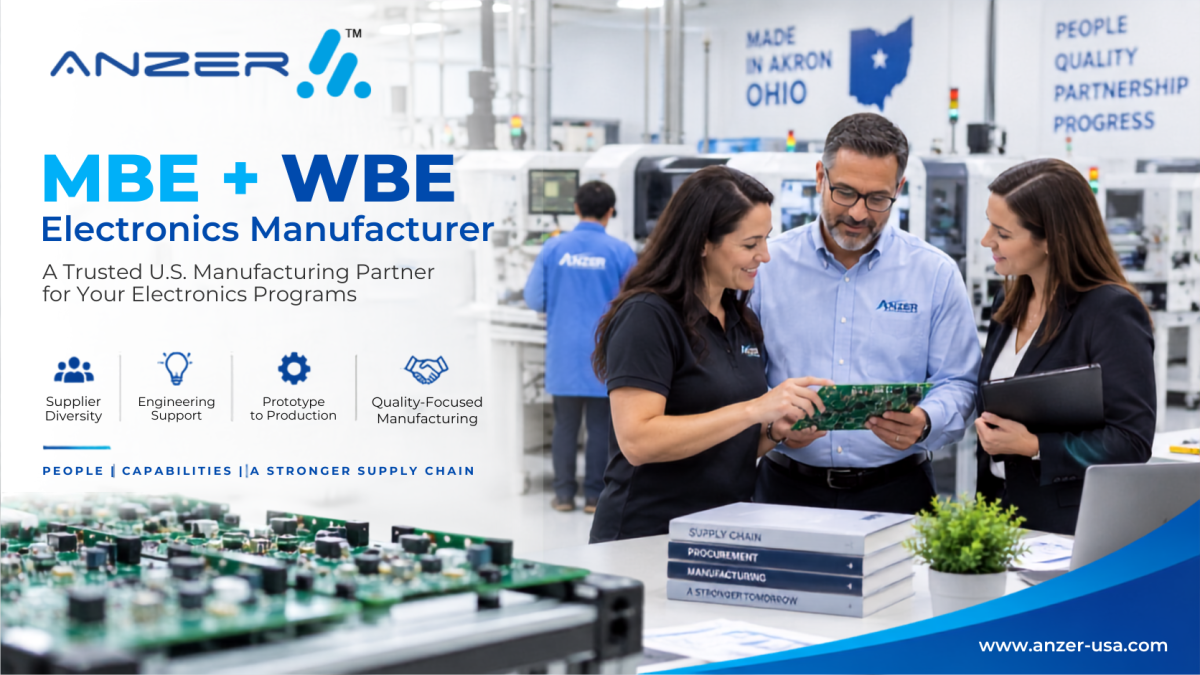
ANZER USA is a Made in USA electronics contract manufacturer in Akron, Ohio, with verified MBE and WBE certifications, PCB assembly, box build, wire harness assembly, prototyping, testing, coating, potting, and engineering capabilities.
What Is an MBE WBE Electronics Manufacturer?
An MBE WBE electronics manufacturer is an electronics manufacturing company that holds recognized Minority Business Enterprise and Women’s Business Enterprise certifications.
These designations matter most when an OEM, corporation, government organization, or procurement team has supplier-diversity requirements or actively seeks certified suppliers.
The certification itself does not replace technical supplier qualification. Buyers should still evaluate:
- Manufacturing capabilities
- Quality management systems
- Engineering support
- PCB assembly processes
- Testing capabilities
- Traceability and documentation
- Production capacity and fit
- Industry experience
- Domestic manufacturing requirements
- RFQ and onboarding requirements
In Ohio, MBE, EDGE, and WBE certification programs are administered through the Ohio Department of Development’s Minority Business Development Division. Current Ohio rules establish certification criteria and allow certified businesses to be listed for contracting authorities.
Why MBE and WBE Certification Can Matter to Procurement Teams
Supplier diversity is not simply about adding another checkbox to a sourcing spreadsheet.
For qualified programs, certification can help procurement teams identify suppliers that meet specific diversity-sourcing requirements.
Ohio’s procurement framework includes MBE set-aside provisions. For example, Ohio Revised Code Section 125.081 establishes purchases selected for competition only by certified minority business enterprises within the state’s applicable procurement framework.
That means procurement teams should understand the difference between:
Certification
The supplier has met the applicable requirements of a certification program.
Supplier qualification
The supplier has demonstrated that it can manufacture the required product to the customer’s technical, quality, documentation, and delivery requirements.
Contract eligibility
The supplier meets the specific requirements of a particular solicitation or purchasing organization.
These are related, but they are not interchangeable.
Why Choose an MBE WBE Electronics Manufacturer for Electronics Production?
For electronics buyers, the value comes from combining supplier-diversity credentials with manufacturing capability.
ANZER’s verified MBE and WBE status sits alongside its electronics manufacturing capabilities, including PCB assembly, SMT, THT, mixed-technology assembly, testing, box build, wire harness assembly, coating, potting, prototype manufacturing, and engineering support.
That gives buyers a more complete supplier evaluation framework.
1. Supplier Diversity and Manufacturing in One Relationship
A certified supplier can potentially support procurement objectives while also serving as a production partner.
For an electronics program, that means the sourcing discussion should go beyond certification and examine whether the manufacturer can support the actual product lifecycle.
2. Domestic Electronics Manufacturing
ANZER manufactures in Akron, Ohio, with all manufacturing based in the United States.
For OEMs evaluating domestic manufacturing, this can be relevant when sourcing strategy includes U.S. production requirements, engineering collaboration, documentation control, or domestic supply-chain considerations.
3. PCB Assembly Capabilities
A qualified electronics manufacturer should be able to explain how it handles the actual assembly process.
ANZER’s verified capabilities include:
- SMT assembly
- THT assembly
- Mixed-technology assembly
- Reflow soldering
- Wave soldering
- Hand soldering
- AOI
- X-ray inspection
- ICT
- Functional testing
- Flying probe testing
- Burn-in testing
- Serialization and labeling
These capabilities allow buyers to evaluate the supplier based on the manufacturing requirements of the product rather than certification status alone.
For a broader evaluation of assembly capabilities, see ANZER’s PCB assembly services.
MBE WBE Certification Should Be One Part of Supplier Qualification
This is an important distinction.
A procurement team should not select an electronics manufacturer solely because it holds MBE or WBE status.
Instead, use certification as one part of a broader supplier qualification process.
| Evaluation Area | Questions for the Electronics Manufacturer |
|---|---|
| Certification | Does the company hold the certification required by the procurement program? |
| Manufacturing | Can it build the required PCBAs, assemblies, or finished systems? |
| Quality | Which quality systems and workmanship standards apply? |
| Engineering | Does the supplier perform DFM, DFA, and BOM reviews? |
| Testing | What inspection and functional testing options are available? |
| Traceability | What manufacturing and product documentation can be maintained? |
| Prototyping | Can the supplier support early builds before production? |
| Production | Can the supplier support the required production model? |
| Integration | Are harnesses, box builds, coating, and potting available when required? |
| Location | Does domestic manufacturing matter to the sourcing strategy? |
This approach prevents certification from becoming a substitute for technical due diligence.
What Should OEMs Ask an MBE WBE Electronics Manufacturer?
Before sending an RFQ, engineering and procurement teams should establish the requirements of the program.
Manufacturing Questions
Ask:
- What PCB technologies are supported?
- Does the supplier support SMT and THT?
- Can it handle mixed-technology assemblies?
- Is prototype production supported?
- Can the supplier transition a qualified prototype into production?
- Are box build and system integration available?
- Can wire harnesses and cable assemblies be manufactured?
- Are coating and potting available?
Quality Questions
Ask:
- Which quality certifications apply to the facility?
- Which IPC workmanship classes can the manufacturer support?
- What inspection methods are available?
- Is AOI available?
- Is X-ray inspection available for applicable assemblies?
- Can ICT or functional testing be incorporated?
- How is traceability handled?
- What documentation is maintained?
ANZER’s verified quality credentials include ISO 9001:2015, ISO 13485:2016, AS9100D, IPC-A-610 certification, ESD controls, RoHS compliance, and REACH compliance. ANZER also manufactures to IPC Class 2 and Class 3 requirements.
MBE WBE Electronics Manufacturing for Medical and Aerospace Programs
Certification can be particularly relevant when procurement requirements intersect with regulated electronics manufacturing.
However, buyers should separate supplier-diversity requirements from industry-specific quality requirements.
Medical Electronics
Medical electronics programs can require disciplined documentation, traceability, manufacturing controls, and quality management.
ANZER is ISO 13485:2016 certified and provides medical electronics assembly capabilities. Its verified medical manufacturing experience includes the Ohio State University RALPH project, for which ANZER provided design and production services.
Learn more about medical electronics assembly when evaluating suppliers for medical-device electronics.
Aerospace Electronics
Aerospace programs can introduce additional requirements around quality systems, workmanship, traceability, and reliability.
ANZER is AS9100D certified and supports IPC Class 3 manufacturing for high-reliability electronics. Its capabilities include SMT, THT, mixed-technology assembly, testing, conformal coating, and potting.
See aerospace electronics assembly for more information.
MBE WBE Electronics Manufacturer vs. Commodity PCB Supplier
Not every electronics sourcing requirement is simply a request for assembled circuit boards.
Some OEM programs require multiple manufacturing stages.
For example:
PCB fabrication → PCB assembly → inspection → testing → wire harness → mechanical integration → box build → coating/potting → final inspection → packaging
When these activities are split between multiple suppliers, the OEM has additional interfaces to manage.
ANZER’s verified capabilities cover PCB assembly, testing, wire harness assembly, box build, coating, potting, machining, prototyping, and engineering support.
For complex products, this can make the supplier evaluation broader than simply comparing PCB assembly prices.
What to Include in an Electronics Manufacturing RFQ
A strong RFQ helps the manufacturer evaluate the project accurately.
Include:
- BOM
- Gerber or fabrication data
- Assembly drawings
- PCB specifications
- Component requirements
- Expected build quantity
- Prototype or production status
- Testing requirements
- IPC class requirements
- Coating or potting requirements
- Box build documentation, if applicable
- Traceability requirements
- Required certifications
- Packaging and labeling requirements
- Any supplier-diversity requirements
Engineering teams should also request a DFM/DFA review before production when the design is still being finalized.
ANZER provides DFM, DFA, BOM optimization, testing-strategy consultation, and prototype-to-production support.
MBE and WBE Certification Does Not Guarantee a Contract
This point is important for procurement accuracy.
Certification can create eligibility or sourcing opportunities, but it does not automatically mean that a certified manufacturer will receive a contract.
WBENC explicitly explains that WBE certification is a procurement and supplier-diversity tool and does not guarantee corporate, retail, or government contracts.
The same principle applies to electronics manufacturing qualification.
The manufacturer still needs to demonstrate that it fits the technical requirements, quality expectations, commercial requirements, and scope of the specific project.
How to Evaluate an MBE WBE Electronics Manufacturer
A practical evaluation can follow five stages.
Step 1: Verify Certification
Confirm that the certification is current and applicable to your procurement program.
Ohio’s current rules specify certification requirements for MBE and WBE programs, including ownership, control, and other eligibility criteria.
Step 2: Evaluate Manufacturing Fit
Review:
- SMT
- THT
- Mixed technology
- PCB assembly
- Testing
- Box build
- Wire harness
- Coating
- Potting
- Prototype production
Step 3: Review Quality Requirements
Match the supplier’s quality system and workmanship capability to the product.
For example, regulated medical and aerospace electronics may require more stringent quality and documentation considerations than a general industrial assembly.
Step 4: Review Engineering Support
Determine whether the manufacturer can participate before production through:
- DFM
- DFA
- BOM review
- Component sourcing
- Prototype feedback
- Testing strategy
Step 5: Evaluate Long-Term Production Fit
The strongest supplier relationship is not necessarily the one that produces the cheapest initial prototype.
Consider whether the supplier can support the product as it moves from prototype through pre-production and production.
Why Akron, Ohio Matters for Domestic Electronics Buyers
For buyers searching for an MBE WBE electronics manufacturer in Ohio, location can be part of the sourcing decision.
ANZER operates from Akron, Ohio, and manufactures in the United States. The business has a manufacturing legacy dating to 1991 and has completed more than 4,000 projects, according to ANZER’s verified company information.
That gives Ohio-based OEMs and other domestic buyers a local manufacturing option to evaluate alongside technical, quality, and supplier-diversity requirements.
MBE WBE Electronics Manufacturer Checklist
Before approving an electronics manufacturing supplier, confirm:
- MBE certification verified
- WBE certification verified
- Certification applicable to your procurement requirement
- U.S. manufacturing location confirmed
- PCB assembly capability confirmed
- SMT capability confirmed
- THT capability confirmed
- Testing requirements reviewed
- IPC requirements reviewed
- Quality certifications reviewed
- Traceability requirements reviewed
- DFM/DFA support evaluated
- Prototype capability confirmed
- Production transition discussed
- Box build requirements reviewed
- Wire/cable harness requirements reviewed
- Coating/potting requirements reviewed
- RFQ documentation prepared
Frequently Asked Questions
What does MBE mean in electronics manufacturing?
MBE stands for Minority Business Enterprise. In Ohio, MBE certification is part of a state-administered supplier certification and procurement framework.
What does WBE mean?
WBE stands for Women’s Business Enterprise. The exact certification criteria depend on the certifying organization or program. WBENC, for example, defines a certified WBE around qualifying women ownership, control, operation, and management.
Does MBE or WBE certification mean an electronics manufacturer is technically qualified?
No. Certification and technical qualification are separate evaluations. Buyers should assess manufacturing capabilities, quality systems, testing, documentation, traceability, and product-specific requirements.
Can an MBE WBE electronics manufacturer support prototypes?
Yes, if the manufacturer has prototype capabilities. ANZER has a dedicated prototype production line and no minimum order quantity, according to its verified company information.
What should OEMs look for beyond MBE and WBE certification?
Look at manufacturing capability, quality certifications, IPC workmanship requirements, engineering support, testing, traceability, domestic production, prototype capability, and the supplier’s ability to support production after qualification.
Conclusion
For procurement teams searching for an MBE WBE electronics manufacturer, certification can be an important part of supplier selection, particularly where supplier-diversity requirements apply. But certification should be evaluated alongside the fundamentals of electronics manufacturing.
The practical questions are straightforward: Can the manufacturer build the product? Can it meet the required quality and workmanship standards? Can it support engineering and testing? Can it document the process? Can it support the product beyond the first prototype?
ANZER USA combines verified MBE and WBE certifications with Made in USA electronics manufacturing in Akron, Ohio, PCB assembly, SMT, THT, box build, wire harness assembly, testing, prototyping, DFM/DFA support, coating, potting, and regulated-industry quality systems.
For an OEM evaluating a new electronics manufacturing partner, those are the areas worth putting into the RFQ and supplier qualification process.
Ready to discuss an electronics manufacturing project? Start with ANZER’s Get a Quote page and provide the BOM, PCB data, drawings, quantities, testing requirements, and applicable quality or procurement requirements.