Contract Electronics Manufacturer: What OEMs Should Evaluate Before Choosing an EMS Partner
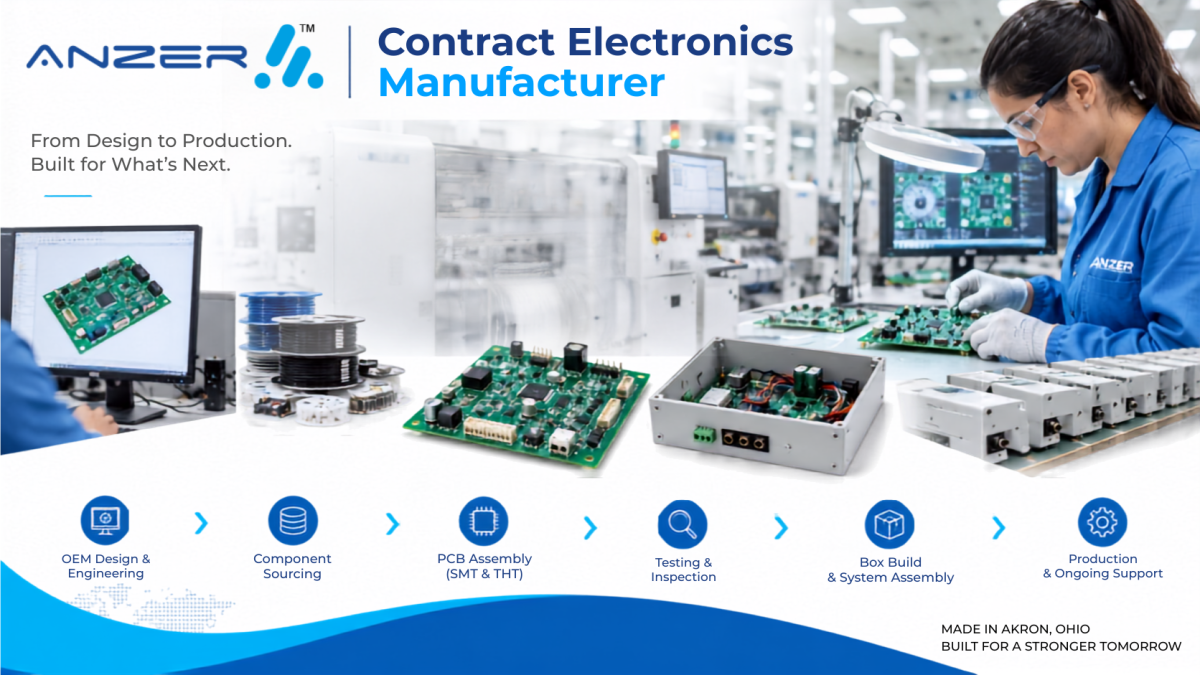
A contract electronics manufacturer helps OEMs turn an electronic design into a manufacturable product without requiring the OEM to operate every production process internally. Depending on the supplier and project, services can include component sourcing, PCB assembly, testing, box build integration, wire and cable assembly, quality control, and production support.
For OEMs, choosing a contract electronics manufacturer should involve more than comparing unit prices. The right evaluation should consider manufacturing capability, quality systems, engineering support, testing, traceability, supply-chain control, production volume, and the complexity of the final product.
ANZER provides electronic contract manufacturing from its Akron, Ohio facility, supporting PCB assembly, turnkey manufacturing, box build, wire harness and cable assembly, testing, coating, potting, prototyping, and related engineering services.
What Is a Contract Electronics Manufacturer?
A contract electronics manufacturer, often called an ECM, EMS provider, or electronics contract manufacturer, produces electronic assemblies or finished electronic products for another company.
The OEM generally controls the product requirements, specifications, drawings, bill of materials, and product objectives. The manufacturing partner provides the production resources and processes needed to build the product according to those requirements.
The exact scope varies by supplier.
A contract electronics manufacturer may provide:
- PCB assembly
- Surface Mount Technology (SMT)
- Through-Hole Technology (THT)
- Mixed-technology assembly
- Component procurement
- PCB fabrication
- Inspection and testing
- Wire harness and cable assembly
- Box build and system integration
- Conformal coating
- Potting
- Prototype production
- Production manufacturing
- Packaging and serialization
Industry sources commonly use EMS and ECM as overlapping terms for outsourced electronics manufacturing services.
For an OEM, the important question is not simply what a manufacturer calls itself. The better question is:
Can the manufacturer support the actual technical, quality, documentation, testing, and production requirements of your product?
Contract Manufacturer vs. EMS vs. ODM
These terms are often used interchangeably, but there are meaningful differences in business models.
| Model | Primary Role | Typical Relationship |
|---|---|---|
| OEM | Owns the product, brand, or product requirements | Outsources manufacturing when appropriate |
| EMS | Provides electronics manufacturing services | Builds products for OEM customers |
| ECM/CEM | Contract electronics manufacturing | Manufactures electronic assemblies/products for customers |
| ODM | Designs and manufactures its own products for another brand | May retain significant product design/IP ownership |
For an OEM that already has its own product design and wants a manufacturing partner, an EMS or ECM relationship is generally the relevant model.
The terminology matters less than clearly defining responsibilities before production begins.
What Does a Contract Electronics Manufacturer Do?
A capable contract electronics manufacturer can support one stage of production or multiple stages of the product lifecycle.
1. Component Sourcing
Component procurement can become one of the most difficult parts of an electronics manufacturing program.
A manufacturer may source components according to the customer’s BOM and approved requirements, while managing availability and purchasing coordination.
For OEM buyers, the important questions include:
- Who is responsible for purchasing?
- Are approved manufacturers and distributors specified?
- How are substitutions handled?
- What documentation accompanies components?
- How are obsolete or unavailable components managed?
- Can the manufacturer support engineering changes?
For turnkey manufacturing, these questions should be addressed before the first production order.
2. PCB Assembly
PCB assembly is one of the core services provided by an electronics manufacturing partner.
Depending on the product, this can include:
- SMT assembly
- THT assembly
- Mixed-technology assembly
- Reflow soldering
- Wave soldering
- Hand soldering
- AOI
- X-ray inspection
- ICT
- Flying probe testing
- Functional testing
- Burn-in testing
ANZER supports prototype through high-volume production and does not require a minimum order quantity.
For buyers evaluating PCB assembly capabilities, the important issue is not simply whether a supplier owns SMT equipment. Evaluate whether its manufacturing process matches your board technology, quality requirements, production volume, and testing needs.
Related ANZER resource: PCB Assembly
Why DFM Should Be Part of the Manufacturing Conversation
A contract electronics manufacturer should be able to identify manufacturing problems before they become production problems.
Design for Manufacturability, or DFM, examines whether the product design can be manufactured consistently and efficiently.
A DFM review can consider issues such as:
- Component availability
- Component placement
- Part clearances
- PCB design rules
- Assembly access
- Soldering requirements
- Test requirements
- BOM risks
- Manufacturing process compatibility
This is particularly important during new product introduction.
ANZER provides DFM and DFA support as part of its engineering capabilities.
Related ANZER resource: DFM Checklist for PCB Assembly
Quality Systems Matter More Than a Factory Tour
A modern manufacturing facility can look impressive. That does not automatically tell an OEM how consistently a supplier controls production.
When evaluating a contract electronics manufacturer, ask about the quality system behind the equipment.
Relevant considerations include:
- Quality management certification
- IPC workmanship requirements
- Inspection processes
- Testing procedures
- Traceability
- Documentation control
- Nonconformance handling
- Employee training
- Process verification
ANZER is certified to ISO 9001:2015, ISO 13485:2016, and AS9100D, and its workforce is trained to IPC-A-610 requirements. Jay Mendpara, ANZER’s CEO, holds IPC-A-610 Certified Trainer credentials.
ANZER manufactures to IPC Class 2 and Class 3 requirements.
That distinction matters when electronics move from general industrial applications into higher-reliability environments.
Related ANZER resource: IPC Class 2 vs. Class 3 Standards
Testing Should Be Defined Before Production
Testing is not one universal process.
The appropriate strategy depends on the product, design, risk profile, customer requirements, and production objectives.
Common electronics manufacturing tests include:
| Test or Inspection | Purpose |
|---|---|
| AOI | Automated inspection of component placement and solder joints |
| X-ray | Inspection of hidden solder connections such as certain BGA joints |
| ICT | Checks electrical characteristics including shorts, opens, and component values |
| Flying Probe | Contact-based electrical testing without a traditional fixed test fixture |
| Functional Testing | Evaluates whether the assembly operates as intended |
| Burn-In | Applies thermal/electrical stress to identify early-life failures |
A buyer should ask the manufacturer:
What will be inspected, what will be tested, when will it be tested, and what documentation will be retained?
That is more useful than simply asking whether a supplier offers “testing.”
Related ANZER resource: In-Circuit Testing
Traceability Is Important for Regulated Electronics
Traceability becomes particularly important when OEMs need to understand what components and processes went into a finished assembly.
Depending on the program, buyers may need visibility into:
- Component information
- Manufacturing records
- Inspection results
- Test results
- Serialization
- Production documentation
- Quality records
For medical and aerospace programs, manufacturing documentation can become an important part of the supplier evaluation process.
ANZER provides traceability and documentation support for its regulated-industry manufacturing programs.
Related ANZER resource: PCB Component Traceability in Manufacturing
When PCB Assembly Is Not Enough: Box Build Manufacturing
Some OEMs do not need a supplier that only assembles a circuit board.
They need the complete electronic product assembled.
That is where box build assembly becomes important.
A box build can integrate:
- PCB assemblies
- Wire harnesses
- Cable assemblies
- Mechanical enclosures
- Connectors
- Sensors
- Displays
- Hardware
- Other product components
The process can include subassembly preparation, mechanical integration, wiring, labeling, testing, serialization, packaging, and delivery.
For an OEM, using one manufacturing partner for multiple stages can reduce the number of supplier handoffs that have to be coordinated.
ANZER provides box build assembly as part of its electronic contract manufacturing capabilities.
Related ANZER resource: Box Build Assembly Services
Wire Harness and Cable Assembly Can Be Part of the Same Program
Electronic products frequently require more than a PCBA.
A wire harness organizes individual wires within a product, while a cable assembly generally incorporates wires within an exterior sleeve or sheathing for additional protection.
The correct approach depends on how the connection will be used and what environmental protection is required.
For OEMs purchasing a box build, asking whether the contract manufacturer can also produce the required harnesses or cable assemblies can simplify manufacturing coordination.
ANZER provides both wire harness and cable assembly services.
Related ANZER resource: Wire Harness and Cable Assembly
Medical and Aerospace Electronics Require a Different Evaluation
Not every contract electronics manufacturer is appropriate for every application.
For medical electronics, buyers should evaluate whether the supplier’s quality system and manufacturing processes support the requirements of the program.
ANZER holds ISO 13485:2016 certification for medical device quality management and manufactures medical electronics assemblies.
The company also has AS9100D certification for aerospace manufacturing.
For higher-reliability applications, buyers should also examine IPC workmanship requirements, traceability, inspection, testing, documentation, and environmental protection processes.
ANZER offers conformal coating and potting in-house for applications requiring additional protection from environmental conditions.
Medical electronics: ANZER Medical Electronics Assembly
Aerospace electronics: ANZER Aerospace Electronics Assembly
Prototype-to-Production Capability Can Reduce Supplier Handoffs
A common manufacturing challenge occurs when a prototype supplier and production supplier are different companies.
The production manufacturer may need to learn:
- The product history
- Design changes
- Manufacturing problems
- Test requirements
- Component decisions
- Assembly lessons from earlier builds
ANZER maintains a dedicated prototype production line and supports prototype-to-production manufacturing.
The company’s prototype process can include DFM/DFA review, component sourcing, fabrication, SMT/THT assembly, testing, and engineering feedback.
For OEMs, continuity between prototype and production can be worth considering when evaluating manufacturing partners.
Related ANZER resource: Prototype to Production PCB Manufacturing
What Should You Send a Contract Electronics Manufacturer for an RFQ?
A stronger RFQ generally gives the manufacturer enough information to understand both the product and the manufacturing requirement.
Consider providing:
Product information
- Product description
- Application
- Target market
- Expected production stage
PCB documentation
- Gerber files
- PCB fabrication information
- Assembly drawings
- Pick-and-place data when available
BOM information
- Complete BOM
- Approved manufacturer information
- Approved alternates
- Component lifecycle information
Manufacturing requirements
- SMT/THT requirements
- Assembly specifications
- IPC class
- Coating or potting requirements
- Test requirements
- Serialization requirements
Production information
- Prototype quantity
- Expected production quantity
- Target production schedule
- Packaging requirements
- Documentation requirements
A complete package allows the manufacturer to evaluate the project more accurately before production begins.
Related ANZER resource: Getting a PCB Assembly Quote
10 Questions to Ask Before Selecting a Contract Electronics Manufacturer
Before awarding an electronics manufacturing program, ask:
- What electronics manufacturing processes are performed in-house?
- Does the manufacturer support both prototypes and production?
- What IPC workmanship classes can it manufacture to?
- Which quality certifications apply to the facility and program?
- What inspection and testing methods are available?
- How is component and production traceability managed?
- Can the manufacturer support DFM and DFA reviews?
- Can it perform box build, wire harness, or cable assembly if required?
- Can it manage turnkey component procurement?
- Can the same manufacturing partner support the product from prototype through production?
These questions help move the supplier evaluation away from price alone and toward actual manufacturing fit.
Why OEMs Consider a U.S.-Based Contract Electronics Manufacturer
For some OEMs, manufacturing location is part of the sourcing decision.
A U.S.-based supplier can be relevant when the buyer values domestic manufacturing, direct communication, engineering collaboration, supply-chain visibility, or specific domestic sourcing requirements.
ANZER conducts its manufacturing in Akron, Ohio, and identifies its manufacturing as Made in USA. The company has more than 33 years of manufacturing history, tracing the business legacy to its founding as Western Reserve Controls in 1991.
ANZER has also completed 4,000+ projects and served 200+ customers across 10+ industries, according to its verified company information.
Related ANZER resource: U.S.A. Electronic Manufacturing Benefits
What Makes a Contract Electronics Manufacturer a Good Fit?
There is no single manufacturer that fits every OEM.
A supplier may be a good fit when its capabilities align with the actual requirements of the product.
A contract manufacturer may be a strong fit when you need:
- PCB assembly
- SMT and THT manufacturing
- Prototype production
- DFM/DFA support
- Component sourcing
- Inspection and testing
- Wire harness assembly
- Cable assembly
- Box build
- Conformal coating
- Potting
- Regulated-industry manufacturing
- Prototype-to-production continuity
- Domestic U.S. manufacturing
It may not be the right fit when:
- Your required manufacturing process is outside the supplier’s capabilities
- Your required certification is not held by the manufacturer
- Your production volume does not fit the supplier’s operating model
- Your test requirements cannot be supported
- Your documentation requirements exceed the supplier’s system
- Your product requires capabilities that have not been verified
The right approach is to evaluate the manufacturing requirements first, then determine whether the supplier can meet them.
Contract Electronics Manufacturer vs. Lowest-Cost Supplier
Unit price matters, but it is only one part of manufacturing cost.
A lower quoted assembly price can become less attractive if the program later experiences:
- Rework
- Poor manufacturability
- Component sourcing problems
- Test failures
- Documentation gaps
- Engineering-change problems
- Multiple supplier handoffs
- Production transition issues
For this reason, OEM procurement and engineering teams should evaluate total manufacturing fit, not only quoted piece price.
The better supplier comparison includes capability, quality, engineering, testing, traceability, sourcing, communication, production model, and long-term product requirements.
Frequently Asked Questions
What is a contract electronics manufacturer?
A contract electronics manufacturer produces electronic assemblies or products for OEM customers. Services can include PCB assembly, component sourcing, testing, box build, wire and cable assembly, and other manufacturing activities.
Is an EMS the same as a contract electronics manufacturer?
EMS and electronic contract manufacturing are commonly used for overlapping outsourced electronics manufacturing services. The exact scope depends on the supplier.
What should I look for in a contract electronics manufacturer?
Evaluate manufacturing capabilities, quality certifications, IPC requirements, testing, traceability, DFM support, sourcing capabilities, production volumes, and whether the supplier can support your product lifecycle.
Can a contract electronics manufacturer build prototypes?
Yes. Some manufacturers support prototypes as well as production. ANZER has a dedicated prototype production line and supports prototype-to-production manufacturing.
Can a contract electronics manufacturer provide complete box builds?
Yes, when box build is within its verified capabilities. ANZER supports PCB integration, wire harnesses, mechanical integration, testing, labeling, serialization, packaging, and related box build activities.
Choosing a Contract Electronics Manufacturer
Selecting an electronics manufacturing partner is ultimately a technical and operational decision.
The best evaluation starts with the product requirements. From there, compare manufacturing processes, DFM support, quality systems, IPC standards, inspection, testing, traceability, sourcing, production flexibility, and lifecycle support.
For OEMs looking for a U.S.-based manufacturing partner, ANZER provides electronic contract manufacturing from its Akron, Ohio facility, with capabilities spanning PCB assembly, turnkey manufacturing, prototype production, box build, wire harness and cable assembly, testing, coating, potting, and engineering support.
When you are ready to evaluate a manufacturing program, provide the product documentation, BOM, drawings, expected quantities, testing requirements, and other relevant manufacturing requirements so the project can be reviewed against actual capabilities.
Explore ANZER’s electronic contract manufacturing capabilities:
Electronic Contract Manufacturing Services
Request a manufacturing quote:
Get a Quote from ANZER