HDI Technology: Microvias and Fine Pitch Components Explained
Hey there, fellow innovators and tech enthusiasts. As the CEO of ANZER USA here in Akron, Ohio, I’ve been knee-deep in the electronics manufacturing world for over two decades. With my background in computer science and as an IPC-certified trainer, I’ve witnessed firsthand how advancements like High-Density Interconnect (HDI) technology are revolutionizing everything from medical devices to aerospace systems. If you’ve ever marveled at how today’s gadgets pack so much power into tiny packages – think smartphones or implantable heart monitors – HDI is often the unsung hero behind it. In this article, I’ll break down HDI technology, focusing on microvias and fine pitch components, in a way that’s straightforward and relatable.
Picture this: Back in the early days of my career, PCBs were bulky beasts with wide traces and big vias that took up way too much space. Fast forward to now, and HDI has flipped the script, allowing us to cram more functionality into less real estate without sacrificing performance. It’s like upgrading from a spacious old mansion to a sleek, efficient condo – everything’s optimized, and nothing’s wasted. Let’s dive in and unpack what makes HDI tick.
Table of Contents
What is HDI Technology? A Simple Breakdown
At its core, High-Density Interconnect (HDI) technology refers to PCBs designed with a higher wiring density per unit area than traditional boards. According to standards like IPC-2226, this means using finer traces (often under 100 microns wide), smaller vias, and advanced layering techniques to connect components more efficiently. Unlike standard PCBs that might rely on through-hole vias punching all the way through the board, HDI boards incorporate blind, buried, and microvias to create intricate, multi-layer structures.
Why does this matter? In today’s world, devices need to be smaller, faster, and more reliable. HDI enables that by reducing signal paths, minimizing interference, and improving thermal management. From my vantage point at ANZER in Akron, we’ve seen HDI become essential for Ohio’s booming tech sectors, like the medical hubs in Cleveland or automotive innovations in nearby Toledo. It’s not just about shrinking size – it’s about boosting performance in high-stakes environments where failure isn’t an option.
Demystifying Microvias: The Tiny Powerhouses of HDI
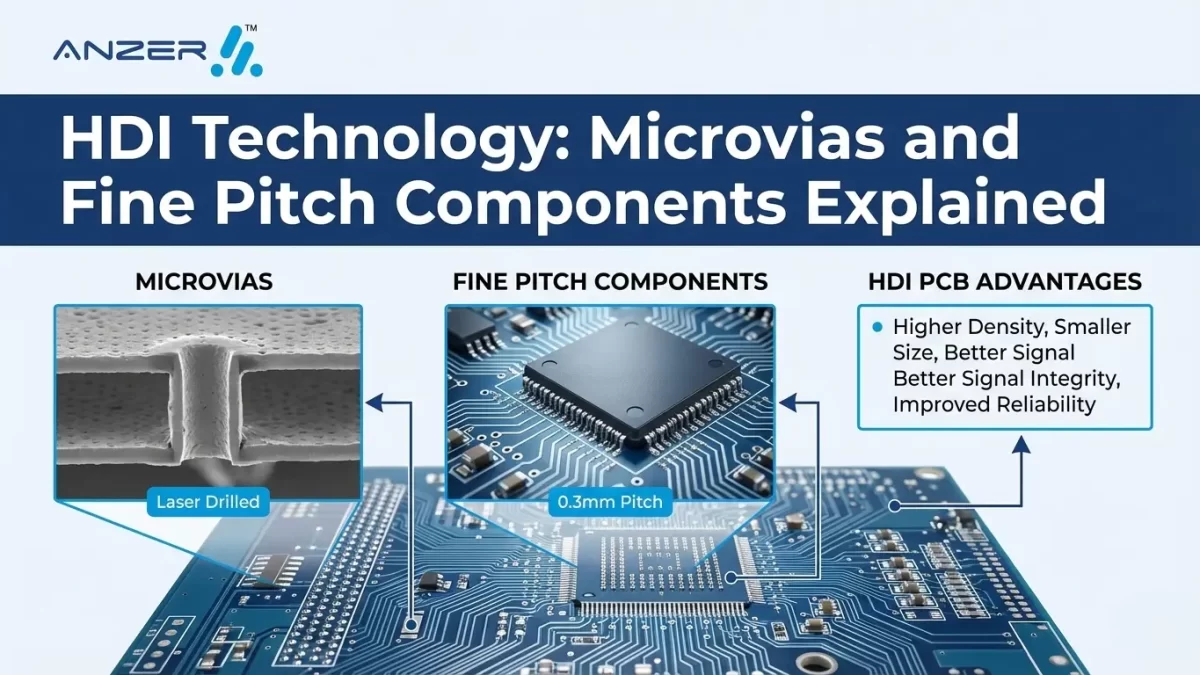
If HDI is the engine, microvias are the spark plugs. These are minuscule vias – typically with diameters between 50 to 150 microns and depths under 0.25 mm – laser-drilled to connect adjacent layers in a PCB. Unlike traditional vias that span the entire board (aspect ratios up to 10:1 or more), microvias keep a low aspect ratio of about 0.75:1 to 1:1, making them easier to plate with copper and more reliable.
How are they made? Laser drilling is the go-to method because it’s precise and clean, avoiding the debris from mechanical drills. Once drilled, they’re filled or plated to ensure strong electrical connections. There are a few types to know:
- Blind Microvias: Start from an outer layer and stop at an inner one – perfect for surface-mounted components.
- Buried Microvias: Hidden entirely within inner layers, freeing up space on the surface.
- Stacked vs. Staggered: Stacked ones align vertically for direct paths but can risk reliability if not designed right; staggered offset them for better stress distribution.
In my experience training teams on IPC standards, getting microvias right is crucial. A poor aspect ratio can lead to plating voids or cracks during thermal cycling – issues we’ve helped clients avoid in projects like our OSU RALPH device, a portable medical reminder tool prototyped in just 11 weeks. For aerospace applications, where vibrations and temperature swings are brutal, microvias ensure signal integrity remains rock-solid. And in medical devices? They allow for compact designs that fit inside the human body, all while meeting FDA compliance.
One real-world tip: Always simulate thermal and mechanical stresses early in design. We’ve seen boards fail in testing because microvias weren’t optimized- lessons that save time and money down the line.
Fine Pitch Components: Fitting More in Less Space
Now, let’s talk about the stars of the show: fine pitch components. These are the chips, BGAs (Ball Grid Arrays), and other parts with super-close spacing between leads or balls – often as tight as 0.3mm pitch. In traditional PCBs, routing these would be a nightmare, with traces overlapping or vias hogging space. Enter HDI: Microvias allow “fanout” routing, where signals escape densely packed pads without cluttering the board.
Why fine pitch? It packs more I/O (inputs/outputs) into a smaller footprint, ideal for high-speed processors or sensors in drones and wearables. But it’s not without challenges – alignment during assembly must be spot-on, and solder masks need to be ultra-thin (around 8 mils) to avoid bridging.
At ANZER, we’ve assembled countless boards with fine pitch components for Ohio’s industrial automation and automotive clients. Take a fine pitch BGA: We use advanced placement machines to hit tolerances under 50 microns, ensuring zero defects. The result? Devices that run cooler, faster, and longer. If you’re in Akron tinkering with a new IoT gadget, fine pitch paired with HDI could be your ticket to market dominance.
Benefits of HDI for Aerospace and Medical Devices
From the skies to the operating room, HDI shines in demanding fields. In aerospace – think Ohio’s NASA Glenn Research Center—HDI reduces weight (up to 60% space savings) and withstands extreme conditions, like -55°C to 125°C temps. Microvias cut down on solder joints, slashing failure risks in vibrations.
For medical devices, HDI enables miniaturization without compromising reliability. Implantables like pacemakers rely on fine pitch for precise sensing, while microvias ensure biocompatibility and sterilization resistance. We’ve supported similar innovations at ANZER, adhering to IPC-A-610 for quality that saves lives.
Overall perks? Better signal integrity (less EMI), cost savings in production (fewer layers needed), and eco-friendlier designs with reduced materials. In a state like Ohio, where manufacturing heritage meets cutting-edge tech, HDI keeps us competitive globally.
Design Considerations and Best Practices
Designing HDI isn’t plug-and-play – here are some guidelines from my playbook:
- Material Choices: Opt for low-CTE (Coefficient of Thermal Expansion) dielectrics like polyimide to match copper and prevent delamination.
- Via Placement: Avoid stacking more than two microvias without staggering; keep drills clean for plating success.
- Routing Tips: Use curved traces in flex areas if needed, and maintain impedance control for high-speed signals.
- Testing: Thermal cycling (2,000+ cycles) and DFA (Design for Assembly) are musts. At ANZER, our in-process checks catch issues early.
Common pitfalls? Overlooking aspect ratios or ignoring fab capabilities – always partner with a manufacturer who gets HDI, like us in Akron.
How ANZER USA Brings HDI to Life in Ohio
At ANZER, we’re more than assemblers; we’re your local partners in pushing boundaries. Our Akron facility handles HDI prototyping to production, with certifications ensuring compliance for aerospace and medical. We’ve served over 200 customers, turning concepts into realities without the overseas delays. If you’re in Ohio facing a dense design challenge, our team can integrate microvias and fine pitch seamlessly.
Wrapping Up: The Future of HDI is Bright – and Compact
HDI technology, with its microvias and fine pitch magic, isn’t just a trend – it’s the future of electronics. As devices get smarter and smaller, mastering these elements will separate the innovators from the pack. From my desk in Akron, I’m excited to see how Ohio leads the charge.
Ready to explore HDI for your project? As Jay Mendpara, I’m here to help. Drop by our facility at 1147 Sweitzer Ave, Akron, or call 330-733-6662 for a free quote. Let’s build something extraordinary – locally and reliably.