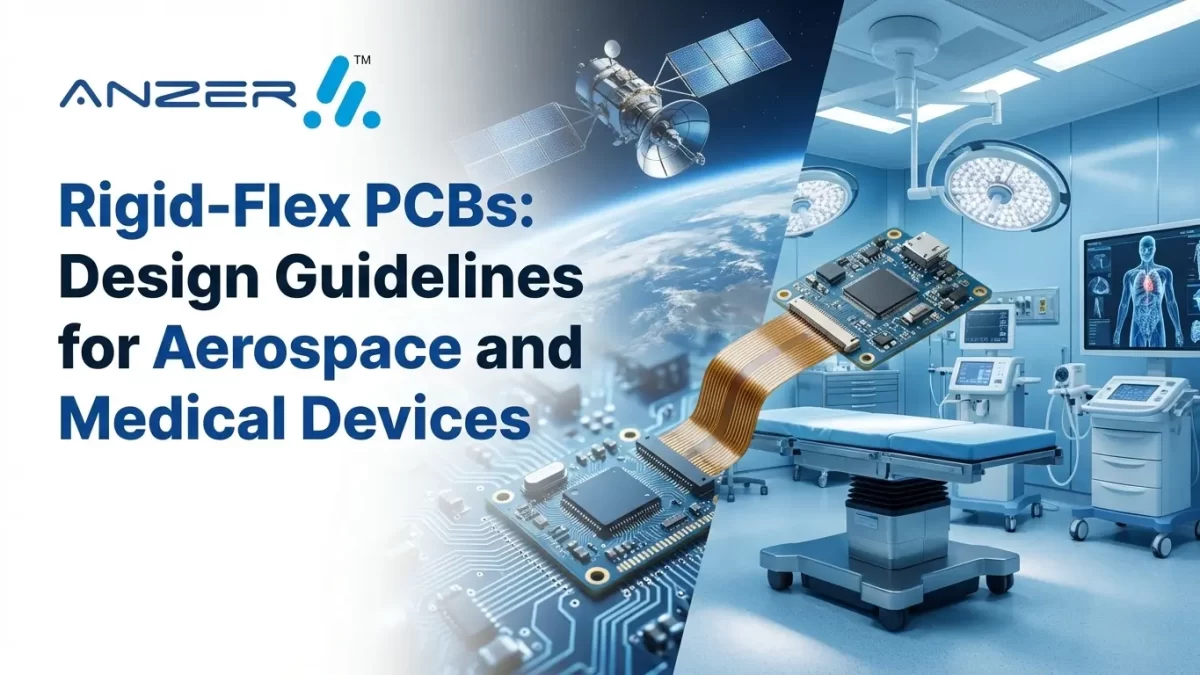
Rigid-Flex PCBs: Design Guidelines for Aerospace and Medical Devices
Our expertise in rigid-flex PCBs has been a cornerstone, especially for high-stakes sectors like aerospace and medical devices. If you’re searching for “rigid-flex PCB design guidelines aerospace” or “medical device PCB assembly Ohio,” you’ve landed in the right spot. In this post, I’ll share practical insights from my experience to help you navigate the design process, ensuring reliability, efficiency, and compliance. Let’s bend the rules – responsibly – to innovate.
Table of Contents
Why Rigid-Flex PCBs Are Ideal for Aerospace and Medical Applications
Imagine a pacemaker that must flex with the human body or an avionics system enduring extreme vibrations in flight. That’s where rigid-flex PCBs excel. These hybrid boards combine the stability of rigid sections (often FR-4) with flexible polyimide layers, reducing weight, minimizing connectors, and enhancing durability. In aerospace, they cut down on solder joints, boosting reliability in high-shock environments. For medical devices, they enable compact, biocompatible designs that withstand sterilization and repeated flexing.
At ANZER USA, we’ve seen rigid-flex transform projects. They’re perfect for Ohio’s thriving aerospace sector – think Cleveland’s NASA Glenn Research Center – and medical innovations in nearby Columbus. Benefits include:
- Space and Weight Savings: Up to 60% reduction in size compared to rigid-only boards, crucial for drones or implantable devices.
- Improved Reliability: Fewer interconnects mean lower failure rates – vital when lives are on the line.
- Cost Efficiency Long-Term: Initial design investment pays off with reduced assembly time and maintenance.
Drawing from our resources on rigid vs. flex PCBs, these boards are game-changers for applications demanding 3D configurations and rugged performance.
Essential Design Guidelines for Rigid-Flex PCBs
Designing rigid-flex isn’t just about flexibility – it’s about precision to avoid cracks, delamination, or signal integrity issues. Based on IPC-2223 and IPC-6013 standards, here are key guidelines tailored for aerospace and medical devices. I’ve trained teams on these, and they’ve saved countless revisions in our Akron facility.
1. Material Selection and Stackup Optimization
Start with the right materials. Use polyimide for flex layers due to its thermal stability (-55°C to 125°C) and low CTE. For rigid sections, FR-4 or high-Tg materials work well. Prefer adhesiveless laminates to prevent thermal stress during reflow, which can crack plated through-holes (PTHs).
- Guideline: Limit flex layers to 1-4 for better bendability. Stagger copper traces across layers to reduce stress.
- Aero/Medical Tip: Ensure biocompatibility (e.g., RoHS-compliant) for medical implants. In aerospace, opt for radiation-tolerant materials up to 100 krad.
- ANZER Insight: We’ve used these in medical electronics assembly, ensuring compliance with FDA standards.
2. Bend Radius and Flex Zone Planning
The bend radius is critical – too tight, and you risk trace fractures. For static bends (one-time fold), aim for 6-10x the flex thickness. Dynamic bends (repeated flexing) need 12-20x.
- Guideline: Define clear rigid-flex transitions. Avoid vias, components, or sharp angles in bend areas. Use teardrops at pad-trace junctions for strain relief.
- Aero/Medical Tip: In aerospace, design for MIL-STD-810G vibration resistance. For medical wearables, ensure bends accommodate body movement without fatigue.
- Pro Tip: Simulate bends in 3D CAD to predict stress – something we do routinely at ANZER.
3. Trace Routing and Signal Integrity
Traces in flex areas must be routed perpendicular to the bend to minimize strain. Avoid 90-degree angles; use curves with radii at least 1.5mm.
- Guideline: Stagger traces on multilayer flex to prevent I-beam effects. Maintain 0.1-0.2mm spacing, and use anchor stubs for added support.
- Aero/Medical Tip: Shield high-speed signals to combat EMI in avionics or MRI-compatible devices. Impedance control is non-negotiable.
- ANZER Insight: Our advanced PCB manufacturing techniques, like those in our rigid-flex resources, emphasize this for zero-defect outcomes.
4. Via and Hole Placement
Vias in flex zones are a no-go – they’re prone to cracking under stress.
- Guideline: Place vias only in rigid areas. Use blind/buried vias if needed, with drill-to-copper clearances per IPC specs.
- Aero/Medical Tip: For Class 3 electronics (high-reliability), ensure no copper voids in PTH barrels to meet aerospace standards.
- Pro Tip: Add stiffeners (e.g., polyimide or FR-4) in high-stress flex areas.
5. Thermal Management and Testing
Heat dissipation is tricky in compact designs. Incorporate thermal vias and heatsinks in rigid sections.
- Guideline: Model thermal cycling (2,000+ cycles) early. Follow DFA (Design for Assembly) to place heavy components on rigid parts.
- Aero/Medical Tip: Aerospace demands -55°C to 125°C tolerance; medical requires sterilization compatibility.
- ANZER Insight: Our thorough testing, aligned with IPC-A-610, catches issues before production.
ANZER USA’s Expertise in Rigid-Flex for Ohio Innovators
At ANZER, we’re not just assemblers – we’re partners in innovation. Our Akron-based facility handles everything from prototyping to full production, with certifications ensuring top-tier quality. We’ve supported projects like the OSU RALPH – a medical reminder device – using rigid-flex for compact, reliable design. For local Ohio businesses in aerospace or medical, we offer tailored solutions that reduce lead times and costs, avoiding overseas pitfalls.
If you’re in Akron or greater Ohio, leveraging our rigid-flex capabilities means faster iterations and U.S.-made excellence.
Overcoming Common Challenges and Looking Ahead
Challenges like higher initial costs or complex fabrication are real, but proper guidelines mitigate them. Future trends? AI-driven simulations and advanced materials will make rigid-flex even more accessible.
Partner with ANZER USA for Your Next Rigid-Flex Project
As Jay Mendpara, I’m passionate about turning complex designs into reality. If you’re exploring “rigid-flex PCB assembly Ohio” or need expert guidance on aerospace/medical devices, contact us today. Visit our facility at 1147 Sweitzer Ave, Akron, or call 330-733-6662 for a free consultation. Let’s design the future – flexibly and reliably.