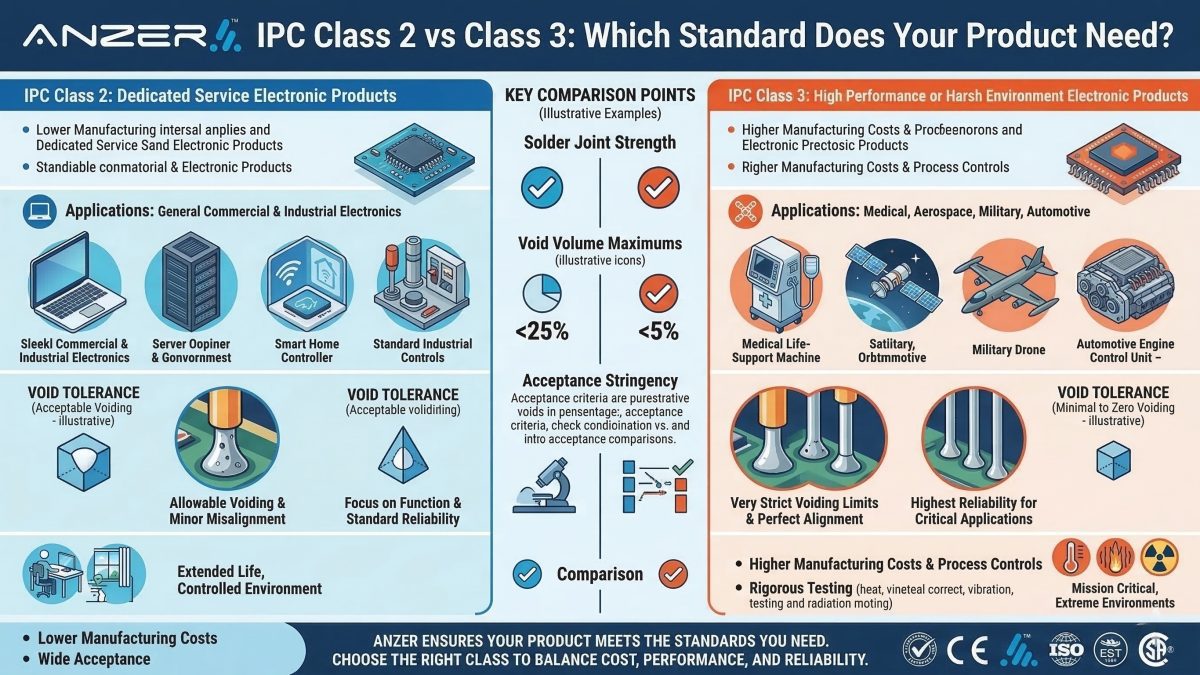
IPC Class 2 vs Class 3: Which Standard Does Your Product Need?
IPC Class 2 covers general consumer electronics with moderate reliability needs. IPC Class 3 applies to high-reliability aerospace, medical, and military electronics where failure is unacceptable. Class 3 has stricter acceptance criteria for solder joints, component placement, and defects – allowing zero cosmetic imperfections that don’t affect function in Class 2. Class 3 costs 15-35% more due to tighter tolerances, longer inspection times, and higher rejection rates. Choose Class 2 for commercial products; use Class 3 when safety, mission criticality, or regulatory requirements demand the highest reliability.
One question I hear constantly from OEM engineering teams is: “Do we really need IPC Class 3, or can we use Class 2?”
It’s not a casual question. The answer determines your manufacturing cost, lead time, supplier options, and ultimately – product reliability in the field.
I’m Jay Mendpara, CEO of Anzer USA and an IPC-certified trainer with over 20 years overseeing electronic manufacturing operations. Part of my role involves training technicians on IPC-A-610 workmanship standards – the document that defines Class 2 and Class 3 requirements. I’ve seen firsthand how choosing the wrong class leads to either over-engineering (wasting money on unnecessary Class 3 for a consumer product) or under-engineering (using Class 2 for a medical device that demands Class 3).
This guide breaks down the real differences between IPC Class 2 and Class 3, when each applies, and how to make the right decision for your product.
Table of Contents
What Are IPC Classes?
IPC classes are workmanship standards defined in IPC-A-610 (Acceptability of Electronic Assemblies) that establish acceptance criteria for PCB assembly quality. The standard defines three classes – Class 1, Class 2, and Class 3 – based on the product’s intended use and the consequences of failure.
Think of IPC classes as quality tiers. Higher classes have tighter tolerances, stricter defect limits, and more rigorous inspection requirements. The class you choose determines what’s acceptable during manufacturing.
Here’s the official breakdown:
IPC Class 1 – General Electronic Products Products where cosmetic imperfections are acceptable and the main requirement is function. Examples include disposable electronics, prototypes, and short-life consumer goods. Very few commercial manufacturers use Class 1 today.
IPC Class 2 – Dedicated Service Electronic Products Products with moderate reliability requirements where continued performance is desired but not critical. Examples include consumer electronics, computers, business equipment, and general industrial controls. This is the standard for most commercial electronics.
IPC Class 3 — High Performance Electronic Products Products where continued high performance or performance-on-demand is critical, equipment downtime is unacceptable, and end-use environment is harsh. Examples include aerospace avionics, life-support medical devices, military systems, and critical infrastructure controls.
At Anzer’s PCB assembly services , we manufacture to both Class 2 and Class 3 standards. About 60% of our projects are Class 2 commercial/industrial products. The remaining 40% are Class 3 aerospace and medical assemblies where our AS9100:2016 and ISO 13485:2016 certifications come into play.
The key point: IPC class is not about how well you build something – it’s about what you’re allowed to accept. A Class 2 manufacturer might build perfect assemblies. But they’re permitted to accept certain cosmetic defects that would be rejected under Class 3 criteria.
IPC Class 2 vs Class 3: The Critical Differences
Let’s get specific. Here are the real differences that matter in manufacturing:
Solder Joint Quality
This is where Class 2 and Class 3 diverge most dramatically.
Class 2 Requirements:
- Solder fillet must cover at least 75% of the pad and component lead
- Minor voids in solder joints are acceptable if they don’t exceed 25% of the joint area
- Solder overflow onto adjacent pads is acceptable up to 25% of the gap
- Minor cosmetic defects (slight discoloration, small pits) are permitted if they don’t affect reliability
Class 3 Requirements:
- Solder fillet must cover 100% of the pad with full wetting visible
- No voids are acceptable in critical solder joints; minimal voids (less than 10%) permitted in non-critical areas only after engineering approval
- Zero solder overflow onto adjacent pads – any bridging is a defect
- No cosmetic defects permitted – complete, uniform, shiny solder joints required
The practical difference? A solder joint that easily passes Class 2 inspection might be rejected immediately under Class 3 criteria. One aerospace customer brought us a batch of “failed” boards from another vendor. Under Class 2 standards, the joints were acceptable. Under Class 3 standards, they required zero solder overflow, complete fillet formation – they failed on 15% of joints.
Component Placement Tolerance
Class 2 Tolerance: Surface mount components can overhang the pad edge by up to 50% of the component width. Example: a 0805 resistor (0.08″ wide) can overhang by 0.04″.
Class 3 Tolerance: Maximum 25% overhang, and for critical fine-pitch components (QFPs, BGAs), essentially zero overhang is permitted.
Tighter placement tolerances require better equipment, skilled operators, and more frequent machine calibration. This is one reason Class 3 manufacturing costs more.
Defect Acceptance
Class 2 Defects Allowed (with limits):
- Minor scratches and nicks in solder mask
- Small amounts of flux residue
- Minor component skew or rotation (up to 10 degrees for discrete components)
- Lifted leads on through-hole components (if solder provides mechanical support)
- Minor discoloration from thermal stress
Class 3 Defects – Zero Tolerance:
- No lifted leads permitted under any condition
- No component skew beyond minimal tolerance (typically 5 degrees maximum)
- No solder mask damage in component areas
- Flux residue must be completely removed per J-STD-001 Class 3
- No thermal discoloration indicating temperature excursions
In my 20 years training IPC standards, I’ve seen good technicians struggle when transitioning from Class 2 to Class 3. The mindset shift is significant. What you accepted yesterday is rejected today.
Inspection and Documentation
Class 2 Inspection: Visual inspection at 1-3x magnification for most components. Automated Optical Inspection (AOI) is common but not always required. Documentation focuses on functional test results.
Class 3 Inspection: Visual inspection at 3-10x magnification is standard. X-ray inspection required for critical hidden joints (BGAs, QFNs). AOI is effectively mandatory for high-density boards. Every defect must be documented with photographic evidence. First article inspection requires 100% inspection of all solder joints.
Class 3 inspection takes 3-5x longer than Class 2. For a complex aerospace board with 2,000 components, Class 2 inspection might take 30 minutes. Class 3 inspection for the same board can take 2-3 hours.
| Criteria | IPC Class 2 | IPC Class 3 |
|---|---|---|
| Solder Coverage | 75% minimum | 100% required |
| Voids in Solder Joints | Up to 25% acceptable | 0-10% (critical joints only with approval) |
| Solder Overflow/Bridging | Up to 25% of gap | Zero tolerance |
| Component Overhang | Up to 50% of width | Maximum 25% (0% for critical) |
| Lifted Through-Hole Leads | Acceptable if solder provides support | Not permitted |
| Flux Residue | Minimal cleaning required | Complete removal per J-STD-001 Class 3 |
| Inspection Magnification | 1-3x | 3-10x + X-ray for hidden joints |
| Cosmetic Defects | Allowed if no functional impact | Zero tolerance |
| Typical Applications | Consumer electronics, computers, industrial | Aerospace, medical implants, military |
| Cost Premium vs Class 2 | Baseline | +15-35% |
When Does Your Product Need IPC Class 3?
The decision isn’t arbitrary. Several factors determine which class applies:
Regulatory Requirements
Some industries mandate Class 3 by regulation:
Aerospace: FAA regulations for flight-critical avionics require Class 3. Our means we’re qualified to manufacture these assemblies.
Medical Devices: FDA considers life-support and implantable devices to require Class 3 under ISO 13485 quality systems. Our ISO 13485:2016 certification covers this.
Military/Defense: MIL-STD-454 and other defense standards reference Class 3 as the baseline for electronics in weapons systems, communications, and mission-critical equipment.
If your product falls under these regulations, the decision is made for you.
Failure Consequence Analysis
For non-regulated products, ask three questions:
- What happens if the electronics fail?
- Class 2: Product stops working, customer annoyed, warranty claim filed
- Class 3: Safety hazard, mission failure, potential loss of life
- What’s the operating environment?
- Class 2: Controlled indoor environment, moderate temperature, low vibration
- Class 3: Extreme temperatures, high vibration, thermal cycling, moisture exposure
- What’s the expected service life without maintenance?
- Class 2: 3-5 years with accessible repair/replacement
- Class 3: 10-20+ years with no maintenance access
If your answers lean toward the Class 3 column, you need Class 3 manufacturing.
Cost-Benefit Calculation
Class 3 manufacturing costs 15-35% more than Class 2. The premium comes from:
- Tighter component placement tolerances (requires better equipment)
- Longer inspection times (3-5x more time per assembly)
- Higher rejection rates during assembly (more rework or scrap)
- Additional documentation and traceability requirements
- Specialized training for IPC-A-610 Class 3 certification
For a $500 industrial control board, Class 3 might add $75-175. If that board controls a water treatment plant where failure means contaminated drinking water, the premium is trivial. If it controls a consumer appliance where failure means calling customer service, it’s over-engineering.
One mistake I see OEMs make is specifying Class 3 “to be safe” without analyzing whether it’s necessary. You’re paying a significant premium for reliability you may not need. Conversely, I’ve seen companies try to use Class 2 for aerospace subassemblies because they didn’t understand the regulatory requirements – resulting in rejected lots and expensive re-manufacturing.
Can a Class 2 Manufacturer Build Class 3 Products?
Not without significant investment.
Class 3 manufacturing requires:
- IPC-A-610 Class 3 certified trainers (like myself) who can train and certify assembly technicians
- IPC J-STD-001 Class 3 certified operators who understand the tighter acceptance criteria
- High-magnification inspection equipment (stereo microscopes, X-ray systems)
- Controlled process documentation that proves every assembly meets Class 3 criteria
- Quality management system (AS9100, ISO 13485) that supports Class 3 traceability
At Anzer, we’ve made these investments. Our IPC-certified trainers ensure our team understands the standards. Our inspection equipment supports Class 3 requirements. Our AS9100 and ISO 13485 certifications demonstrate we can manage Class 3 processes.
But not every contract manufacturer can make this claim. If you’re sourcing Class 3 manufacturing, verify:
- Do they have IPC-certified trainers on staff?
- Are their assembly operators IPC J-STD-001 Class 3 certified?
- Do they hold AS9100 (aerospace) or ISO 13485 (medical) certification?
- Can they provide Class 3 first article inspection reports showing detailed solder joint analysis?
The Anzer Approach: Right Class, Right Product
Here’s how we help OEMs make the Class 2 vs Class 3 decision:
Application Review: We start by understanding your product’s end use, operating environment, and reliability requirements. A lighting control module for commercial buildings? Likely Class 2. The same module for an offshore oil platform? Probably Class 3.
Regulatory Mapping: We identify which standards apply. Aerospace avionics? AS9100 + Class 3. Medical infusion pump? ISO 13485 + Class 3. Industrial PLC? Often Class 2 unless installed in a critical application.
Failure Mode Analysis: We walk through potential failure modes and their consequences. If a solder joint failure means a warranty return, Class 2 works. If it means a crashed aircraft, only Class 3 is acceptable.
Cost Modeling: We provide transparent cost comparisons. Sometimes the Class 3 premium is 15%. Sometimes it’s 35%. You need real numbers to make an informed decision.
Hybrid Approaches: For some products, we recommend a hybrid approach – Class 3 for critical circuits (power supply, safety interlocks) and Class 2 for non-critical sections (user interface, indicators). This balances reliability and cost.
As an IPC-certified trainer with over 33 years of electronic manufacturing experience (starting when we were Western Reserve Controls), I’ve trained hundreds of technicians on the practical differences between Class 2 and Class 3. The standards exist for good reasons. Class 3 requirements eliminate failure modes that Class 2 tolerates. But that doesn’t mean every product needs Class 3.
The right standard is the one that matches your product’s actual reliability requirements without over-engineering.
Making the Right Choice
IPC Class 2 vs Class 3 isn’t about which is “better” – it’s about which matches your product’s reliability requirements and regulatory obligations.
Choose Class 2 when your product serves general commercial or industrial applications where failure means replacement, not catastrophe. The cost savings allow you to deliver competitive pricing without sacrificing appropriate quality.
Choose Class 3 when your product is safety-critical, mission-critical, or operates in harsh environments where field failures are unacceptable. The cost premium delivers measurably higher reliability – typically 10-20x lower field failure rates.
At Anzer USA, we manufacture to both standards with equal expertise. Our IPC-certified trainers, AS9100 and ISO 13485 certifications, and 33+ years of experience mean we can guide you to the right decision and execute flawlessly regardless of which class your product requires.
If you’re unsure which IPC class your product needs, let’s discuss your application. We’ll help you navigate the standards and ensure you’re building to the right quality level – not too little, not too much, but exactly what your product demands.
Frequently Asked Questions About IPC Class 2 vs Class 3
Q: Can you mix IPC Class 2 and Class 3 standards on the same PCB assembly?
A: Yes, hybrid approaches are permitted under IPC-A-610. You can designate critical circuits or components as Class 3 while allowing Class 2 acceptance criteria for non-critical sections. This requires clear documentation specifying which areas require which class. For example, power supply circuits and safety interlocks might be Class 3, while LED indicators and user interface circuits are Class 2. The assembly drawing must clearly mark Class 3 zones. This approach balances reliability and cost but requires careful process control to ensure operators understand which standards apply to each area.
Q: How much longer does IPC Class 3 assembly take compared to Class 2?
A: Class 3 assembly typically takes 20-40% longer than Class 2 for the same board design. The time increase comes from tighter component placement tolerances (requiring more careful operator work), additional cleaning steps to remove all flux residue, and significantly longer inspection times. Inspection is where the biggest difference appears – Class 3 requires 3-5x more inspection time due to higher magnification requirements and zero-tolerance defect criteria. For a complex aerospace board, Class 2 inspection might take 30 minutes while Class 3 inspection requires 2-3 hours for the same assembly.
Q: What happens if a Class 3 assembly fails inspection?
A: Failed Class 3 assemblies go to engineering review for disposition. Options include: rework if the defect is correctable (e.g., re-soldering a joint with insufficient fillet), scrap if the defect cannot be repaired (e.g., damaged component body or lifted pad), or engineering concession if the defect truly doesn’t affect reliability and the customer agrees to accept. However, Class 3 concessions are rare – aerospace and medical customers typically reject assemblies that don’t meet full Class 3 criteria. This is why Class 3 has higher rejection rates and costs more – there’s less margin for error.
Q: Do IPC Class 2 manufacturers need special certification to build Class 3 products?
A: Yes. Building Class 3 products requires IPC J-STD-001 Class 3 certified operators and IPC-A-610 Class 3 certified inspectors. The manufacturer must have at least one IPC-certified trainer on staff who can train and certify personnel to Class 3 standards. Additionally, aerospace Class 3 work requires AS9100 certification, and medical Class 3 work requires ISO 13485 certification. A manufacturer certified only for Class 2 cannot legally claim Class 3 capability without these additional certifications and trained personnel. At Anzer, our IPC-certified trainers and AS9100/ISO 13485 certifications demonstrate we meet Class 3 requirements.
Q: Is IPC Class 3 the same as AS9100 or ISO 13485 certification?
A: No, they’re different but complementary. IPC Class 3 defines workmanship acceptance criteria for solder joints, component placement, and defects. AS9100 and ISO 13485 are quality management system certifications that govern how you design, manufacture, test, and trace products in aerospace and medical industries respectively. You need both – Class 3 defines what an acceptable assembly looks like, while AS9100/ISO 13485 defines the quality processes to consistently achieve it. A manufacturer can be AS9100-certified but only build to Class 2 standards (uncommon but possible). Conversely, building to Class 3 standards without AS9100 certification means you can’t supply aerospace customers even though the assemblies meet Class 3 workmanship criteria.