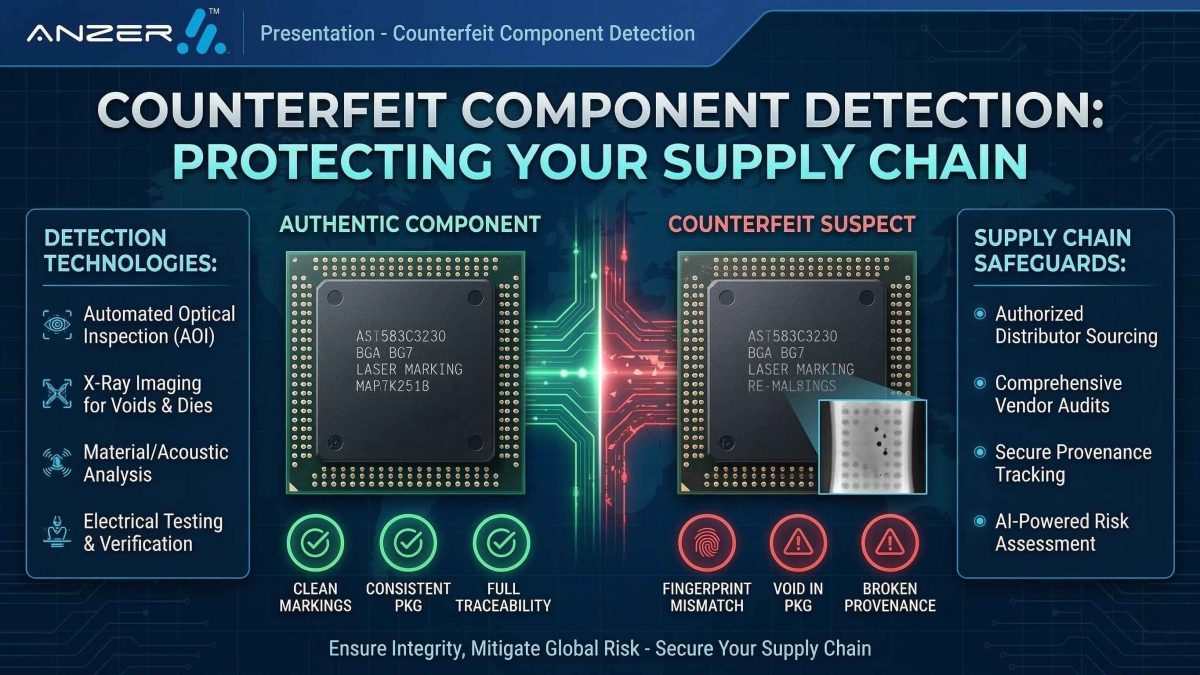
Counterfeit Component Detection: Protecting Your Supply Chain
TL;DR: Counterfeit electronic components – including remarked, recycled, and completely fake parts – represent a multi-billion dollar threat to electronics supply chains. Industry data shows 5-15% of components from unauthorized distributors are counterfeit. These parts cause field failures, safety hazards, and regulatory violations. Detection requires multi-layered inspection per AS5553 (Counterfeit Electronic Parts Mitigation) and AS6496 (Fraudulent/Counterfeit Electronic Parts Detection): authorized distributor verification, Certificate of Conformance validation, visual inspection, X-ray analysis, electrical testing, and component traceability. Proper counterfeit prevention costs $500-$2,000 per component shipment but prevents catastrophic failures costing $50,000-$500,000+. For aerospace and defense manufacturing, AS5553/AS6496 compliance isn’t optional – it’s mandatory for supply chain integrity.
A batch of “military-grade” microcontrollers arrives at your receiving dock. The paperwork looks legitimate. Certificates of Conformance from a reputable distributor. Proper packaging. Correct part numbers.
Three months later, your assembled boards start failing in the field. Analysis reveals the microcontrollers aren’t military-grade – they’re remarked commercial parts. The “authorized distributor” was unauthorized. The C of C was forged. You’ve built 500 assemblies with counterfeit components.
Total cost: $350,000 in scrapped boards, replacement units, field service, and customer penalties. Plus immeasurable damage to your reputation.
This is why counterfeit component detection exists.
I’m Jay Mendpara, CEO of Anzer USA with over 20 years overseeing manufacturing operations and supply chain management for aerospace and defense electronics. Our AS9100:2016 certification requires documented counterfeit detection procedures per AS5553 and AS6496 standards. In my experience managing component procurement, I’ve seen counterfeit detection prevent million-dollar disasters – and I’ve seen manufacturers who skipped these procedures face catastrophic consequences.
This guide explains what counterfeit components actually are, how they enter supply chains, and the multi-layered detection process that protects aerospace and high-reliability manufacturing.
Table of Contents
What Are Counterfeit Electronic Components?
Counterfeit electronic components are parts that are misrepresented as meeting original manufacturer specifications but actually contain remarked, recycled, cloned, or entirely fake devices intended to deceive buyers into believing they are authentic components from legitimate sources. The goal is profit – counterfeiters buy cheap components and resell them as expensive ones, or sell old/defective parts as new.
Counterfeit components fall into several categories:
Remarked Components
The most common type. Genuine components from manufacturer A are remarked with manufacturer B’s part number, or commercial-grade parts are remarked as military/aerospace-grade. The component might function initially but fails to meet the specifications claimed on the marking.
Example: Commercial temperature range (-40°C to +85°C) microcontrollers remarked as military extended range (-55°C to +125°C). They work fine in lab testing but fail when deployed in aircraft operating at temperature extremes.
Recycled/Reclaimed Components
Components harvested from scrapped boards, “cleaned up,” and resold as new. Lead-free solder laws created a cottage industry of recovering components from e-waste for resale. These parts have already been through one product lifecycle – they’ve experienced thermal stress from original assembly, field operation, and removal. Their reliability is compromised.
Identification clues: Solder on leads that wasn’t completely removed, scratches on component bodies from removal tools, irregular date codes (older than claimed manufacturing date).
Overproduced/Out-of-Spec Components
Components manufactured by the legitimate factory but failing quality control, sold through unauthorized channels. They’re “real” in that they came from the actual manufacturer, but they didn’t pass final test and were supposed to be destroyed.
Cloned/Copied Components
Complete fakes manufactured to physically resemble genuine components but with inferior internal construction. Common with simple ICs and discrete components. Modern security measures (laser-etched codes, holographic labels) make perfect cloning difficult but not impossible.
Tampered Documentation
Sometimes the component is genuine but the paperwork is fake. Altered Certificates of Conformance showing false test data, counterfeit manufacturer lot codes, forged traceability documents. This conceals the component’s true origin or specification.
Industry estimates suggest 5-15% of components purchased from unauthorized distributors are counterfeit in some form. For authorized distributors (franchised by the component manufacturer), counterfeit rates are below 0.1% – but authorized channels sometimes face allocation shortages, creating temptation to source from “gray market” suppliers.
At Anzer’s component procurement, we maintain an Approved Vendor List (AVL) of authorized distributors only. We source from unauthorized channels only under strict controls with enhanced inspection procedures.
Why Counterfeit Components Are Catastrophic
The risks go far beyond cost:
Safety Hazards
Counterfeit components in safety-critical systems create unacceptable risks. A remarked automotive airbag controller that fails to fire in a crash. A counterfeit flight control processor that crashes an aircraft. A fake pacemaker component that delivers incorrect electrical pulses.
People die when counterfeit components fail in critical applications.
Field Failures and Warranty Costs
Even in non-safety applications, counterfeit components cause premature failures. A commercial-grade capacitor remarked as industrial-grade might survive 2 years instead of 10. The product “works” initially but fails during the warranty period.
Field failure costs are 10-100x higher than factory costs. A $5 counterfeit component that fails after deployment costs $500-$5,000 to diagnose, replace, and service in the field.
Regulatory Violations
Using counterfeit components – even unknowingly – violates aerospace and defense regulations. AS9100 certification requires documented counterfeit detection procedures. Government contracts include anti-counterfeit clauses with severe penalties.
Manufacturers caught shipping products with counterfeit components face:
- Contract termination
- Financial penalties
- Loss of AS9100 or ITAR certifications
- Criminal liability in some cases
The penalties aren’t for using counterfeits intentionally – they’re for failing to implement adequate detection procedures.
Intellectual Property Theft
Counterfeit components fund criminal enterprises. Money paid for fake parts flows to organizations involved in IP theft, document forgery, and potentially worse activities. Beyond the direct harm, purchasing counterfeits supports illegal supply networks.
Real Cost Example: A defense contractor unknowingly used remarked network processors in a communications system. The components failed electrical screening after 200 units were assembled. Investigation revealed an unauthorized distributor had supplied remarked commercial parts as military-grade. Total cost: $340,000 in scrapped assemblies, $180,000 in replacement components from authorized sources, 6-week schedule delay costing $95,000 in contract penalties, and a major finding during the next AS9100 audit requiring complete supply chain review. Total impact: over $600,000 from one batch of counterfeit components.
AS5553 and AS6496: The Anti-Counterfeit Standards
Two SAE International standards define counterfeit detection requirements for aerospace:
AS5553: Counterfeit Electronic Parts; Avoidance, Detection, Mitigation, and Disposition
Purpose: Establish requirements for managing counterfeit risk throughout the supply chain.
Key Requirements:
- Maintain Approved Vendor List (AVL) of authorized distributors
- Risk assessment for all component sources (authorized vs unauthorized)
- Receiving inspection procedures scaled to risk level
- Training for personnel involved in procurement and inspection
- Counterfeit reporting procedures when suspect parts are discovered
- Documented disposition process for confirmed counterfeits
Risk-Based Approach: AS5553 uses a tiered inspection strategy:
- Low Risk (Authorized Distributors): Basic visual inspection, C of C verification, traceability documentation
- Medium Risk (Franchised but Non-Preferred Sources): Enhanced visual inspection, date code verification, sample testing
- High Risk (Unauthorized/Gray Market): Comprehensive inspection including destructive testing, electrical characterization, X-ray analysis
AS6496: Fraudulent/Counterfeit Electronic Parts; Avoidance, Detection, Mitigation, and Disposition – Distributors
Purpose: Establish requirements specifically for distributors to prevent counterfeits from entering supply chains.
Key Requirements:
- Distributor qualification procedures
- Source verification (authorized franchises vs unauthorized)
- Inspection capabilities and procedures
- Training and certification for distributor personnel
- Traceability systems linking components to manufacturers
AS6496 helps OEMs evaluate whether their distributors have adequate counterfeit prevention systems.
At Anzer’s AS9100 certified operations, our counterfeit detection program implements both AS5553 and AS6496 requirements. We audit our distributors annually, maintain documented risk assessments, and execute tiered inspection procedures based on component source.
Multi-Layered Counterfeit Detection Process
Effective counterfeit detection requires multiple inspection techniques. No single method catches all counterfeits – layered defenses are essential.
Layer 1: Source Verification
First defense: Only purchase from authorized distributors whenever possible.
Authorized Distributor Verification:
- Confirm distributor is franchised by component manufacturer (check manufacturer’s website)
- Verify distributor authorization covers the specific part number and manufacturer
- Maintain relationships with distributor sales and quality teams
- Audit distributor facilities and inspect their receiving procedures
Risk Assessment for Unauthorized Sources: When authorized sources are unavailable (obsolete components, allocation shortages, emergency purchases), we perform formal risk assessment:
- Document justification for unauthorized purchase
- Identify alternative authorized sources that were evaluated
- Define enhanced inspection procedures required
- Obtain engineering and quality approval before purchasing
This risk assessment creates traceability proving we exhausted authorized options before accepting higher-risk sources.
Layer 2: Documentation Verification
Certificate of Conformance (C of C) Analysis: Every component shipment includes C of C from the distributor. We verify:
- Manufacturer lot codes and date codes match C of C claims
- Test data (if provided) shows values within specification ranges
- C of C format matches known legitimate templates from that distributor
- Signatures and contact information are valid
Red Flags:
- Generic C of C templates (not distributor-specific)
- Missing or obviously fake signatures
- Test data showing suspiciously perfect values (real components have variation)
- Lot codes or date codes that don’t match manufacturer formatting standards
Layer 3: Visual and Physical Inspection
What We Inspect:
- Package condition and labeling (genuine manufacturers use specific label formats, fonts, adhesive types)
- Component markings (laser etching vs ink printing, font consistency, alignment)
- Lead finish and condition (bright shiny leads suggest recent manufacture or recycling)
- Date codes and lot codes (verify against manufacturer date code conventions)
- Physical dimensions (compare to known-good samples or manufacturer drawings)
Inspection Tools:
- Stereo microscopes (10-40x magnification) for detailed marking inspection
- Digital calipers for dimensional verification
- Comparative samples (known-genuine components for side-by-side comparison)
- Blacklight (some remarked parts show evidence of original marking removal)
Common Visual Indicators of Counterfeits:
- Inconsistent font styles or sizes in part markings
- Evidence of sanding or chemical treatment (removing original markings)
- Solder residue on leads (indicates recycled components)
- Irregular date code formats (remarked parts often have date codes that don’t match manufacturer conventions)
- Package damage or signs of repackaging
Layer 4: X-Ray Fluorescence (XRF) Analysis
Purpose: Verify lead finish composition and detect remarking.
How It Works: X-ray fluorescence analyzes the elemental composition of component leads and package surfaces. Different lead finishes (tin, tin-lead, nickel-palladium-gold) have distinct elemental signatures.
Applications:
- Verify lead-free (RoHS) compliance claims
- Detect components that have been through multiple solder cycles (recycled parts show contamination)
- Identify regions where original markings were removed and replaced
XRF is non-destructive and fast (30 seconds per component). It’s our first-choice method for suspect components from medium-risk sources.
Layer 5: Electrical Testing
Purpose: Verify component functionality and electrical characteristics.
Tests Performed:
- Parametric testing (compare measured values against datasheet specifications)
- Functional testing (does the component perform its intended function?)
- Temperature sensitivity (does performance degrade at specification extremes?)
What This Reveals: Commercial-grade parts remarked as military-grade will fail at temperature extremes. Recycled components often show degraded electrical parameters. Completely fake parts may not function at all or function only marginally.
Limitation: Electrical testing is time-consuming and requires specialized equipment. We use it for high-risk components or when other methods raise suspicion.
Layer 6: Destructive Physical Analysis (DPA)
Purpose: Definitively confirm or reject counterfeit suspicion through internal inspection.
Techniques:
- Decapsulation: Remove component package using acid or plasma etching to expose internal die
- Die inspection: Examine actual silicon die under microscope – genuine manufacturers have specific die designs, logos, manufacturing features
- Cross-sectioning: Cut through component to inspect internal construction, bond wires, die attach
When We Use DPA:
- High-value components from unauthorized sources (sample testing)
- Confirmed suspect counterfeits requiring proof for supplier disputes
- Failure analysis when field failures suggest counterfeit possibility
Limitation: DPA destroys the component. We sample 1-5% of high-risk shipments for DPA, not every component.
Counterfeit Detection in Practice: Our Process
Here’s how we execute counterfeit detection at Anzer for every component shipment:
Step 1: Pre-Purchase Qualification
AVL Verification: Confirm distributor is on our Approved Vendor List. If not on AVL, supplier qualification must occur before purchase.
Source Risk Assessment: Document whether this is authorized distributor, franchised distributor, or unauthorized source. Enhanced inspection automatically triggers for non-authorized sources.
Step 2: Receiving Inspection
All Shipments (Baseline Inspection):
- Count verification (quantity matches purchase order)
- Package integrity (no damage, proper ESD protection)
- Part number verification (labels match PO)
- C of C review (presence and basic validity check)
- Date code recording (photograph and document all codes)
Medium-Risk Sources (Additional Inspection):
- Detailed C of C analysis (verify test data, signatures, format)
- Visual inspection under microscope (10-40x magnification)
- Comparative analysis against known-good samples
- XRF analysis on sample components (5-10% of shipment)
High-Risk Sources (Comprehensive Inspection):
- All medium-risk inspections plus:
- Electrical parametric testing (10% sample)
- Destructive physical analysis (1-5% sample)
- Third-party authentication lab testing if warranted
- Engineering review and approval before acceptance
Step 3: Documentation and Traceability
Every accepted shipment receives:
- Internal lot identifier linking to manufacturer lot/date codes
- Receiving inspection report documenting all checks performed
- Digital photographs of component markings and packaging
- C of C archived in component traceability system
- Risk level documentation (authorized vs unauthorized source)
This creates full backward traceability. If a counterfeit escapes detection and is later discovered, we can trace which shipment it came from, identify other assemblies using components from that batch, and trace forward to all products potentially affected.
Step 4: Suspect Counterfeit Reporting
If we identify a suspect counterfeit:
- Quarantine entire shipment immediately (no components released to production)
- Notify distributor and request investigation
- Report to GIDEP (Government-Industry Data Exchange Program) if defense-related
- Perform root cause analysis (how did our procedures miss this?)
- Update inspection procedures to catch similar counterfeits in future
- Return shipment to distributor or destroy per AS5553 disposition requirements
We treat suspect counterfeits with the same rigor as confirmed counterfeits. Better to reject 10 legitimate parts than accept 1 counterfeit.
| Factor | Authorized Distributor | Unauthorized/Gray Market |
|---|---|---|
| Counterfeit Risk | <0.1% (very low) | 5-15% (high) |
| Source Verification | Franchised by manufacturer | Unknown or non-franchised |
| Certificate of Conformance | Guaranteed legitimate | May be forged |
| Component Age | Recent manufacture (fresh stock) | Unknown, potentially obsolete/recycled |
| Inspection Required | Basic (visual, C of C review) | Comprehensive (visual, XRF, electrical, DPA) |
| Cost Premium | Standard pricing | Often “too good to be true” pricing |
| AS5553 Risk Level | Low | High |
| Sample DPA Required | No (unless failure suspected) | Yes (1-5% of shipment) |
| Typical Inspection Cost | $50-$200 per shipment | $500-$2,000 per shipment |
| Lead Time | Standard (1-4 weeks) | Variable (may be faster or slower) |
| Traceability | Full manufacturer traceability | Often incomplete or suspect |
The Cost-Benefit of Counterfeit Detection
Manufacturers sometimes resist counterfeit detection because of perceived cost and schedule impact. The reality:
Counterfeit Detection Costs:
- Baseline inspection (authorized sources): $50-$200 per component shipment
- Enhanced inspection (medium risk): $200-$500 per shipment
- Comprehensive inspection (high risk): $500-$2,000 per shipment
- Annual AVL audits and training: $3,000-$10,000
Counterfeit Incident Costs:
- Single component batch with counterfeits reaching production: $50,000-$150,000 (scrap, rework, replacement)
- Field failures from undetected counterfeits: $200,000-$500,000+ (warranty, field service, customer penalties)
- AS9100 audit finding for inadequate procedures: Major nonconformance, certification at risk
- Government contract violations: Contract termination, debarment, criminal prosecution
Real ROI Example: We implemented comprehensive counterfeit detection procedures in 2017 at a cost of approximately $12,000 annually (enhanced inspection on medium/high-risk sources, AVL audits, training). Since then, we’ve intercepted 7 suspect counterfeit shipments before they reached production. Conservative estimate of prevented losses: $350,000+ (estimated cost if those counterfeits had been assembled into products). ROI: 30x in prevented losses.
The investment isn’t just cost-effective – it’s mandatory for AS9100 certification and customer confidence.
The Anzer Counterfeit Prevention Advantage
Here’s what differentiates our counterfeit detection capabilities:
Approved Vendor List Excellence: We maintain relationships with authorized distributors for all major component manufacturers. Our AVL includes only franchised distributors who have passed our supplier qualification audits.
AS5553/AS6496 Certified Procedures: Our counterfeit detection procedures are documented in our AS9100:2016 quality system and audited during surveillance visits. We demonstrate compliance to customers and auditors regularly.
In-House Inspection Capabilities:
- Stereo microscopes with digital imaging
- X-ray fluorescence analyzer
- Parametric test equipment for electrical verification
- Relationships with third-party authentication labs for DPA
Trained Personnel: Receiving inspection personnel receive annual training on counterfeit identification. They understand visual indicators, date code formats, manufacturer marking conventions, and when to escalate for enhanced inspection.
Traceability Integration: Every component lot links to receiving inspection records, C of C documentation, and supplier source information. If a counterfeit is discovered in the field, we can trace backward to the shipment and forward to all assemblies potentially affected – enabling targeted response instead of broad recalls.
Supplier Audits: We audit distributors annually, reviewing their receiving procedures, training programs, and counterfeit detection capabilities. Distributors who can’t demonstrate AS6496 compliance don’t make our AVL.
In 33+ years of electronic contract manufacturing (starting as Western Reserve Controls), we’ve built counterfeit prevention into our culture. It’s not a checkbox exercise – it’s fundamental to how we manage supply chains.
Counterfeit Detection: Supply Chain Integrity
Counterfeit electronic components are an ever-present threat. Criminal enterprises continuously adapt, finding new ways to introduce fake parts into supply chains. One successful counterfeit batch can generate millions in illegal profit – the incentive is enormous.
But so is the risk to manufacturers who accept counterfeits unknowingly. Field failures, safety hazards, warranty costs, regulatory violations, and reputation damage make counterfeit components catastrophically expensive.
The defense is multi-layered: authorized distributors first, risk-based inspection procedures, documented traceability, trained personnel, and continuous improvement as new counterfeit methods emerge.
For aerospace, defense, medical, and other high-reliability manufacturing, AS5553 and AS6496 compliance isn’t optional – it’s the foundation of supply chain integrity.
If you’re an OEM evaluating contract manufacturers for aerospace or defense electronics, ask about counterfeit detection procedures. Can they show you their AVL? Do they have documented risk assessment procedures? Can they demonstrate XRF or electrical testing capabilities? Are receiving inspection personnel trained in counterfeit identification?
At Anzer USA, counterfeit detection is integrated into our AS9100:2016 quality system. Our AVL, inspection procedures, and traceability systems ensure that only authentic components from legitimate sources enter our production processes.
If your product requires proven supply chain protection and component authenticity verification, let’s discuss how our counterfeit detection program protects your manufacturing and your reputation.
Frequently Asked Questions About Counterfeit Component Detection
Q: How can you tell if a component is counterfeit just by looking at it?
A: Visual inspection alone cannot definitively confirm counterfeits, but it reveals red flags requiring further investigation. Key visual indicators include: (1) inconsistent font styles or sizes in part markings – genuine manufacturers use precise laser etching or printing with uniform appearance; (2) evidence of sanding, chemical treatment, or blacktopping to remove original markings; (3) solder residue on component leads indicating recycled parts; (4) irregular date code formats that don’t match manufacturer conventions; (5) package damage or signs of repackaging. However, sophisticated counterfeits can pass visual inspection, which is why we use multi-layered detection: visual inspection identifies obviously suspicious parts for quarantine, but XRF analysis, electrical testing, and destructive physical analysis provide definitive confirmation. Visual inspection is the first filter, not the final determination.
Q: Are “gray market” components always counterfeit?
A: No, but gray market components carry significantly higher counterfeit risk. Gray market refers to genuine components sold through unauthorized distribution channels – they’re real manufacturer parts but distributed outside official franchised networks. Three scenarios exist: (1) Overproduction: manufacturer’s excess inventory sold through unofficial channels (genuine parts, questionable traceability); (2) Geographic arbitrage: components intended for one market diverted to another (genuine but warranty/support issues); (3) Counterfeit laundering: fake components introduced into gray market claiming to be excess inventory (outright fraud). The problem: you cannot reliably distinguish these scenarios without comprehensive inspection. AS5553 treats all gray market sources as high-risk requiring enhanced inspection. Some gray market components are genuine, but 5-15% counterfeit rates make the risk unacceptable for aerospace/defense applications without rigorous verification.
Q: What’s the difference between “suspect counterfeit” and “confirmed counterfeit”?
A: AS5553 defines two categories: Suspect counterfeit means a component exhibits characteristics suggesting it may be fraudulent but hasn’t been definitively proven – examples include irregular markings, suspicious date codes, inconsistent C of C documentation, or failure in initial electrical testing. Suspect counterfeits are quarantined and subjected to enhanced inspection. Confirmed counterfeit means destructive physical analysis, electrical testing, or manufacturer verification has proven the component is fake – examples include remarked parts where decapsulation reveals different die than claimed, recycled components with evidence of prior solder exposure, or manufacturer confirmation that lot codes are invalid. The distinction matters because suspect counterfeits require investigation and cannot be used until cleared, while confirmed counterfeits must be reported, destroyed, and trigger supply chain investigation. We treat both with equal caution – suspect status is sufficient to reject a shipment and demand distributor investigation.
Q: Can authorized distributors ever ship counterfeit components?
A: Extremely rare but theoretically possible. Authorized distributors are franchised directly by component manufacturers and receive stock from manufacturer-controlled sources – their counterfeit rates are below 0.1%. However, even authorized distributors face risk if: (1) A sophisticated counterfeit enters the manufacturer’s own supply chain (very rare but has occurred); (2) Distributor personnel make errors and mix unauthorized stock with authorized inventory; (3) Distributor warehouse security is compromised allowing counterfeit introduction. This is why AS5553 requires baseline inspection even for authorized sources: verify C of C, confirm package integrity, document date codes, perform visual inspection. We’ve never encountered a confirmed counterfeit from our AVL authorized distributors in 20+ years, but procedures exist because zero-risk doesn’t exist. The key difference: authorized distributor issues are addressable through warranty claims and investigation, while unauthorized sources have no recourse.
Q: How long does comprehensive counterfeit inspection take and does it delay production?
A: Inspection timing depends on risk level and component complexity. Authorized distributor sources: 30-60 minutes for baseline inspection (counting, visual check, C of C review) – no meaningful production delay. Medium-risk sources: 2-4 hours for enhanced inspection including microscopy and XRF analysis – may delay by 1 day. High-risk sources: 3-7 days for comprehensive inspection including electrical testing and DPA (destructive analysis requires sending samples to external lab) – material must arrive 1-2 weeks ahead of production need. Smart procurement planning eliminates delays: (1) Order from authorized sources whenever possible (minimal inspection overhead); (2) When using high-risk sources, order with extended lead time allowing inspection completion; (3) Maintain safety stock of critical components from authorized sources to avoid emergency high-risk purchases. At Anzer, our procurement planning accounts for inspection time – we’ve never delayed customer deliveries due to counterfeit inspection procedures.