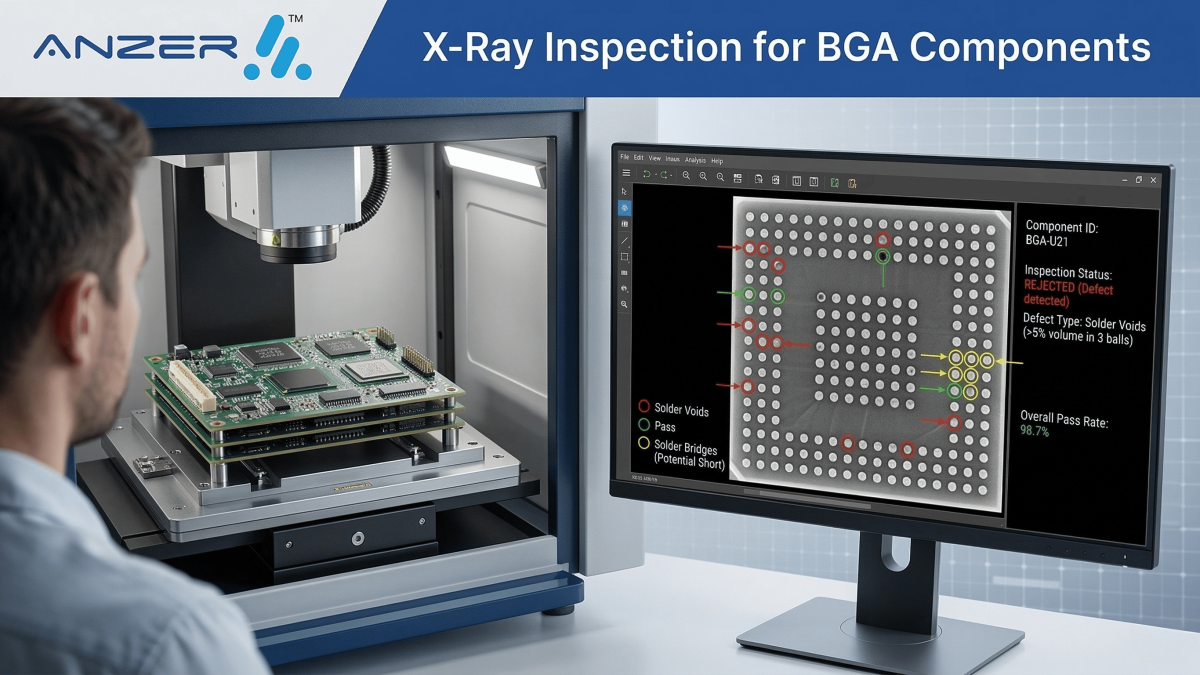
X-Ray Inspection for BGA Components: Complete Guide (2026)
X-ray inspection (AXI) is the only reliable method to verify BGA and leadless component solder joints because these connections are hidden beneath the package. Visual and optical inspection can’t see under the component. X-ray reveals voids, insufficient solder, bridging, and misalignment – defects that cause field failures. For aerospace (AS9100D) and medical (ISO 13485) assemblies, AXI isn’t optional. It’s required.
Table of Contents
What Is X-Ray Inspection for BGA Components?
X-ray inspection – also called Automated X-ray Inspection (AXI) – uses radiation to create images of internal PCB structures. It lets you see through component packages to inspect solder joints that sit hidden underneath.
BGA (Ball Grid Array) components don’t have external leads. The solder connections are balls arranged in a grid pattern on the bottom of the package. You literally cannot see these joints after reflow. Optical AOI (Automated Optical Inspection) can check component placement and outer fillet quality. But it can’t verify the joint itself.
That’s where X-ray comes in. The system passes a controlled X-ray beam through the assembly. Denser materials (like solder) absorb more radiation and appear lighter in the image. Voids, missing solder, or misalignment show up as darker areas. An operator or software analyzes the image to accept or reject the joint.
At ANZER, an electronics design and contract manufacturing company in Akron, Ohio, we’ve inspected thousands of BGA assemblies across aerospace, medical, and industrial projects over 33+ years. We use automated in-line X-ray inspection as part of our AS9100D and ISO 13485-certified quality processes. In aerospace applications, we’ve seen X-ray catch defects in approximately 2–4% of BGA joints that passed visual inspection – defects that would have caused failures in the field.
Why BGA and Leadless Components Require X-Ray Inspection
Hidden Solder Joints Can’t Be Visually Verified
This is the fundamental problem. Traditional through-hole and leaded surface mount components have visible solder fillets. You can inspect them with magnification or AOI cameras. BGAs, QFNs (Quad Flat No-Lead), and LGAs (Land Grid Array) hide their connections.
An AOI system might confirm the BGA is centered and the outer ball row looks acceptable. But it has no visibility into:
- Void percentage inside the solder joint
- Solder volume under each ball
- Bridge defects between adjacent balls in interior rows
- Non-wet-open (NWO) defects where solder didn’t reflow properly
IPC-A-610, the electronics assembly acceptability standard, requires X-ray for BGA verification. Section 10.2.7 defines void acceptance criteria. For Class 3 assemblies (aerospace, medical, life support), the standard is strict: no more than 25% void area in thermal or ground balls, and no more than 30% in signal balls.
We can’t meet that requirement without X-ray.
Thermal Cycling and Vibration Failures Start at Hidden Defects
Here’s what happens when a defective BGA joint slips through. The assembly works fine during initial functional test. Then it ships to the customer. In service, the product experiences:
- Thermal cycling – repeated heating and cooling
- Vibration – mechanical stress from operation or transport
- Flexing – PCB bending under load
A joint with 40% void area has less mechanical strength and poorer thermal conductivity. Under stress, microcracks propagate through the weakened solder. The joint fails intermittently or completely. The product returns as a field failure.
Rework at that stage costs 10- 50x more than catching the defect during assembly. And if it’s a medical device or aerospace module, the liability exposure is massive.
How X-Ray Inspection Works: 2D vs 3D Systems
2D X-Ray Inspection
A 2D system creates a flat radiographic image from a single angle – typically straight down through the PCB. It’s fast and effective for most BGA inspection tasks.
What 2D catches well:
- Large voids (>30% area)
- Missing solder balls
- Severe bridging between balls
- Gross misalignment of the component
Limitation: Parallax error. If you’re inspecting a dense BGA with many ball rows, features from upper and lower layers overlap in the image. A void in row 3 might visually align with a ball from row 5, making interpretation harder.
For aerospace assemblies with fine-pitch BGAs (0.5mm ball pitch or tighter), we sometimes see parallax issues. The solution is 3D inspection.
3D X-Ray Inspection (CT Scanning)
A 3D system rotates the X-ray source or detector around the PCB, capturing images from multiple angles. Software reconstructs a computed tomography (CT) slice at each layer. You can digitally “slice” through the assembly and view individual ball rows without overlap.
Advantages:
- Eliminates parallax – each solder joint is isolated
- Accurate void measurement even in high-density BGAs
- Can measure solder height and coplanarity
Trade-off: Slower and more expensive. We use 3D for critical aerospace and medical modules where the BGA count is high and failure risk is intolerable.
At ANZER, we determine inspection method based on assembly class, component density, and customer specification. For most industrial and automotive BGAs, 2D is sufficient. For flight-critical avionics or implantable medical devices, we default to 3D analysis.
What Defects Does X-Ray Inspection Detect in BGAs?
1. Voids in Solder Joints
Voids are gas bubbles trapped in the solder during reflow. They reduce joint strength and thermal transfer. IPC-A-610 allows some voiding, but sets percentage limits by assembly class and ball function.
IPC-A-610 void acceptance criteria:
- Class 2 (general industrial): 25% max void area in any ball
- Class 3 (aerospace, medical): 25% max in thermal/ground balls, 30% max in signal balls
X-ray shows voids as dark circles or irregular shapes within the lighter solder mass. Software can calculate void percentage automatically.
In our experience, excessive voiding often traces back to:
- Moisture absorbed in the PCB laminate (didn’t bake before reflow)
- Contamination on pads or BGA balls
- Incorrect reflow profile (too fast ramp or insufficient soak)
2. Insufficient Solder Volume
This happens when the solder ball didn’t fully collapse during reflow. The joint looks properly formed on X-ray, but the solder volume is low. The ball might be sitting proud instead of compressed into a proper joint geometry.
Insufficient solder reduces mechanical strength and increases the risk of cold joints. In vibration environments – think automotive or industrial equipment – these joints fail early.
3. Solder Bridging Between Adjacent Balls
If solder paste spreads beyond the pad or solder balls merge during reflow, you get a short between pins. On a BGA, this is hard to detect visually because the bridge is underneath the component.
X-ray clearly shows solder connecting two or more balls. We’ve caught bridging defects on prototypes where stencil aperture design was too aggressive. The extra paste volume caused coalescence during reflow.
4. Non-Wet-Open (NWO) Defects
This is when solder didn’t wet to the pad or ball properly. The joint has solder present, but it’s not metallurgically bonded. It might look acceptable on X-ray at first glance, but closer inspection shows a gap or irregular interface.
NWO defects are the hardest to catch with 2D X-ray. 3D systems or oblique-angle X-ray imaging help here. In AS9100D audits, inspectors specifically look for NWO risk in high-reliability assemblies.
5. Component Misalignment
If the BGA isn’t centered on the pad pattern, some balls might land partially off-pad. X-ray shows the offset clearly. Even 0.1mm misalignment can reduce joint reliability in fine-pitch components.
X-Ray Inspection Standards and Requirements by Industry
| Industry | Standard | Void Limit | Inspection Requirement |
|---|---|---|---|
| Aerospace | AS9100D + IPC-A-610 Class 3 | ≤25% (thermal/ground), ≤30% (signal) | Mandatory for all BGAs |
| Medical Devices | ISO 13485 + IPC-A-610 Class 3 | ≤25% (thermal/ground), ≤30% (signal) | Required for implantable and life-support devices |
| Automotive (ADAS, EV) | IATF 16949 + IPC-A-610 Class 2/3 | ≤25% (Class 3), ≤35% (Class 2) | Recommended for safety-critical modules |
| Industrial Automation | IPC-A-610 Class 2 | ≤25% typical | Specified per customer requirement |
| Consumer Electronics | IPC-A-610 Class 2 | ≤35% typical | Optional unless customer-specified |
ANZER is AS9100D and ISO 13485-certified. We follow Class 3 inspection protocols for aerospace and medical assemblies by default. That means every BGA gets X-ray verification before final acceptance.
For industrial projects, we recommend X-ray on high-I/O BGAs (>256 balls) and any application exposed to thermal cycling or vibration. The cost of inspection is $2–5 per assembly. The cost of a field failure is $500–$5,000+. The math is obvious.
When Should You Specify X-Ray Inspection for Your Assembly?
Always Require X-Ray If:
- Your product is AS9100D or ISO 13485-certified
- BGAs are used in aerospace, defense, or medical applications
- The assembly is Class 3 (high reliability)
- Components have >100 balls or fine pitch (<0.65mm)
- Thermal or mechanical stress is expected in service
- Your contract manufacturer recommends it (listen to them)
Consider X-Ray For:
- Industrial automation control systems
- Automotive electronics (especially ADAS, powertrain, safety)
- Outdoor or harsh-environment applications
- LED drivers and power conversion modules with thermal-enhanced packages
- Prototypes and NPI builds to validate process
X-Ray Might Be Overkill For:
- Low-complexity consumer products (Class 1)
- Simple BGAs (<64 balls) in benign environments
- Assemblies where other inspection methods (functional test, AOI) provide sufficient coverage
But here’s the reality: if you’re sourcing contract manufacturing in the U.S. from an AS9100D or ISO 13485 shop, X-ray is probably already included. The equipment and process are standard for quality-focused manufacturers. It’s not an expensive add-on anymore.
At ANZER, automated in-line X-ray is part of our baseline quality process. We don’t charge extra for it on aerospace or medical builds. It’s just how we operate. For industrial projects, we discuss inspection requirements during design review and quote accordingly.
Common X-Ray Inspection Questions Answered
Q: Can X-ray inspection replace functional testing?
No. X-ray verifies solder joint integrity. Functional test verifies electrical performance. Both are required for Class 3 assemblies. A perfect-looking joint can still have an internal component defect or firmware issue.
Q: How long does X-ray inspection add to the assembly process?
For in-line automated systems, 10–30 seconds per panel. Manual offline X-ray takes longer — maybe 2–5 minutes per assembly if you’re inspecting every BGA. At production volumes, in-line AXI is faster and more repeatable.
Q: Does X-ray damage components?
No. The radiation dose used in industrial X-ray systems is far below the threshold that affects semiconductors. We’ve X-rayed the same assembly multiple times during rework troubleshooting with no issues.
Q: What’s the difference between AXI and AOI?
AOI (Automated Optical Inspection) uses cameras and lighting to inspect the top surface of the PCB. It catches component presence, polarity, and solder fillet quality. AXI (Automated X-ray Inspection) uses radiation to see through components and inspect hidden joints. You need both.
Q: Can X-ray detect counterfeit components?
Sometimes. X-ray can reveal internal die size, wire bond patterns, or package construction inconsistencies. But dedicated counterfeit detection requires more specialized equipment and methods (decapsulation, spectroscopy). X-ray is a first-pass screening tool.
Need X-ray inspection for your BGA assemblies?
ANZER offers automated in-line X-ray as part of our AS9100D and ISO 13485-certified PCB assembly services. We’ve completed 4,000+ projects across aerospace, medical, and industrial sectors. Contact us for a quote or to discuss your inspection requirements.