Flying Probe vs. Bed of Nails (ICT): Which Test Method is Best?
No single method wins every time – Flying Probe excels for prototypes, low-volume runs, and quick-turn projects with zero fixture costs and high flexibility, while Bed of Nails ICT dominates high-volume production with blazing speed (seconds per board), lower per-unit costs after setup, and broader coverage for mission-critical boards in aerospace, medical, and automotive.
Key Takeaways
- Flying Probe requires no custom fixture – ideal for prototypes and runs under 500 boards.
- Bed of Nails ICT delivers ultra-fast testing and drops per-board costs dramatically at 1,000+ units.
- Both detect opens, shorts, component values, and polarity issues, but ICT often provides deeper functional checks.
- For regulated industries like aerospace sensors or medical devices, pair the right test with AOI/X-ray for full reliability.
- Anzer USA tailors the strategy to your volume and specs, ensuring zero escapes.
What Is Flying Probe Testing?
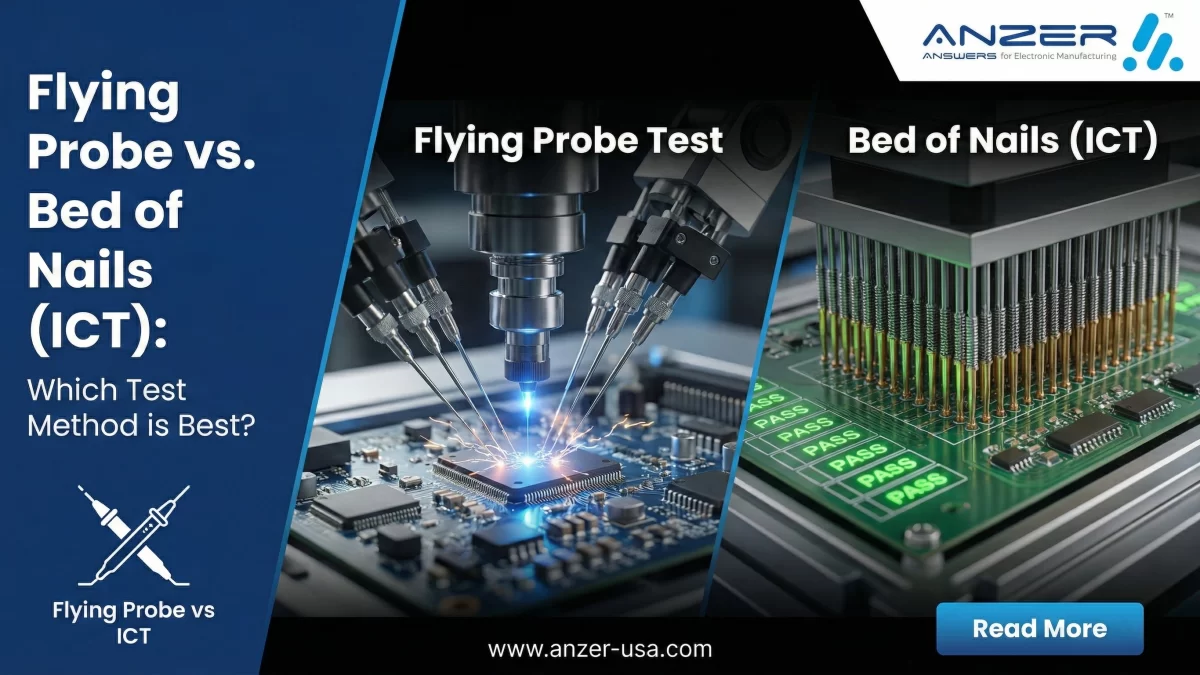
Flying Probe uses movable robotic probes (typically 4–20 per side) that “fly” across the PCB to contact test points sequentially. Programmed from CAD/netlist data, it measures resistance, capacitance, shorts/opens, and basic component values without a dedicated fixture.
Technicians load the board, probes move precisely, and the system flags defects in minutes.
What Is Bed of Nails (In-Circuit Test – ICT)?
Bed of Nails ICT employs a custom fixture – a “bed” of spring-loaded pogo pins that contact hundreds or thousands of nodes simultaneously when the board presses down. It applies signals, measures responses, and verifies individual components plus some powered functional tests.
Setup includes fixture fabrication and programming, but once ready, it tests boards in 5–30 seconds.
Flying Probe vs ICT: Head-to-Head Comparison
Choose based on volume, timeline, budget, and board complexity.
- Cost Flying Probe wins upfront – no fixture ($0 vs. $1,000–$10,000+ for ICT). Per-board cost stays higher due to sequential testing. ICT amortizes fixture cost quickly; per-board drops to pennies at scale.
- Speed & Throughput Flying Probe: 1–15 minutes per board (depending on nodes). ICT: 5–30 seconds per board—perfect for high-volume lines.
- Flexibility & Setup Time Flying Probe: Reprogram in hours for design changes; no tooling delays. Great for prototypes or frequent revisions. ICT: Longer setup (weeks for fixture); less flexible once built.
- Test Coverage Both catch manufacturing defects (opens, shorts, wrong/missing parts, polarity). ICT often adds powered tests and better analog/digital checks. Flying Probe accesses hard-to-reach points without fixed pins.
- Risk to Board Flying Probe: Minimal – gentle probing. ICT: Low risk with proper fixturing, but potential for probe marks on sensitive surfaces.
- Best For Flying Probe: Prototypes, low-to-medium volume (<500–1,000 boards), NPI, or complex boards with limited access. ICT: High-volume production (1,000+ boards), where speed and cost-per-unit matter most.
Real-World Impact in Regulated Industries
Aerospace flight-control modules or medical imaging PCBs can’t tolerate escapes. Flying Probe shines during development – catch defects early without fixture investment. Once designs lock and volumes ramp (e.g., automotive ADAS controllers), ICT ensures rapid, repeatable verification to meet AS9100 or ISO 13485 traceability.
Industrial automation boards with dense layouts benefit from Flying Probe’s adaptability during iterations.
At Anzer USA, we evaluate your project upfront: prototype phase? Flying Probe. Scaling to production? Transition to ICT. We layer both with AOI and X-ray for comprehensive coverage.
Limitations and Smart Combinations
Flying Probe slows down at high volumes – throughput bottlenecks lines. ICT fixtures lock you in; changes cost time and money.
Smart manufacturers hybridize: Flying Probe for first articles and low runs, ICT for ramp-up. We add functional testing or boundary scan for full confidence.
Choose the Right Partner for Your Test Strategy
Don’t guess – match the method to your reality. Anzer USA delivers precision PCB assembly with tailored testing: Flying Probe for agility, Bed of Nails ICT for scale, always backed by ISO 9001:2015, AS9100, and ISO 13485.
As a certified Minority (MBE) and Women Business Enterprise (WBE) in Akron, Ohio, we keep every build on-spec, on-time, on-budget.
Need help deciding for your next aerospace, medical, or industrial project? Reach out – our team reviews your Gerber files and volume to recommend the optimal path. Contact us today.