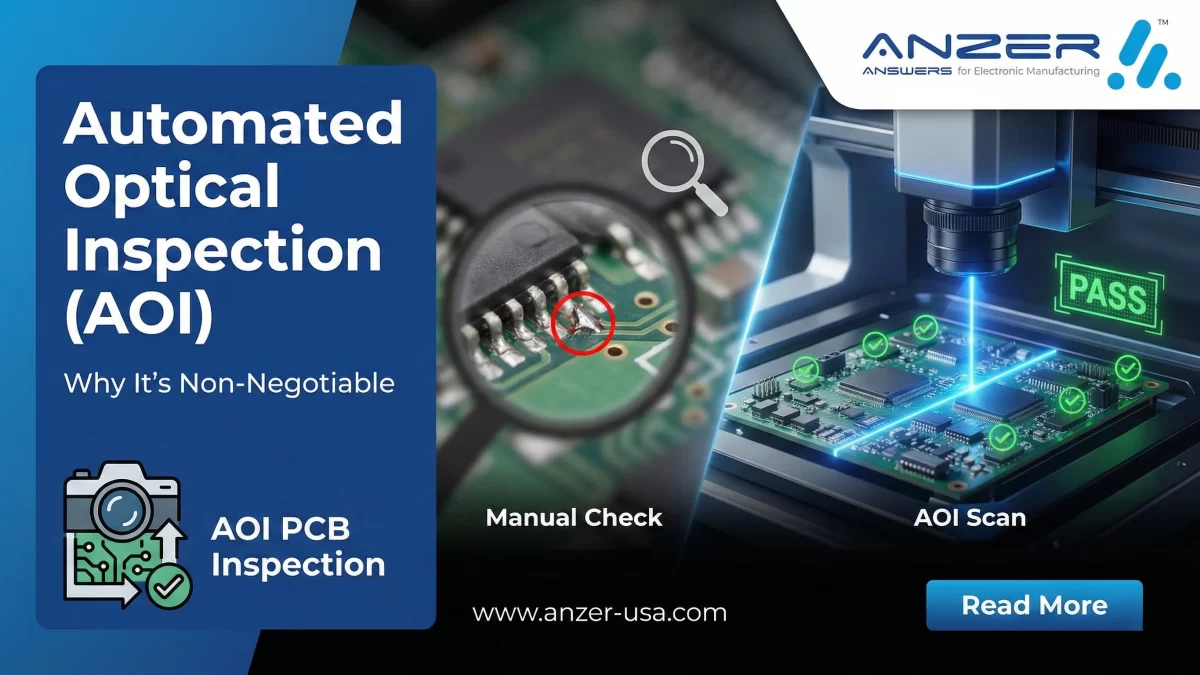
Automated Optical Inspection (AOI): Why It’s Non-Negotiable
Automated Optical Inspection (AOI) catches surface-level defects like missing components, misalignment, solder bridges, and insufficient solder in PCB assembly – making it non-negotiable for achieving high yield, reliability, and compliance in regulated industries like aerospace, medical, and automotive.
Key Takeaways
- AOI detects visual and placement defects early in the assembly process, preventing costly rework downstream.
- It outperforms manual inspection in speed, consistency, and accuracy – especially on dense, high-reliability boards.
- For mission-critical applications in aerospace, medical devices, and automotive systems, AOI supports strict certifications like AS9100 and ISO 13485.
- At Anzer USA, we integrate AOI to deliver on-spec, on-time, on-budget results for every project.
What Is Automated Optical Inspection (AOI) in PCB Assembly?
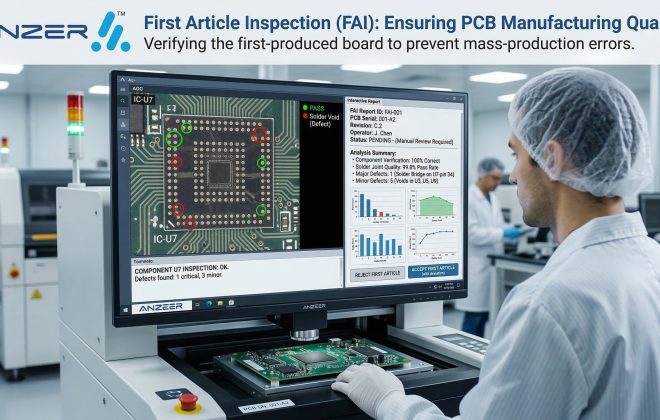
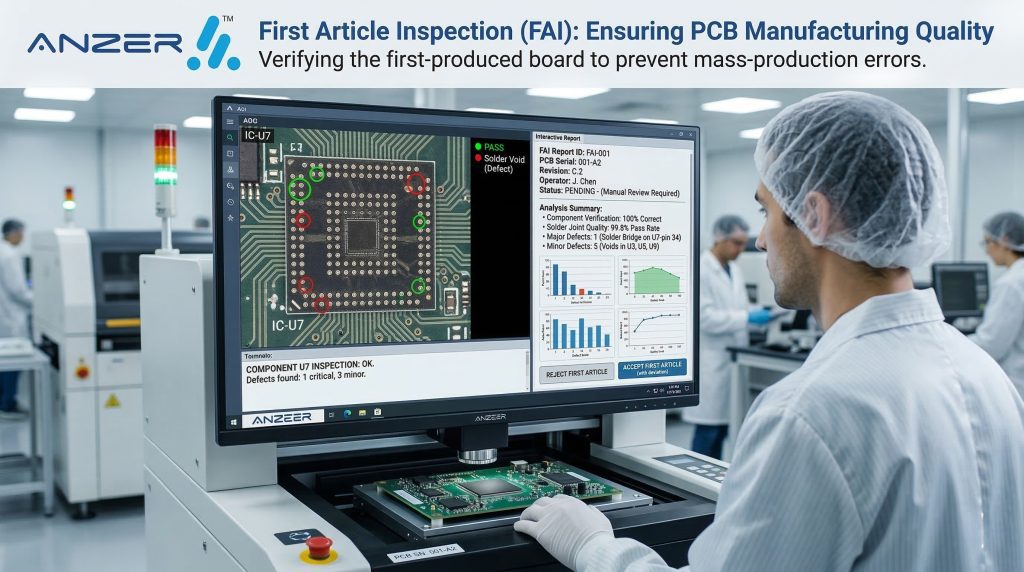
Automated Optical Inspection uses high-resolution cameras, specialized lighting, and advanced software to scan assembled PCBs. The system compares captured images against a golden reference board or programmed criteria. It flags anomalies in seconds.
Engineers place AOI right after key SMT stages – post-solder paste print, pre-reflow, or post-reflow – to catch issues immediately.
Common defects AOI identifies include:
- Missing or incorrect components
- Tombstoning or lifted leads
- Solder bridges and insufficient solder
- Misalignment or wrong polarity
- Polarity errors on polarized parts
- Scratches, stains, or excess solder balls
Modern 3D AOI systems add height measurement, detecting volume issues like insufficient solder or lifted components that 2D systems miss.
Why AOI PCB Inspection Is Non-Negotiable Today
Electronics keep shrinking. Component packages get denser. Tolerances tighten. Human eyes simply can’t keep up reliably at scale.
AOI steps in as the reliable gatekeeper. Manufacturers who skip or minimize AOI risk escaped defects reaching functional test – or worse, the field. In aerospace sensors or medical diagnostic equipment, one missed solder bridge can mean failure.
Key reasons AOI has become essential:
- Early Defect Detection Saves Money A defect caught post-reflow costs far less to fix than one found at final test or in a returned product. AOI spots problems right after assembly steps, so technicians address root causes immediately.
- Consistency Beats Human Fatigue Inspectors tire. They miss subtle issues after hours on the line. AOI delivers the same objective standard on board #1 and board #10,000.
- Speed Matches High-Volume Production AOI inspects complex boards in seconds. This keeps lines moving without bottlenecks.
- Data Drives Continuous Improvement AOI logs every defect with photos and coordinates. Teams analyze trends, tweak stencil designs or reflow profiles, and reduce defects over time.
- Regulatory Compliance Demands It Standards like AS9100 (aerospace) and ISO 13485 (medical) require traceable, repeatable quality processes. AOI provides documented proof of inspection.
Real-World Impact in Regulated Industries
In aerospace, AOI verifies precise placement on flight-control PCBs or mission-critical sensors. A single misalignment could compromise safety.
Medical device manufacturers rely on AOI to ensure sterile, reliable assemblies for imaging equipment or implantable monitors. Escaped defects here trigger recalls and patient risk.
Automotive electronics – think ADAS sensors or EV battery management – demand zero escapes under IATF 16949. AOI catches issues that could lead to field failures.
At Anzer USA, we run AOI on every assembly. Our certified processes combine it with X-ray for hidden joints (like BGAs) to give full coverage.
AOI vs. Manual Inspection: The Clear Winner
Manual visual inspection still has a place for first-article checks or complex troubleshooting. But for production:
- AOI detects defects as small as 0.01–0.05 mm consistently.
- It handles 100% inspection without slowdown.
- It eliminates subjective judgment calls.
Manual methods introduce variability and fatigue errors – unacceptable when reliability matters most.
Limitations of AOI (and How We Address Them)
No tool is perfect. AOI excels at surface-visible issues but can’t see inside solder joints or under components like BGAs. That’s why we pair it with X-ray inspection for hidden connections.
Programming takes time upfront. False calls occur if lighting or fiducials aren’t optimized. Our experienced team fine-tunes programs to minimize those.
Despite these, AOI remains the backbone of reliable PCB assembly.
Partner with Anzer USA for AOI-Driven Quality
When your project demands zero-compromise reliability – whether it’s a medical diagnostic tool, aerospace control system, or industrial automation controller – choose a partner who treats AOI as standard, not optional.
Anzer USA delivers precision PCB assembly with full AOI coverage, backed by ISO 9001:2015, AS9100, and ISO 13485 certifications. As a certified Minority (MBE) and Women Business Enterprise (WBE), we bring diversity and excellence to every build.
We keep your boards on-spec, on-time, on-budget.
Ready to discuss your next high-reliability assembly? Contact our team in Akron, Ohio today.