ISO 13485 Electronics Manufacturing: What Medical Device OEMs Need to Know
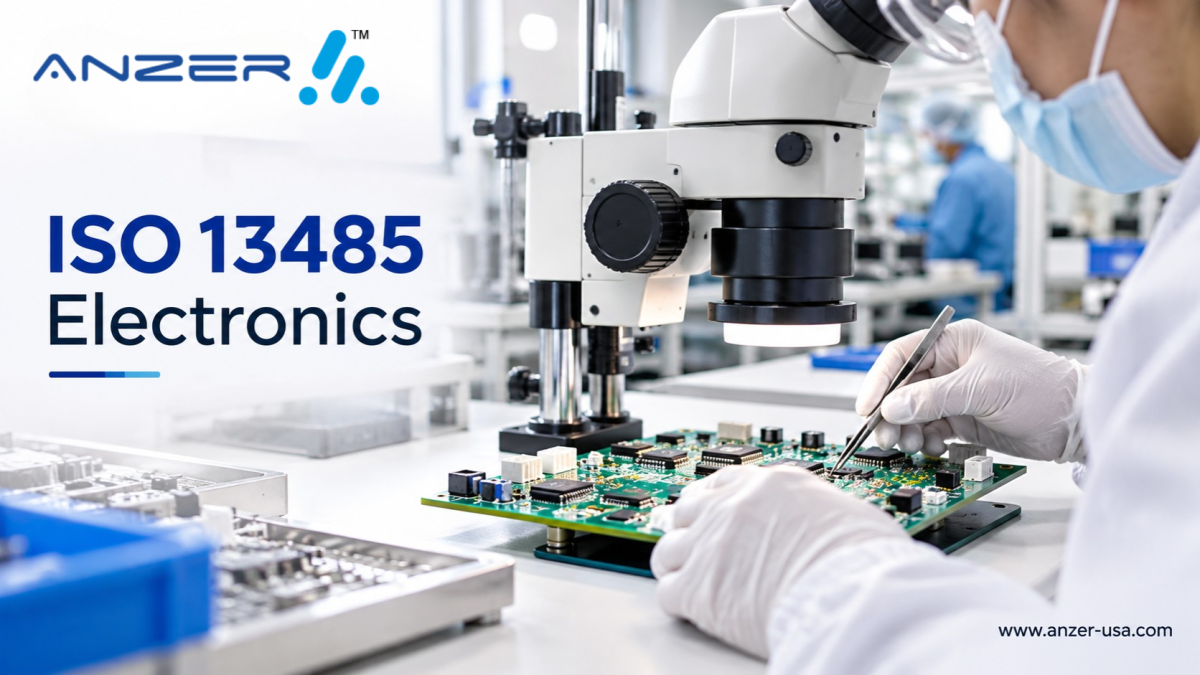
Medical device electronics must do more than function correctly on the production line. They must be manufactured through controlled processes, supported by appropriate documentation, and evaluated against defined quality requirements. ISO 13485 electronics manufacturing helps establish the quality management framework needed to control these activities throughout the medical device lifecycle.
For OEMs outsourcing printed circuit board assembly (PCBA), electronic subassemblies, or complete electronic systems, choosing an ISO 13485-certified manufacturing partner is an important part of supplier qualification. But certification alone is not enough. Buyers also need to understand how the manufacturer handles traceability, component sourcing, process control, inspection, testing, engineering changes, and nonconforming products.
ANZER USA is an ISO 13485:2016-certified electronic contract manufacturer based in Akron, Ohio. Its capabilities include medical electronics assembly, SMT and through-hole PCB assembly, testing, conformal coating, potting, and box build integration.
This guide explains what ISO 13485 means for electronics manufacturing, what OEMs should verify before selecting a supplier, and how to prepare a medical electronics manufacturing RFQ.
What Is ISO 13485 Electronics Manufacturing?
ISO 13485 electronics manufacturing refers to producing electronic assemblies within a quality management system designed for medical devices and related services. The system establishes requirements for controlling applicable processes, managing quality risks, maintaining records, and demonstrating that requirements are consistently addressed.
ISO 13485:2016 is an internationally recognized medical device quality management standard. It applies to organizations involved in relevant activities across the medical device supply chain, including manufacturers and certain suppliers providing products or quality-related services.
For an electronics contract manufacturer, this means the buyer should evaluate how the quality management system applies to the specific manufacturing activities being outsourced.
Examples include:
- Medical device printed circuit board assembly.
- Surface-mount technology (SMT) and through-hole technology (THT) assembly.
- Electronic subassembly manufacturing.
- Component procurement and supplier controls.
- Inspection and testing of assembled boards.
- Manufacturing records and product identification.
- Nonconformance management and corrective action.
- Engineering changes and production-process updates.
ISO 13485 does not mean every product built by a certified supplier automatically meets every medical device requirement. The applicable controls depend on the product, the supplier’s defined scope, contractual requirements, and the responsibilities assigned across the supply chain.
For buyers, the objective is to establish that the supplier’s actual processes support the quality requirements of the product being manufactured.
Why ISO 13485 Matters for Medical Electronics
An electronic assembly can pass an electrical test and still have a manufacturing problem. A substituted component, an uncontrolled process change, an incomplete production record, or a solder joint that fails inspection criteria can create problems that are not immediately visible during functional testing.
Medical electronics manufacturing requires a disciplined approach to identifying, preventing, detecting, documenting, and addressing these risks.
Controlled manufacturing processes
Work instructions, process requirements, and inspection criteria should be defined and controlled for the activities within the supplier’s responsibility.
Traceability and records
Manufacturing records should support the level of identification and traceability required by the product, customer agreement, and applicable regulations.
Risk-based quality planning
Risks associated with components, assembly processes, inspection, testing, and changes should be addressed according to their relevance to the product and the quality system.
Evidence of conformity
Inspection results, applicable test records, approvals, and disposition of nonconforming material help demonstrate whether requirements have been met.
These controls matter when an OEM investigates a field issue, qualifies a new supplier, transfers a product from prototype to production, or needs to demonstrate how a specific assembly was manufactured.
ISO 13485 vs. ISO 9001: What Is the Difference?
Both standards address quality management, but they are not interchangeable.
| Area | ISO 9001:2015 | ISO 13485:2016 |
|---|---|---|
| Primary focus | Quality management across many industries | Quality management for medical devices and related organizations |
| Regulatory context | General quality management requirements | Medical device-specific regulatory and customer requirements |
| Risk and process controls | Risk-based quality management approach | Controls tailored to medical device requirements, including applicable risk management and process validation |
| Documentation | Records needed to demonstrate conformity and effective processes | Medical-device-specific documentation and records appropriate to applicable requirements |
| Intended use | Broad range of organizations | Organizations involved in relevant medical device lifecycle activities and associated supply chains |
| Supplier relevance | Supports general supplier quality evaluation | Particularly relevant when qualifying suppliers for medical device-related work |
For medical device OEMs, the practical question is not whether one certificate looks more impressive than another. It is whether the supplier’s quality system is appropriate for the work, the product risks, and the regulatory obligations involved.
ANZER USA holds both ISO 9001:2015 and ISO 13485:2016 certifications, according to its company records.
What Changed With the FDA’s QMSR in 2026?
U.S. medical device buyers should account for the FDA’s updated regulatory framework when qualifying suppliers and reviewing quality documentation.
The FDA’s Quality Management System Regulation (QMSR) became effective on February 2, 2026. It amended the device current good manufacturing practice requirements in 21 CFR Part 820 and incorporated ISO 13485:2016 by reference, subject to the regulation’s applicability and provisions.
There is an important distinction for electronics OEMs: an ISO 13485-certified contract electronics manufacturer and a finished medical device manufacturer may have different regulatory responsibilities.
Buyers should not assume that certification of an outsourced assembly supplier automatically makes the OEM’s complete device compliant. Nor should they assume that every supplier is subject to every finished-device obligation in the same way.
Instead, clarify:
- Which organization is responsible for the finished device.
- Which manufacturing activities the electronics supplier performs.
- Which quality requirements apply to the supplier’s scope.
- Which records, approvals, and change notifications must be exchanged.
- How supplier performance and nonconformances are communicated.
- Which regulatory and contractual obligations remain with the OEM.
For the current regulatory position, consult the FDA’s Quality Management System Regulation guidance and the applicable requirements for your device.
What Should an ISO 13485 Electronics Manufacturer Control?
Certification is a starting point for supplier qualification, not a substitute for evaluating manufacturing practices. The following areas are particularly important when outsourcing medical PCB assembly and electronic systems.
1. Component sourcing and supplier control
A PCB assembly is only as reliable as the parts, materials, and processes used to build it.
Component risks can include obsolete parts, incorrect part numbers, unauthorized substitutions, inconsistent supplier documentation, and changes in availability. A supplier’s purchasing controls should address the requirements applicable to the components and materials being sourced.
Before awarding a program, ask:
- How are approved manufacturers and part numbers identified?
- Who approves component substitutions?
- How are sourcing concerns communicated to the OEM?
- What purchasing and receiving records are maintained?
- How are suspect or nonconforming components handled?
- What documentation can be supplied for critical components when required?
A buyer should also define whether the OEM or the contract manufacturer owns procurement decisions and how exceptions are approved.
Related resource: PCB component traceability in manufacturing.
2. Document control and manufacturing instructions
Manufacturing must be performed against the correct revision of the applicable documentation.
For a medical electronics program, this can include:
- Bill of Materials (BOM).
- PCB fabrication and assembly files.
- Approved drawings and specifications.
- Assembly instructions.
- Inspection criteria.
- Test procedures and acceptance criteria.
- Approved engineering changes.
- Product-specific handling or storage requirements.
A common sourcing risk occurs when an OEM releases a design update but the manufacturing partner continues working from an older revision.
The buyer should understand how revisions are received, reviewed, approved where necessary, released to production, and retained in the applicable records.
Ask how the supplier prevents superseded instructions from being used and how changes are communicated before production continues.
3. Traceability and product identification
Traceability helps an OEM connect a finished assembly with the relevant manufacturing information.
The required depth varies by product and agreement. It may include serialized finished units, component or material lot information, production records, inspection results, and applicable test results.
A traceability plan should answer four questions:
- What product or production lot is being identified?
- Which materials and components need to be traceable?
- Which process, inspection, and test records must be retained?
- How quickly can relevant records be retrieved when an issue arises?
Do not assume that a barcode or serial number alone provides complete traceability. Identification is useful only when it connects to accurate, controlled records.
OEMs should agree on traceability depth and record-retention expectations before production begins.
4. Process control and workmanship
Electronic assemblies may use SMT, THT, mixed-technology assembly, hand soldering, or other processes depending on the design.
Manufacturing controls should address the applicable requirements for component placement, soldering, handling, inspection, and acceptance. Process parameters and inspection criteria should be appropriate for the assembly and the quality requirements.
For example, buyers should discuss:
- How assembly instructions and process requirements are controlled.
- How soldering and component-placement quality are evaluated.
- How inspection findings are recorded and dispositioned.
- How process deviations are escalated.
- How approved changes to the manufacturing process are handled.
IPC-A-610 is a widely used standard for acceptability of electronic assemblies. The applicable revision, class, and customer-specific acceptance requirements should be established for the program rather than assumed.
ANZER manufactures to IPC Class 2 and Class 3 requirements, according to its company records. The appropriate acceptance criteria for a particular medical electronics program should be agreed upon with the OEM.
Related resource: IPC Class 2 vs. Class 3 standards.
5. Inspection and testing
Inspection and testing answer different questions. No single method provides complete assurance for every failure mode.
| Method | What it helps evaluate | Buyer consideration |
|---|---|---|
| Automated Optical Inspection (AOI) | Visible assembly features, component placement, and detectable solder defects | Confirm coverage, inspection criteria, and handling of detected defects |
| X-ray inspection | Hidden solder connections and internal features, such as applicable BGA joints | Define when X-ray is required and how results are evaluated |
| In-Circuit Testing (ICT) | Electrical connectivity and component-related checks supported by the test setup | Confirm fixture access, test coverage, and design compatibility |
| Flying probe testing | Electrical checks without a dedicated bed-of-nails fixture | Discuss coverage and suitability for the board and production stage |
| Functional testing | Whether the assembly performs against defined operating requirements | Agree on test procedures, equipment interfaces, acceptance limits, and records |
| Burn-in testing | Whether assemblies meet defined requirements under specified electrical or thermal stress conditions | Determine whether it is appropriate, how it is performed, and what constitutes a pass |
Testing plans should follow the design, identified risks, product requirements, and intended application. Not every board requires every method, and inspection cannot replace a suitable functional test where functional performance must be demonstrated.
For a deeper comparison, see ANZER’s guide to AOI and PCB inspection.
6. Nonconformance and corrective action
A quality system must address what happens when material, workmanship, documentation, or test results fail to meet requirements.
Ask a prospective supplier how it:
- Identifies and segregates nonconforming material.
- Records defects and deviations.
- Determines disposition and obtains required approvals.
- Investigates recurring or significant problems.
- Implements corrective actions.
- Verifies whether corrective actions were effective.
- Communicates relevant findings to the OEM.
The objective is not merely to repair a defective board. It is to understand the problem, control affected product, determine the appropriate disposition, and prevent recurrence where warranted.
For OEMs, clear escalation paths and agreed decision authority are especially important when production schedules or engineering changes are affected.
7. Engineering change management
A medical electronics design can change during development, qualification, or production. Components may become unavailable, firmware may be revised, or an engineering team may identify a necessary design improvement.
Changes can affect manufacturing instructions, component sourcing, test coverage, tooling, inspection criteria, or the product’s validated state.
Before starting a program, agree on:
- Who can authorize a change.
- Which changes require written approval.
- How affected inventory and work-in-process are managed.
- How revised files and instructions are released.
- Whether additional inspection or testing is required.
- How the change is documented and communicated.
This process helps prevent an apparently minor change from creating an unapproved difference between the released design and the assembly being built.
Related resource: PCB engineering and design for manufacturability.
How to Choose an ISO 13485-Certified Electronics Manufacturing Partner
The right supplier is one whose quality system, manufacturing capabilities, documentation, and communication practices fit the requirements of your product.
A certificate should be verified, but the evaluation should continue into the supplier’s actual scope and working practices.
Supplier qualification checklist
Use this checklist during initial screening or a supplier audit.
- Certification and scope: Verify the ISO 13485:2016 certificate, issuing certification body, validity, and scope relevant to the proposed work.
- Manufacturing capability: Confirm SMT, THT, mixed-technology, or box build capabilities required by the design.
- Engineering readiness: Review DFM/DFA support, BOM review, revision control, and communication of design concerns.
- Component sourcing: Establish sourcing responsibility, substitution approval, and documentation expectations.
- Inspection and testing: Agree on AOI, X-ray, ICT, flying probe, functional testing, or other justified methods.
- Traceability and records: Define serial or lot identification, manufacturing records, test evidence, and retention expectations.
- Nonconformance handling: Review defect escalation, material segregation, disposition authority, and corrective-action processes.
- Production transfer: Understand prototype, pilot build, process release, and engineering-change arrangements.
- Commercial and operational fit: Clarify order quantities, capacity, component ownership, delivery expectations, and communication responsibilities.
This is a practical buyer checklist, not a substitute for a formal regulatory audit, certification review, or assessment of the supplier’s documented scope.
Questions to ask before issuing a purchase order
Beyond the checklist, ask direct questions that reveal how the supplier will work with your team.
Quality and compliance
- Can you provide current evidence of ISO 13485 certification and confirm that the relevant activities fall within scope?
- Which quality and workmanship requirements will govern the assembly?
- What documentation will be supplied with each build or shipment?
Engineering and manufacturing
- Can your team review our BOM, fabrication files, assembly files, and test requirements before quoting?
- Which design or sourcing concerns need to be resolved before production?
- What are the approval requirements for substitutions and engineering changes?
Production and accountability
- How will prototype and pilot-build findings be documented?
- Who is responsible for approving nonconforming material or proposed deviations?
- What is the agreed process for communicating quality issues and corrective actions?
The supplier’s answers should be specific to your product and documented agreement, not just general statements about quality.
Common Mistakes When Outsourcing Medical Electronics
Even experienced OEM teams can overlook manufacturing details when selecting a supplier.
Mistake 1: Treating certification as proof of product compliance
ISO 13485 certification is evidence of a quality management system within a defined scope. It does not independently demonstrate that every assembly, finished product, or regulatory submission meets all applicable requirements.
Better approach: Review the certification scope, product requirements, supplier responsibilities, and actual manufacturing evidence.
Mistake 2: Defining testing after the assembly is complete
A test plan developed too late may encounter inaccessible test points, unavailable interfaces, missing fixtures, or unclear acceptance limits.
Better approach: Discuss design-for-test considerations and functional test requirements before production files are released.
Mistake 3: Leaving traceability expectations vague
A serial number does not automatically connect an assembly to its components, inspection records, and test history.
Better approach: Specify the required level of traceability and the records that must be retained or supplied.
Mistake 4: Allowing component substitutions without clear approval
A replacement component can affect electrical performance, mechanical fit, regulatory documentation, or qualification status.
Better approach: Establish a written substitution and change-approval process before procurement begins.
Mistake 5: Choosing a supplier solely on unit price
A low quote may not include the required inspection coverage, testing fixtures, documentation, engineering support, or production controls.
Better approach: Compare quotations against the same scope of work, quality requirements, test coverage, deliverables, and commercial assumptions.
Mistake 6: Failing to plan the move from prototype to production
A prototype build can expose design issues that need resolution before a repeatable production process is established.
Better approach: Define how build feedback, corrective actions, revised files, and process readiness will be handled before moving to the next stage.
ISO 13485 Electronics Manufacturing at ANZER USA
ANZER USA provides electronic contract manufacturing services from its facility in Akron, Ohio. Its company records confirm ISO 13485:2016 certification, along with ISO 9001:2015 and AS9100D certifications.
For medical electronics OEMs, relevant ANZER capabilities include:
- PCB assembly: SMT, THT, and mixed-technology assembly.
- Inspection and testing: AOI, X-ray, ICT, flying probe, functional testing, and burn-in where appropriate to the agreed program.
- Engineering support: DFM/DFA review, BOM considerations, and design-to-manufacturing collaboration.
- Environmental protection: In-house conformal coating and potting when specified.
- System integration: Box build assembly incorporating PCBAs, wiring, enclosures, and other required components.
- Prototype and production support: A dedicated prototype line, no minimum order quantity, and support for progression toward production.
- Domestic manufacturing: Manufacturing operations based in Akron, Ohio, USA.
These capabilities allow OEMs to discuss a range of manufacturing needs with one electronic contract manufacturing partner. The suitability of individual services, processes, and documentation deliverables should be confirmed for each product and RFQ.
A relevant example: the OSU RALPH project
ANZER announced its role in the design and production of The Ohio State University’s RALPH device in February 2024. RALPH stands for Research Assignment Learner for the Prehospital Setting. It is a portable reminder device intended to support clinical research involving emergency medical services.
The project provides a verified example of ANZER’s involvement in developing and manufacturing a medical research-related electronic device. It should not be interpreted as proof that every medical device type or regulatory pathway is covered by the same project experience.
Read more about ANZER’s medical electronics assembly capabilities.
What to Include in an ISO 13485 Electronics Manufacturing RFQ
A complete request for quotation helps the manufacturing partner assess technical scope, manufacturing requirements, and commercial assumptions before pricing the work.
Use the following list to prepare your RFQ package.
| RFQ item | What to provide |
|---|---|
| Design files | Current Gerber or other fabrication files, assembly files, drawings, and relevant design documentation |
| Bill of Materials | Part numbers, manufacturer details, approved alternatives, and sourcing restrictions |
| Quantity and forecast | Prototype quantities, pilot requirements, expected production demand, and forecast assumptions |
| Quality requirements | Applicable certification, workmanship class, customer requirements, and any product-specific controls |
| Inspection and testing | Required inspection methods, test procedures, acceptance criteria, and test-equipment responsibilities |
| Traceability | Serial or lot identification, component traceability expectations, and record-retention requirements |
| Environmental protection | Coating, potting, handling, storage, or other requirements specified for the assembly |
| Documentation package | Required build records, inspection evidence, test results, approvals, and shipment documentation |
| Change control | Revision status, approval contacts, deviation handling, and engineering-change requirements |
| Commercial terms | Component ownership, delivery expectations, packaging, shipping, and other applicable purchasing terms |
If some information is not yet available, identify it as an open item instead of leaving the supplier to make assumptions.
For support with design readiness, review ANZER’s electronic design for manufacturability services.
When the package is ready, use ANZER’s request a quote page to discuss the project and confirm the information required for a meaningful quotation.
Frequently Asked Questions
1. What is ISO 13485 in electronics manufacturing?
ISO 13485 is a medical device quality management standard. In electronics manufacturing, it provides a framework for managing applicable production processes, supplier controls, documentation, traceability, risk-related controls, and quality records for work within the organization’s scope.
2. Is ISO 13485 mandatory for every electronics manufacturer serving medical OEMs?
Not universally. The requirement depends on applicable regulations, the supplier’s role, customer specifications, product requirements, and the quality responsibilities assigned across the supply chain. OEMs should determine whether certification is required for their particular program and verify the supplier’s scope.
3. Does ISO 13485 certification guarantee a defect-free medical PCBA?
No. Certification does not guarantee that every assembly will be defect-free or that a finished medical device complies with every applicable requirement. Buyers should also evaluate manufacturing controls, inspection, test coverage, traceability, nonconformance management, and product-specific acceptance criteria.
4. What testing methods can support ISO 13485 electronics manufacturing?
Depending on the design and identified risks, manufacturers may use AOI, X-ray inspection, ICT, flying probe testing, functional testing, and burn-in. The appropriate methods and acceptance criteria should be defined for the product and agreed upon before production.
5. Does ANZER USA provide ISO 13485-certified medical electronics assembly?
ANZER USA’s company records confirm ISO 13485:2016 certification and medical electronics assembly capabilities. Buyers should confirm the current certificate, its scope, and the specific manufacturing and documentation requirements for their program through ANZER’s medical electronics assembly page.
Conclusion: Build Medical Electronics With Quality Requirements Defined Up Front
ISO 13485 electronics manufacturing is about more than having a certificate on file. It is about establishing appropriate controls, maintaining the records needed to demonstrate conformity, managing changes, and ensuring that the manufacturing partner understands the requirements of the product.
For medical device OEMs, the best time to address these requirements is before the first production build. Define the documentation package, component sourcing rules, traceability expectations, inspection and testing strategy, and change-approval process early. Doing so gives engineering, quality, procurement, and manufacturing teams a clearer basis for working together.
ANZER USA supports medical electronics OEMs with ISO 13485:2016-certified manufacturing, PCB assembly, engineering support, inspection and testing capabilities, and box build integration from Akron, Ohio.
Planning a medical electronics build? Share your current design files, BOM, quality requirements, expected quantities, and testing needs with ANZER’s team to discuss the appropriate manufacturing approach.