PCB Burn-In Testing: Eliminating Early-Life Failures
PCB burn-in testing applies thermal and electrical stress to eliminate weak components before they fail in the field. It reduces infant mortality failures by 60-80% and is essential for aerospace, medical, and mission-critical electronics. Proper burn-in follows JEDEC and MIL-STD protocols, typically running 24-168 hours at elevated temperatures (85-125°C) with power cycling. The investment pays off – field failures cost 10-100x more than factory testing.
Nothing frustrates an engineering team more than a product failing within weeks of shipment. You designed it carefully. You tested every function. Yet somehow, units are coming back with early-life failures.
This is the infant mortality problem. And it’s why PCB burn-in testing exists.
I’m Jay Mendpara, CEO of Anzer USA and an IPC-certified trainer with over 20 years overseeing manufacturing operations. In my time running electronic contract manufacturing, I’ve seen how burn-in testing transforms product reliability – and how skipping it leads to expensive field failures, warranty claims, and damaged reputations.
This guide explains what burn-in testing actually does, why electronics fail early, and when the investment makes sense for your product.
Table of Contents
What Is PCB Burn-In Testing?
PCB burn-in testing is a reliability qualification process that subjects assembled circuit boards to elevated temperature and electrical stress for an extended period – typically 24 to 168 hours – to precipitate latent defects and eliminate weak components before they reach the field. The goal is to push failures that would occur in the first weeks or months of operation to happen in a controlled factory environment instead.
Burn-in accelerates the aging process. Components with marginal solder joints, weak semiconductors, or latent manufacturing defects fail during burn-in rather than in your customer’s hands. Think of it as forced aging under stress.
Here’s what makes burn-in different from standard functional testing. Functional testing verifies that a board works correctly at room temperature for a few minutes. Burn-in testing operates the board continuously at high temperature (often 85-125°C) for days, stressing every component until weak ones fail.
The technical term for these early failures is “infant mortality” – and the data is clear. Research shows that proper burn-in testing eliminates 60-80% of infant mortality defects. For aerospace and medical applications where field failures are unacceptable, this isn’t optional.
we run burn-in testing in dedicated thermal chambers with continuous monitoring. Boards are powered and cycled through operational states while temperature is elevated. Any failure triggers immediate investigation.
Why Do Electronics Fail Early? The Bathtub Curve Explained
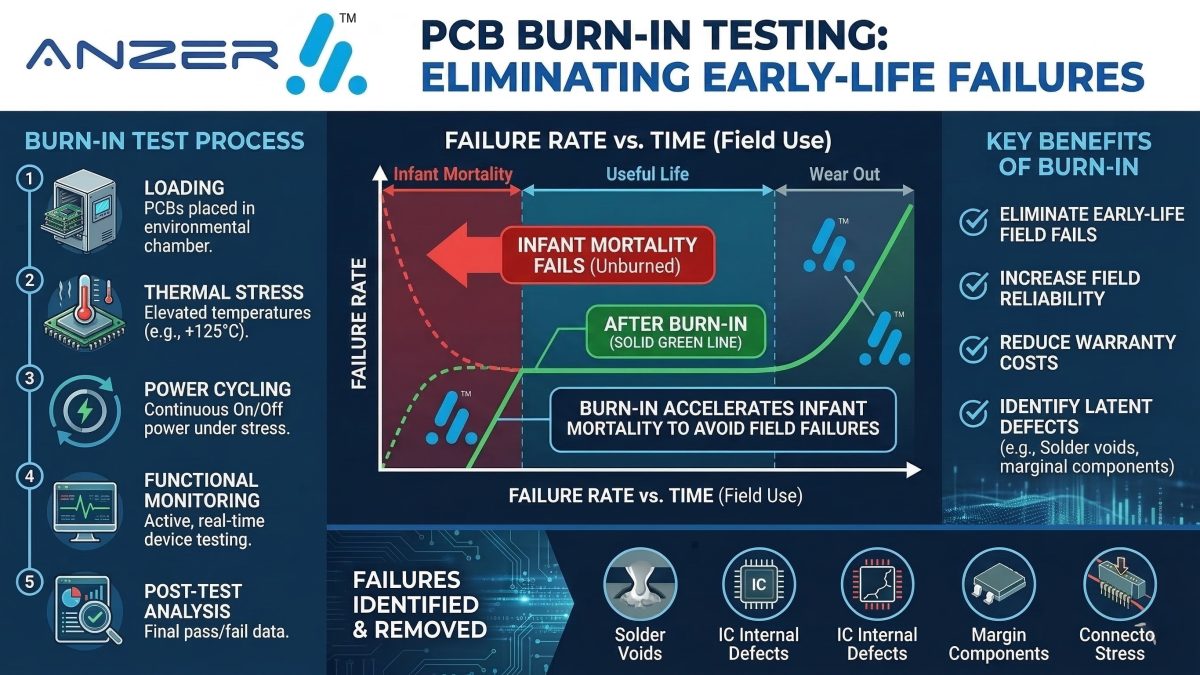
Electronic component reliability follows a pattern called the bathtub curve. Failure rates start high (infant mortality), drop to a low steady-state level (useful life), then rise again as components wear out.
Infant mortality failures represent manufacturing-induced weaknesses that weren’t caught during inspection. These include:
- Marginal solder joints that pass visual inspection but have microscopic voids or cold joints
- Semiconductor defects from wafer-level contamination or handling damage
- Component tolerance stacking where parts at the edge of specification interact badly
- Electrostatic discharge (ESD) damage that weakens but doesn’t immediately kill a component
- Contamination from flux residue, moisture ingress, or particulates
Standard testing won’t catch these. A functional test at 25°C for 30 seconds might show the board working perfectly. But run that same board at 100°C for 48 hours, and the weak solder joint cracks or the marginal capacitor shorts.
The numbers tell the story. Industry data shows that 80% of early-life failures occur within the first 5% of a product’s expected lifetime. For a component rated for 100,000 hours, that means most infant mortality happens in the first 5,000 hours. Burn-in accelerates this timeline dramatically.
One mistake we see OEMs make is confusing burn-in with Environmental Stress Screening (ESS). ESS applies rapid thermal cycling and vibration to find manufacturing defects. Burn-in applies sustained thermal and electrical stress to find component-level weaknesses. Both are valuable. They’re not interchangeable.
How Does PCB Burn-In Testing Work?
The burn-in process follows a deliberate protocol based on JEDEC standards (JESD22-A108) and military specifications (MIL-STD-883 Method 1015). Here’s how we execute it at Anzer:
Step 1: Pre-Burn-In Functional Test Every board goes through complete functional testing at room temperature. We establish a baseline. Any board that fails pre-test doesn’t enter burn-in – it goes to rework or failure analysis.
Step 2: Thermal Chamber Loading Boards are placed in environmental chambers capable of precise temperature control. For commercial products, we typically use 85°C. For aerospace and high-reliability applications, we go to 100-125°C based on the component ratings.
Step 3: Power-On and Operational Cycling This is where burn-in differs from simple temperature soaking. Boards are powered on and cycled through their operational states. Microcontrollers run code. Power supplies switch loads. Communication interfaces transmit data. We’re stressing components under realistic electrical conditions while temperature is elevated.
The Arrhenius equation governs acceleration factors. Every 10°C increase in temperature roughly doubles the reaction rate for most failure mechanisms. Running at 100°C versus 25°C accelerates aging by approximately 30x.
Step 4: Duration and Monitoring Burn-in duration depends on the application:
- Commercial/Industrial: 24-72 hours at 85°C
- Aerospace (AS9100 requirements): 168+ hours at 100-125°C
- Medical (ISO 13485 high-risk devices): 96-168 hours with specific protocols
- Military/Defense: Per MIL-STD-883, often 240+ hours
Throughout the burn-in cycle, we monitor for failures. Modern burn-in systems can detect when a board stops responding or draws abnormal current.
Step 5: Post-Burn-In Testing and Analysis After burn-in, boards return to room temperature. We repeat the full functional test. Any board that now fails has revealed a latent defect. These failures are analyzed to understand root cause and improve the process.
Step 6: Final Screening Surviving boards proceed to final inspection, conformal coating (if specified), and packaging. The result is a population with significantly improved reliability.
| Industry | Temperature | Duration | Standard Reference | Typical FIT Rate Target |
|---|---|---|---|---|
| Commercial Electronics | 85°C | 24-72 hrs | JEDEC JESD22-A108 | <500 FIT |
| Industrial Controls | 100°C | 48-96 hrs | IPC-9701 | <200 FIT |
| Aerospace | 100-125°C | 168+ hrs | MIL-STD-883, AS9100 | <100 FIT |
| Medical Devices | 85-100°C | 96-168 hrs | ISO 13485, IEC 60601 | <100 FIT |
| Military/Defense | 125°C | 240+ hrs | MIL-STD-883 Method 1015 | <50 FIT |
FIT = Failures In Time (failures per billion device-hours)
When Should You Use Burn-In Testing?
Not every product needs burn-in. The decision comes down to failure cost versus testing cost.
Burn-in testing makes sense when:
- Field failures are extremely costly. If a product failure means aircraft downtime, medical emergencies, or industrial production stops, the ROI on burn-in is immediate. Field failures cost 10-100x more than factory testing when you factor in logistics, diagnostics, replacements, and reputation damage.
- Safety is critical. Medical devices, aerospace systems, and industrial controls where failure risks injury require the highest reliability. Burn-in is standard practice.
- Warranty returns kill margins. Consumer electronics with tight margins can’t absorb high return rates. Even 1-2% infant mortality wipes out profitability.
- You’re using new component sources. Switching suppliers or introducing new component lots introduces risk. Burn-in provides confidence.
- Low-volume, high-value production. If you’re building 100 units at $5,000 each rather than 100,000 units at $50 each, the relative cost of burn-in is minimal.
You can skip burn-in when:
- The application is truly non-critical (toys, disposable consumer goods)
- The product lifetime is very short (single-use items)
- You have overwhelming component qualification data proving reliability
- Cost constraints make field failures acceptable
At Anzer’s box build services, we help OEMs make this decision. We run failure mode analysis and cost modeling. Sometimes the answer is “don’t burn-in the entire production – just burn-in the first 10% and monitor field data.”
The Anzer Approach: Burn-In Testing Done Right
Here’s what differentiates professional burn-in testing from “we left it in an oven overnight”:
Controlled Thermal Environments: We use calibrated environmental chambers, not improvised heating. Temperature uniformity matters. Hot spots or cold zones invalidate the test.
Proper Power Cycling: True burn-in operates the circuit under realistic electrical stress. Simply heating an unpowered board misses half the failure modes.
Continuous Monitoring: Failures detected in real-time allow immediate analysis. Boards that fail on hour 47 of a 48-hour test provide valuable data.
Adherence to Standards: As an AS9100:2016 certified manufacturer, we follow established protocols. For medical devices, our ISO 13485:2016 certification ensures burn-in aligns with regulatory requirements.
IPC Training Integration: My role as an IPC-certified trainer means our team understands how burn-in connects to broader quality systems. We’re not just running a test – we’re managing risk across the entire manufacturing process.
Failure Analysis Loop: Every burn-in failure feeds back to design and process engineering. Repeated failures from the same root cause trigger corrective action. This closed-loop system continuously improves product reliability.
In over 33 years of electronic contract manufacturing (formerly Western Reserve Controls), we’ve seen burn-in prevent catastrophic field failures countless times. One aerospace customer came to us after experiencing infant mortality in a critical avionics module. We implemented a 168-hour burn-in protocol at 110°C. The first run revealed 4% failure rate during burn-in. After process improvements, we drove that to 0.5%. The field failure rate dropped to zero.
That’s the power of properly executed burn-in testing.
Burn-In Testing: Investment in Reliability
Electronics don’t fail randomly. They fail for reasons. Burn-in testing forces those reasons to surface in your factory instead of your customer’s facility.
The cost is real but manageable – typically adding 5-15% to manufacturing cost depending on duration and complexity. The return is measurable: fewer warranty claims, lower field support costs, stronger reputation, and happier customers.
For aerospace, medical, and industrial applications where reliability isn’t negotiable, burn-in testing is how you deliver products that work from day one and keep working.
At Anzer USA, we build electronics that meet the highest standards. Our burn-in capabilities support customers in regulated industries who can’t afford early-life failures. If your product requires proven reliability, let’s discuss how burn-in testing fits into your manufacturing strategy.
Frequently Asked Questions About PCB Burn-In Testing
Q: How long should PCB burn-in testing last for maximum effectiveness?
A: Burn-in duration depends on your industry and reliability requirements. Commercial products typically use 24-72 hours at 85°C. Aerospace applications require 168+ hours at 100-125°C per AS9100 and MIL-STD-883 standards. Medical devices follow ISO 13485 protocols, usually 96-168 hours. The key is following established standards rather than arbitrary durations. Most infant mortality failures surface within the first 48-96 hours at elevated temperature.
Q: What’s the difference between burn-in testing and Environmental Stress Screening (ESS)?
A: Burn-in testing applies sustained thermal and electrical stress to eliminate component-level weaknesses over 24-168 hours. ESS applies rapid thermal cycling and vibration to find manufacturing defects like poor solder joints or loose connectors, typically completing in hours. Burn-in targets infant mortality from inherent component weaknesses. ESS targets workmanship defects from assembly. Both improve reliability but address different failure modes. High-reliability products often use both.
Q: Does burn-in testing damage components or reduce product lifetime?
A: No. Properly executed burn-in testing follows JEDEC and IPC standards that account for component stress limits. The testing removes weak components that would fail early but doesn’t meaningfully age healthy components. The Arrhenius acceleration factor is calculated to stay within safe operating limits. A 168-hour burn-in at 100°C consumes less than 1% of a typical component’s rated lifetime. The surviving population actually has longer expected field life because weak units are removed.
Q: How much does PCB burn-in testing typically add to manufacturing cost?
A: Burn-in testing typically adds 5-15% to total manufacturing cost depending on duration, chamber space requirements, and monitoring complexity. A 48-hour commercial burn-in might add $20-40 per board. A 168-hour aerospace burn-in could add $100-200 per board. However, field failures cost 10-100x more when you include logistics, diagnostics, replacement, downtime, and reputation damage. For mission-critical applications, the ROI is overwhelmingly positive. For high-volume commercial products, the calculation depends on acceptable field failure rates.
Q: Can burn-in testing catch all defects before products ship?
A: No testing method catches 100% of defects. Burn-in testing specifically targets infant mortality from latent component weaknesses and marginal manufacturing conditions. Industry data shows properly executed burn-in eliminates 60-80% of early-life failures. It won’t catch design flaws, software bugs, or defects that require specific environmental triggers (like vibration or humidity) not present during burn-in. That’s why comprehensive quality programs combine burn-in with design validation, functional testing, ESS, and statistical process control. Burn-in is one powerful tool in a complete reliability toolkit.