Prototype PCB Assembly: From Concept to Production at ANZER
When it comes to bringing an innovative electronic idea to life, one step stands between imagination and market launch: prototype PCB assembly. Whether you’re developing a new medical device, an aerospace control module, or an industrial automation system, prototyping is where the blueprint transforms into a functional, testable product.
At ANZER, headquartered in Akron, Ohio, we’ve helped innovators and OEMs move from concept to production for 33+ years, delivering over 4,000 successful projects across 10+ industries. With AS9100D aerospace certification, ISO 13485 medical certification, and ISO 9001 quality management certification, we’re uniquely positioned to support highly regulated industries that demand precision, reliability, and speed.
This comprehensive guide will walk you through everything you need to know about prototype PCB assembly from design validation to production scaling while showing how ANZER ensures your projects are delivered On-Spec. On-Time. On-Budget.
Table of Contents
What Is Prototype PCB Assembly?
Prototype PCB assembly is the process of building working circuit board samples in small batches to validate design functionality before scaling to mass production.
Unlike bare PCBs (printed circuit boards without components), prototype PCB assemblies include all soldered components, connectors, ICs, and passive elements required to mimic the final design.
In simple terms:
- PCB fabrication = the “blank board” (copper traces, vias, pads).
- PCB assembly (PCBA) = populated board with components soldered in place.
- Prototype PCBA = early version of the final product, tested and iterated before large-scale builds.
This step is essential because design flaws caught during prototyping save thousands of dollars compared to catching them in production.
Why Prototype PCB Assembly Matters
For startups, R&D teams, and OEMs, prototyping is not optional it’s mission-critical. Here’s why:
- Validate Design Functionality
Confirm that your circuit performs exactly as intended. - Catch Errors Early
Identify issues with trace layout, soldering, or component placement. - Test in Real-World Conditions
Evaluate thermal performance, EMI resistance, or durability. - Optimize for Manufacturability (DFM)
Ensure the design can scale efficiently into volume production. - Accelerate Time-to-Market
Rapid prototypes reduce development cycles and help secure funding or regulatory approval.
At ANZER, our dedicated prototype line enables quick turnarounds without disrupting high-volume production schedules.
The Prototype PCB Assembly Process at ANZER
ANZER follows a proven concept-to-production roadmap, ensuring prototypes are not just functional but also manufacturable.
1. Design File Review (DFM & DFA Analysis)
- Customers submit Gerber files, BOMs, and CAD layouts.
- Our engineers conduct a Design for Manufacturability (DFM) and Design for Assembly (DFA) check.
- Potential issues like trace width violations, part clearances, or sourcing risks are flagged early.
Outcome: A refined design that reduces costly rework later.
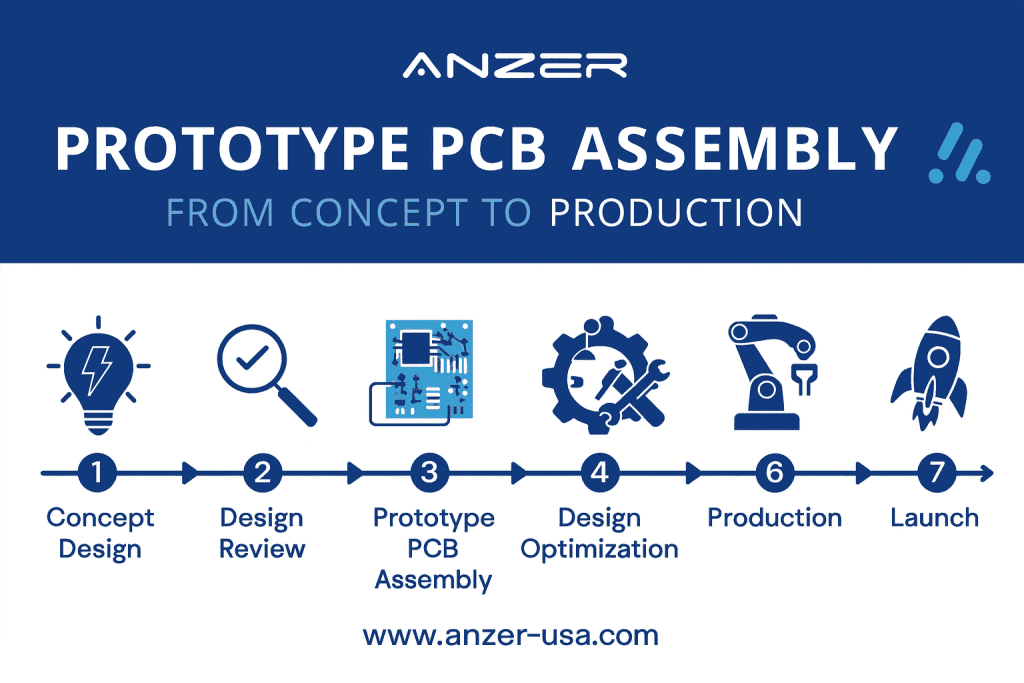
2. Component Sourcing & Procurement
- We leverage global distributor networks while maintaining preferred U.S. suppliers.
- Alternatives are suggested if components face obsolescence or long lead times.
- Our ISO-certified supply chain management ensures traceability and compliance.
Outcome: Reliable, high-quality components ready for assembly.
3. PCB Fabrication
- Multilayer, rigid, flex, or rigid-flex boards can be fabricated.
- Tolerances, copper thickness, and surface finishes (ENIG, HASL, OSP) are specified.
- For prototypes, we often recommend ENIG finish due to its reliability in rework and testing.
Outcome: Boards fabricated to spec, prepared for assembly.
4. PCB Assembly (SMT & Thru-Hole)
- Surface-Mount Technology (SMT): Automated pick-and-place with 01005-size component capability.
- Thru-Hole Assembly: Hand or wave soldering for connectors, power devices, or legacy parts.
- Mixed Technology Builds: Seamless integration of SMT + thru-hole.
Our state-of-the-art SMT lines, AOI (Automated Optical Inspection), and X-ray inspection guarantee placement precision.
Outcome: Fully assembled prototype PCBs ready for testing.
5. Testing & Validation
- ICT (In-Circuit Testing) for shorts, opens, and component values.
- Functional Testing simulates real operating conditions.
- Burn-in and environmental testing (when required for aerospace or medical applications).
Outcome: Verified prototypes that meet performance standards.
6. Feedback Loop & Iteration
- Engineering feedback is provided with each prototype batch.
- Customers can modify schematics, layouts, or components before the next iteration.
- Our agile process supports rapid prototyping cycles until the design is production-ready.
Outcome: Optimized design ready for volume production.
7. Transition to Production
Once prototypes are validated, ANZER seamlessly transitions your project to low, medium, or high-volume production.
Our in-house capabilities like potting, conformal coating, machining, wire harness assembly, and box builds ensure that scaling up doesn’t require multiple vendors.
Outcome: A smooth shift from prototype to market-ready product.
Industries Relying on Prototype PCB Assembly at ANZER
ANZER’s diverse customer base proves that prototype PCB assembly is universal across industries.
Medical Devices
- ISO 13485:2016 certified for medical electronics.
- Prototyping supports FDA submissions, clinical trials, and device validation.
Aerospace & Defense
- AS9100D certification ensures compliance with aerospace standards.
- Prototypes undergo environmental stress and vibration testing.
Industrial Automation & Controls
- Rapid prototyping accelerates control system innovation.
- Emphasis on ruggedized PCBs for harsh environments.
Automotive & EV Systems
- Wire harnesses and PCBAs tested for vibration, thermal cycling, and EMI shielding.
Lighting & Agriculture OEMs
- Prototype assemblies help test efficiency, power delivery, and rugged use cases.
ANZER’s Key Differentiators in Prototype PCB Assembly
Choosing the right manufacturing partner is just as important as the design itself. Here’s what makes ANZER stand out:
- 33+ years of experience and over 4,000 projects delivered.
- Certified Excellence: AS9100D, ISO 13485, ISO 9001.
- No minimum order quantities (MOQ) — perfect for prototypes.
- Dedicated prototype line that ensures rapid delivery.
- Full-service in-house capabilities: potting, coating, harnessing, machining.
- Diversity Certifications (MBE & WBE) — supporting supplier diversity initiatives.
- Made in USA quality assurance with local, responsive support.
How ANZER Ensures On-Spec, On-Time, On-Budget Prototyping
- On-Spec: Rigorous testing, AOI, X-ray, and compliance with IPC standards.
- On-Time: Agile scheduling with a dedicated prototype line.
- On-Budget: Transparent quotes, competitive pricing, and minimized rework.
This three-pillar approach has helped us maintain long-term partnerships with OEMs across regulated industries.
Prototype PCB Assembly: Common Challenges and ANZER’s Solutions
| Challenge | ANZER’s Solution |
|---|---|
| Long lead times for components | Strategic sourcing + vetted distributor network |
| Design not manufacturable | Early DFM/DFA analysis by engineering experts |
| Small batch not cost-effective | No MOQ policy, competitive prototyping pricing |
| Quality issues in prototypes | AOI, X-ray, functional testing, IPC-certified staff |
| Transitioning from prototype to volume | In-house scaling with full-service capabilities |
FAQs About Prototype PCB Assembly
1. What is the typical turnaround time for prototype PCB assembly?
At ANZER, turnaround depends on complexity and part availability, but rapid prototypes can be delivered in as little as 5–10 business days thanks to our dedicated prototype line.
2. Do you require a minimum order quantity (MOQ) for prototypes?
No. ANZER has no MOQ requirements, making us ideal for startups, R&D teams, and OEMs looking to test small batches.
3. How do you ensure prototype quality matches production quality?
We apply the same AS9100D and ISO-certified processes to prototypes as we do for production runs. Every prototype undergoes AOI, X-ray, and functional testing to ensure performance.
4. Can ANZER handle both SMT and thru-hole prototype assembly?
Yes. We specialize in mixed-technology builds including fine-pitch SMT, BGA, thru-hole, and hybrid assemblies.
5. What industries benefit most from prototype PCB assembly at ANZER?
We serve medical, aerospace, industrial automation, automotive, lighting, and agriculture OEMs, among others. Our certifications allow us to handle regulated, high-reliability applications.
Ready to turn your concept into a functional prototype? Partner with ANZER for prototype PCB assembly that’s On-Spec. On-Time. On-Budget.