
Automotive Electronics: 11 Advanced Driver Assistance Systems (ADAS)
Advanced Driver Assistance Systems (ADAS) are a set of technologies and features designed to assist drivers in operating their vehicles safely and more efficiently. These systems use a combination of sensors, cameras, radar, and other electronic manufacturing technologies to monitor the vehicle’s surroundings, provide real-time…

Electrical Drive System in EVs: Components, Controls, and Manufacturing Risks
An electrical drive system in an electric vehicle converts stored battery energy into controlled mechanical torque at the wheels. The main system includes the traction battery, inverter, power electronics controller, electric motor, transmission, regenerative braking controls, thermal management, sensors, wiring, and communication interfaces. For OEMs,…

Automation Control: Ladder Logic Programming Simplified
Ladder Logic Programming is a graphical programming language commonly used in industrial automation and control systems, particularly in programmable logic controllers (PLCs). It was initially developed to mimic traditional control systems’ electrical relay logic diagrams. Ladder Logic is intuitive and easy for control engineers, electricians,…

Renewable Energy Systems: Electronics Manufacturing Guide for OEMs
Renewable energy systems use naturally replenished energy sources such as sunlight, wind, flowing water, geothermal heat, and biomass. For OEMs, the important manufacturing question is not only “Which renewable source is being used?” The bigger question is whether the electronics inside the system can survive…

Switch-Mode Power Supply: 17 Design Steps
Designing a Switch-Mode Power Supply (SMPS) or switching power supply can be a complex process that requires a good understanding of power electronics and electrical engineering principles. Here are the general steps involved in designing a Switch-Mode Power Supply (SMPS): Designing an SMPS can be…

Power Electronics PCB Assembly: Design and Testing Guide
Power electronics PCB assembly is the controlled manufacture of printed circuit board assemblies that convert, regulate, switch, or distribute electrical power. Unlike many low-power control boards, these assemblies may need to manage high current, elevated voltage, concentrated heat, fast switching edges, EMI, large components, and…

IPC Standards Compliance in PCB Assembly: What OEM Buyers Should Check Before Build
IPC standards compliance in PCB assembly means the design package, soldering process, inspection criteria, testing plan, documentation, and acceptance class are aligned to recognized electronics manufacturing standards such as IPC-A-610 and IPC J-STD-001. For OEM buyers, the real question is not only, “Is the supplier…

Wire and Cable Assemblies: Connectors and Terminations
Wire and cable assemblies are crucial components in various electrical and electronic systems. They consist of wires or cables that are connected to one another or other components using connectors and terminations. These connectors and termination methods are selected based on factors like the application,…

Manufacturing Wires and Cables: 10 Basics
Wires and cables are manufactured through various processes involving materials and technologies. The specific methods can vary depending on the type and purpose of the wire or cable, but here is a general overview of how wires and cables are made: It’s important to note…

Battery Technology Evolution: History, Trends & OEM Design
Battery technology evolution is the continuing development of electrochemical cells, materials, controls, packaging, and manufacturing methods used to store and deliver electrical energy. The earliest batteries demonstrated that a chemical reaction could generate a continuous electric current. Later technologies improved rechargeability, portability, energy density, service…

Q: What is a J1772 Charging Adapter
A: A J1772 charging adapter is used in electric vehicle (EV) charging to enable compatibility between different charging standards. J1772 is a standard for Level 2 charging in North America, and it defines the physical connector and communication protocol for charging electric vehicles. Suppose you…

Design for Test in PCB Electronics: DFT Strategies That Prevent Manufacturing Blind Spots
Design for Test, often called DFT or design for testability, means designing a PCB so it can be inspected, probed, programmed, debugged, and verified during manufacturing without unnecessary rework. A circuit can look correct in CAD and still become expensive to manufacture if the assembler…

Residential EV Installations: 15 Considerations
Residential EV installations, often called home Electric Vehicle (EV) charging stations or electric vehicle supply equipment (EVSE), require some important considerations. Here are some key things to know about EV installations at homes: Before proceeding with an EV charger installation at your home, it’s advisable…

PCB Assembly: Controlling Moisture in Semiconductor Devices
Controlling moisture in semiconductor devices during PCB (Printed Circuit Board) assembly is crucial for several reasons: Manufacturers often use techniques such as vacuum-sealed packaging, humidity-controlled storage, and careful handling procedures in controlling moisture in semiconductor devices during PCB assembly. These measures help ensure that the…

Troubleshooting Cable Assemblies: A Practical Guide for OEMs
Troubleshooting cable assemblies starts with safety, current documentation, and the exact failure symptom. Do not stop at continuity. A cable assembly can fail because of an open conductor, short circuit, wrong pinout, high-resistance crimp, damaged insulation, loose terminal, connector wear, poor strain relief, moisture, vibration,…

Wireless Telemetry Systems: Design, Protocols, and OEM Selection Guide
A wireless telemetry system measures conditions at a remote asset, converts the sensor output into usable data, and transmits that data to a gateway, control system, or cloud platform without a dedicated signal cable. A complete system normally includes sensors, signal conditioning, a microcontroller, memory,…
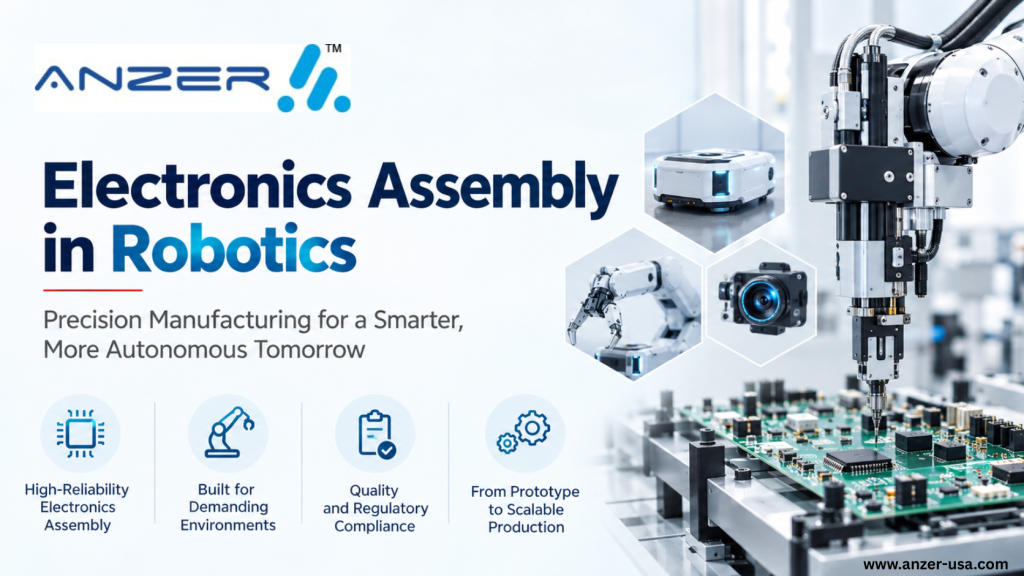
Electronics Assembly in Robotics: What OEMs Need to Know
Robotics systems depend on electronics that can control motion, process sensor inputs, communicate with other equipment, and operate reliably in their intended environments. Electronics assembly in robotics brings together PCB assembly, component placement, soldering, inspection, testing, and, where required, complete box build integration to turn…

Motion Control Systems: Example Applications
Motion control systems is a technology that uses various components to regulate the movement of machines or mechanisms. It is widely used in various industries and applications to precisely control objects’ position, speed, and acceleration. Here are some common applications of motion control: These are…

PCB Assembly: Components on Both Sides
Surface Mount Technology (SMT) components can be placed on both sides of a printed circuit board (PCB) for several reasons: Not all PCBs require components on both sides, and the decision to use both depends on the specific design requirements and constraints. Additionally, designers must…

PCB Assemblers: SMT Inspection Importance
PCB (Printed Circuit Board) assemblers use various methods and tools to perform Surface Mount Technology (SMT) inspection to ensure the quality and functionality of the assembled PCBs. SMT inspection importance is vital in the PCB assembly process to identify and rectify any defects or issues…