U.S. Electronics Manufacturing: What OEM Buyers Should Look For | Anzer USA
U.S. electronics manufacturing is about more than assembling a PCB in an American facility. For OEMs, the real question is whether a manufacturing partner can consistently manage design-for-manufacturing, component sourcing, PCB assembly, inspection, testing, documentation, integration, and production transition.
A U.S.-based electronics manufacturer can also provide closer communication and a domestic manufacturing relationship when engineering collaboration, quality requirements, traceability, or supply-chain considerations matter.
For OEM buyers evaluating an electronics manufacturing services (EMS) or electronic contract manufacturing (ECM) partner, the decision should start with manufacturing capability and quality controls, not simply quoted piece price.
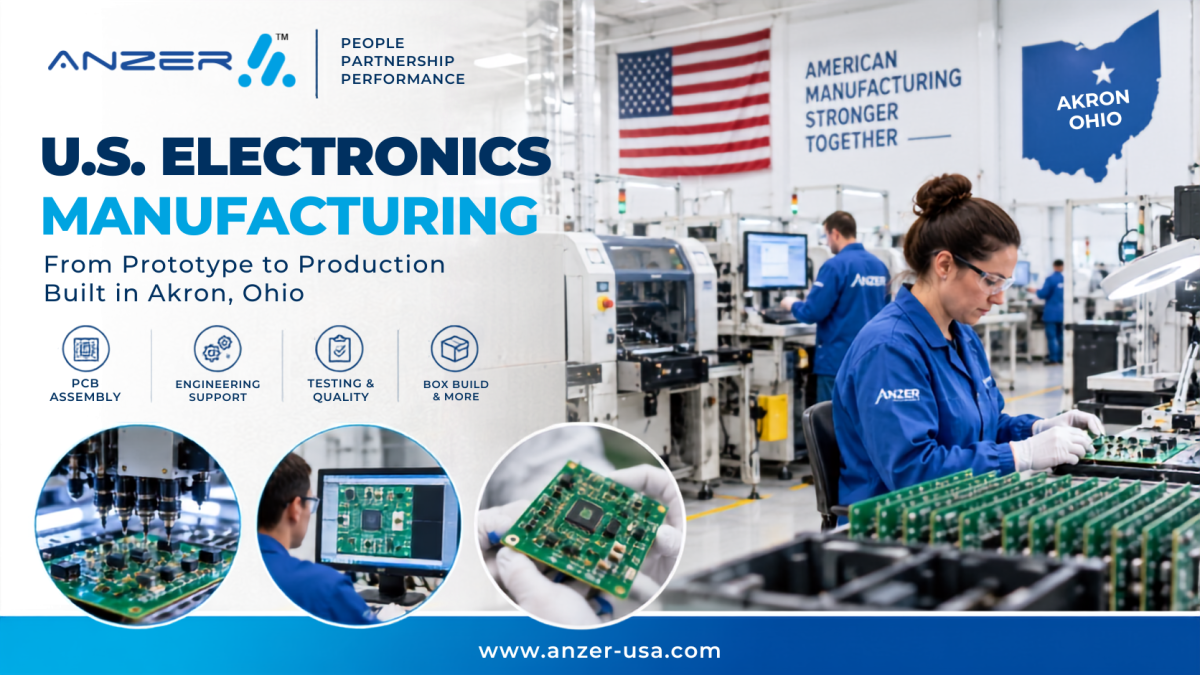
ANZER provides U.S.-based electronics manufacturing from its facility in Akron, Ohio, supporting PCB assembly, contract manufacturing, prototyping, box build assembly, wire harnesses, testing, coating, potting, and related services. The company has more than 33 years of manufacturing history through its WRC legacy and has completed more than 4,000 projects.
What Is U.S. Electronics Manufacturing?
U.S. electronics manufacturing refers broadly to the production and assembly of electronic products and assemblies within the United States.
For an OEM, that can include:
- PCB fabrication and PCB assembly
- Surface-mount technology (SMT)
- Through-hole technology (THT)
- Mixed-technology assembly
- Component procurement
- PCB inspection and testing
- Wire harness and cable assembly
- Box build and system integration
- Conformal coating and potting
- Prototype and pre-production builds
- Final inspection, serialization, packaging, and delivery
The exact scope varies by manufacturer.
That distinction matters because an OEM may be looking for a PCB assembler while actually needing a manufacturing partner capable of supporting the product beyond the circuit board.
ANZER’s manufacturing model covers multiple stages of the electronics product lifecycle, from design and DFM through prototyping, PCB assembly, subsystem assembly, testing, and sustaining engineering.
Why Are OEMs Evaluating Domestic Electronics Manufacturing?
Supply-chain resilience has become an important consideration in electronics procurement.
The U.S. government identifies electronics and semiconductors as strategically important to economic and national security, while federal manufacturing programs continue to support domestic microelectronics capabilities.
NIST has also identified supply-chain concentration and limited domestic production capacity as risks within critical technology supply chains.
For an OEM, however, reshoring or domestic sourcing should not be treated as a simple geographic decision.
A better question is:
Can the U.S. manufacturing partner provide the technical capability, quality system, documentation, testing, and production flexibility the product requires?
That is where supplier evaluation becomes important.
7 Things to Evaluate in a U.S. Electronics Manufacturer
1. PCB Assembly Capability
Start by determining whether the manufacturer can actually build your board as designed.
Ask about:
- SMT assembly
- Through-hole assembly
- Mixed-technology assembly
- Reflow soldering
- Wave soldering
- Hand soldering
- AOI
- X-ray inspection
- ICT
- Flying probe
- Functional testing
- Burn-in testing where required
A manufacturer should also be able to explain how inspection and testing fit into the manufacturing process.
ANZER supports SMT, THT, mixed-technology PCB assembly, AOI, X-ray, ICT, flying probe, functional testing, and burn-in testing.
For more detail, see ANZER’s PCB assembly services.
2. Design-for-Manufacturability Support
A PCB can work perfectly in a prototype and still create manufacturing problems when production begins.
DFM review can identify potential issues involving:
- Component availability
- Part clearances
- PCB layout
- Manufacturing tolerances
- Assembly access
- Soldering requirements
- BOM risks
- Test requirements
This is why engineering involvement before production matters.
ANZER provides electronic design for manufacturability support, including DFM and DFA review and BOM optimization.
NIST research has also emphasized the importance of close interaction between product development and manufacturing suppliers, including design-for-manufacturing across organizational boundaries.
3. Quality Systems and Workmanship Standards
A manufacturer serving commercial electronics may have different requirements from one supporting medical or aerospace electronics.
OEM buyers should determine which quality systems and workmanship standards apply to their product.
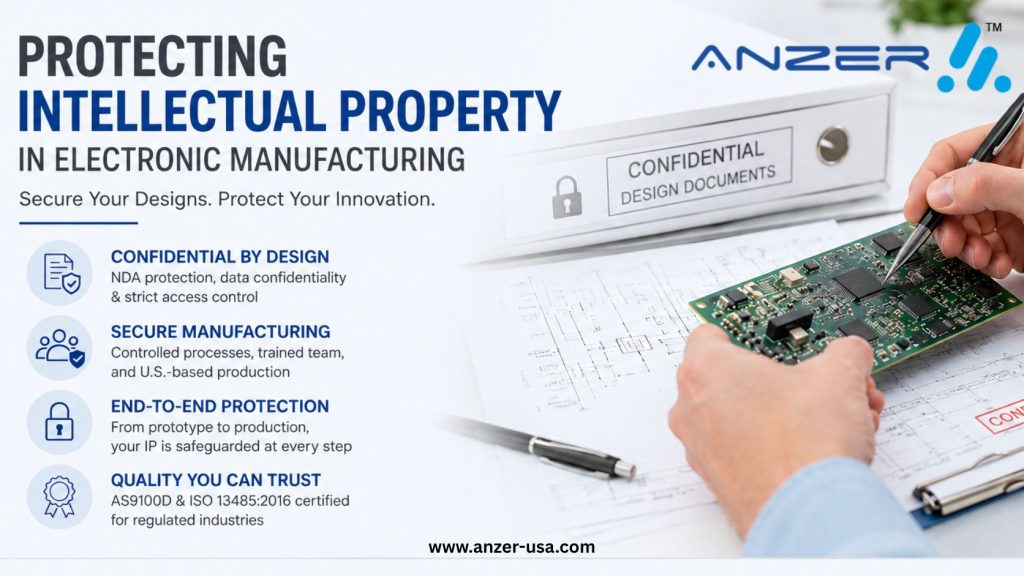
ANZER maintains verified certifications including:
- ISO 9001:2015
- ISO 13485:2016
- AS9100D
- IPC-A-610 certification
- ESD controls
- RoHS compliance
- REACH compliance
ANZER manufactures to IPC Class 2 and Class 3 requirements.
Its IPC Total Quality Management approach is particularly relevant when workmanship consistency and inspection criteria are important.
For medical electronics, buyers can also review medical electronics assembly.
For aerospace applications, see aerospace electronics assembly.
4. Traceability and Documentation
Traceability becomes increasingly important as product risk increases.
Before selecting a U.S. electronics manufacturer, ask what information can be tracked through the manufacturing process.
Depending on the product, relevant records may include:
- Component information
- BOM revisions
- Assembly records
- Inspection results
- Test results
- Serialization
- Manufacturing documentation
- Product revisions
- Quality records
The objective is not simply to have more paperwork. The objective is to create useful manufacturing records that support quality control, troubleshooting, compliance, and future production.
ANZER’s manufacturing capabilities include serialization, labeling, testing, documentation management, and traceability processes.
See also ANZER’s resource on PCB component traceability in manufacturing.
5. Prototype-to-Production Capability
One common sourcing problem occurs when the prototype supplier and production supplier are completely different companies.
That can create another engineering transfer, another DFM review, another supplier qualification process, and another opportunity for manufacturing knowledge to be lost.
A manufacturer that can support both prototype and production can provide continuity.
ANZER operates a dedicated prototype production line and supports builds from prototype through production. Its no-minimum-order approach can also accommodate smaller manufacturing requirements.
For OEMs developing a new product, electronic prototype services can be an important part of supplier evaluation.
6. System Integration Beyond the PCBA
Some products require much more than a populated circuit board.
A complete electronic product may require:
PCBA + wire harness + enclosure + mechanical components + connectors + testing + labeling + packaging
This is where box build and system integration become important.
ANZER’s box build assembly services support the integration of PCBAs, wiring, mechanical components, enclosures, connectors, and other components into finished assemblies.
ANZER also provides wire harness and cable assembly.
For an OEM, consolidating these activities with one manufacturing partner can simplify supplier coordination and production communication.
7. Domestic Manufacturing Location
Location alone does not determine manufacturing quality.
However, a U.S.-based facility can be relevant when an OEM values domestic production, closer engineering communication, regional supply-chain relationships, or specific Made in USA requirements.
ANZER conducts its manufacturing in Akron, Ohio.
The company has maintained its electronics manufacturing legacy since 1991 through Western Reserve Controls and the current ANZER organization.
For OEMs evaluating domestic manufacturing, ANZER’s Made in USA electronics manufacturing positioning is part of its broader U.S. contract manufacturing model.
U.S. Electronics Manufacturing vs. Offshore Sourcing
The right manufacturing location depends on the product and business requirements.
A useful comparison should include more than labor cost.
| Evaluation Area | Questions OEM Buyers Should Ask |
|---|---|
| Unit cost | What is the complete landed manufacturing cost? |
| Communication | How easily can engineering and procurement teams communicate with the manufacturer? |
| Supply chain | How exposed is the program to international logistics and regional concentration? |
| Quality | Which quality systems and workmanship standards apply? |
| Testing | What inspection and functional testing are available? |
| Traceability | What manufacturing and component records are maintained? |
| Prototyping | Can the same manufacturer support prototype and production? |
| Engineering | Is DFM/DFA support available before production? |
| Integration | Can the supplier handle harnesses, box builds, coating, potting, and testing? |
| Location | Does domestic manufacturing support the project’s procurement or customer requirements? |
The U.S. Department of Commerce has noted that measuring “Made in America” can be complex because U.S. manufacturers can still depend on foreign inputs.
That means OEMs should define exactly what “U.S. manufacturing” means for their procurement program rather than treating the phrase as a complete supply-chain description.
What Should You Send When Requesting a Manufacturing Quote?
A stronger RFQ gives the manufacturer enough information to evaluate both cost and manufacturing risk.
Depending on the project, prepare:
- Current BOM
- Gerber files
- Pick-and-place files
- Assembly drawings
- Schematic documentation
- PCB specifications
- Revision information
- Required quantity
- Prototype or production status
- Testing requirements
- Programming requirements
- Coating or potting requirements
- Box build documentation
- Wire harness drawings
- Required quality standards
- Serialization requirements
- Packaging requirements
The more complete the RFQ package, the easier it is for the manufacturer to identify sourcing, assembly, testing, and manufacturability considerations before production.
For a manufacturing discussion, OEMs can use ANZER’s Get a Quote page.
When Does U.S. Electronics Manufacturing Make Sense?
Domestic electronics manufacturing can be particularly relevant when an OEM needs:
- U.S.-based production
- Frequent engineering communication
- Prototype-to-production continuity
- High-mix or lower-volume manufacturing
- Regulated-industry quality systems
- Traceability and documentation
- PCB assembly and system integration
- Wire harness or cable assembly
- Conformal coating or potting
- DFM/DFA support
- A single manufacturing partner for multiple production stages
It is still important to evaluate each supplier against the actual product requirements.
A domestic location cannot compensate for insufficient testing, weak documentation, poor DFM practices, or a quality system that does not fit the application.
How ANZER Supports U.S. Electronics Manufacturing
ANZER is a B2B electronic contract manufacturer based in Akron, Ohio.
Its capabilities span:
- PCB assembly
- SMT and THT
- Mixed-technology assembly
- Electronic contract manufacturing
- PCB fabrication
- DFM and DFA
- Prototype builds
- Box build assembly
- Wire harness and cable assembly
- Conformal coating
- Potting
- AOI and X-ray inspection
- ICT and flying probe
- Functional testing
- Burn-in testing
- Serialization and packaging
ANZER has more than 33 years of manufacturing history, 4,000+ completed projects, 200+ customers, and experience across 10+ industries according to its verified company information.
The goal is straightforward: give OEMs a manufacturing partner capable of supporting the product from engineering and prototype work through production.
U.S. Electronics Manufacturing Buyer Checklist
Before selecting an electronics manufacturing partner, ask:
- Does the manufacturer build the PCB technology my product requires?
- Can it perform the inspection and testing my product needs?
- Does its quality system match the application?
- Can it support IPC Class 2 or Class 3 requirements where applicable?
- Can it provide DFM/DFA feedback?
- Can it manage component sourcing?
- Does it provide traceability?
- Can it support prototypes and production?
- Can it build wire harnesses or cables?
- Can it complete box build integration?
- Are coating and potting available when required?
- Is manufacturing actually performed in the United States?
- Can the supplier support the documentation required by my organization?
- What information should be included in the RFQ?
These questions help shift the supplier decision from “Who has the lowest assembly price?” to “Who is the right manufacturing fit for this product?”
Frequently Asked Questions
What is U.S. electronics manufacturing?
U.S. electronics manufacturing is the production or assembly of electronic products and assemblies within the United States. It can include PCB assembly, component sourcing, testing, box builds, wire harnesses, coating, potting, and other manufacturing activities.
Why do OEMs choose U.S.-based electronics manufacturers?
OEMs may choose domestic manufacturing for reasons including supply-chain considerations, engineering communication, domestic sourcing requirements, quality management, traceability, and production proximity.
What should I look for in a U.S. electronics manufacturer?
Evaluate PCB assembly capability, quality systems, testing, traceability, DFM support, component sourcing, prototype capability, system integration, documentation, and manufacturing location.
Can a U.S. electronics manufacturer handle both prototypes and production?
Yes, some manufacturers support both. ANZER maintains a dedicated prototype production line and supports projects from prototype through production.
Does U.S. manufacturing mean every component is made in the United States?
Not necessarily. The Department of Commerce notes that U.S.-made products can incorporate imported parts and materials. OEMs should define their specific domestic-content and sourcing requirements when evaluating a manufacturer.
Conclusion
U.S. electronics manufacturing should be evaluated as a complete manufacturing capability, not simply as a geographic label.
For OEMs, the strongest evaluation starts with the fundamentals: PCB assembly capability, DFM, quality systems, testing, traceability, component sourcing, prototype support, system integration, and production continuity.
ANZER provides these capabilities from its Akron, Ohio manufacturing facility, supporting OEM electronics programs from prototype and engineering work through PCB assembly, testing, box build, and production.
If your team is evaluating a U.S. electronics manufacturing partner, start with the product requirements, documentation, quality expectations, and production goals. Then select the manufacturer that fits those requirements.
ANZER USA provides electronics manufacturing solutions from Akron, Ohio.