Electronics System Integration: From PCB Assembly to Complete Systems
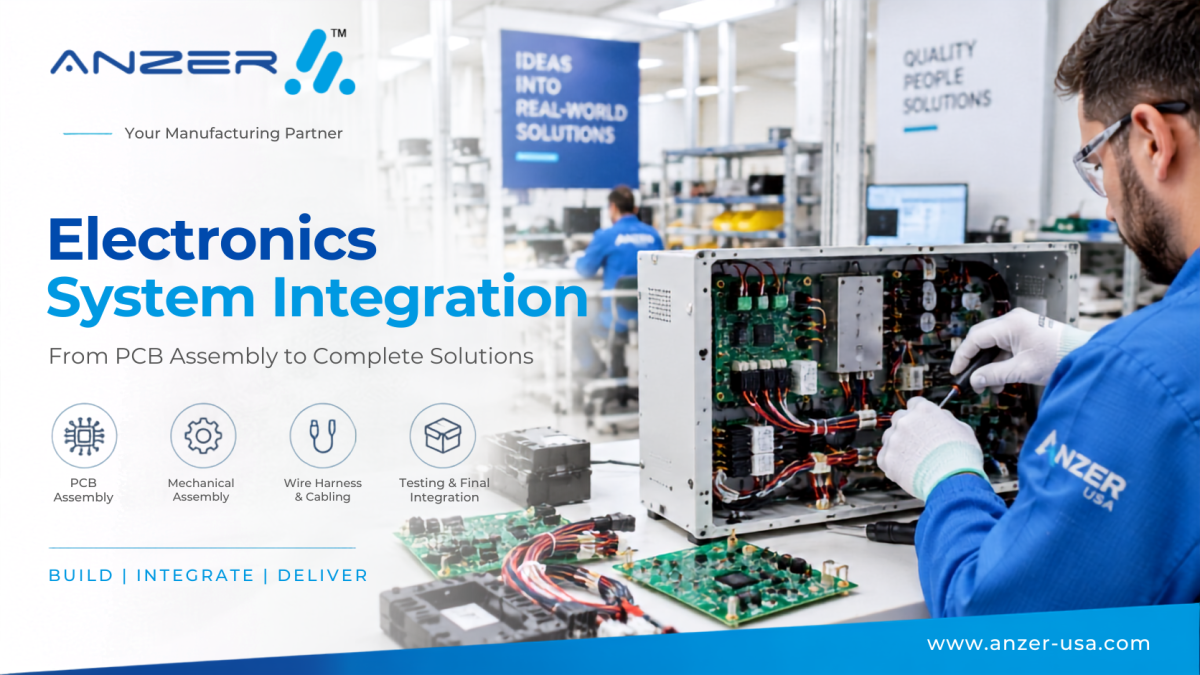
Electronics system integration is the process of bringing electronic, electrical, mechanical, and assembly elements together into a complete functional system. Instead of treating PCB assembly, wiring, mechanical assembly, testing, and final assembly as disconnected activities, system integration connects them into one manufacturing workflow.
For OEMs, the important question is not simply whether a supplier can build a PCBA. The question is whether that supplier can help turn the PCBA into a complete, tested, integrated product or subsystem.
That is where ANZER USA’s manufacturing model is relevant. From our Akron, Ohio facility, we support PCB assembly, wire and cable harness assembly, box build assembly, testing, coating, potting, and other manufacturing requirements for B2B electronic products. Our business has more than 33 years of manufacturing experience through the WRC-to-ANZER legacy.
What Is Electronics System Integration?
Electronics system integration is the manufacturing process of combining electronic assemblies, wiring, mechanical components, enclosures, and required testing into a functional electronic system.
A typical integrated system can include:
- Printed circuit board assemblies
- SMT and THT components
- Wire harnesses
- Cable assemblies
- Connectors
- Mechanical hardware
- Enclosures
- Sensors and other system components
- Electrical connections
- Required testing and inspection
- Labeling and serialization
- Packaging
The exact scope depends on the OEM’s product design.
A PCBA may provide the electronic functionality, but it is often only one part of the finished product. System integration connects that board with the physical and electrical elements required for the product to operate as designed.
For OEMs, this distinction matters because every additional manufacturing handoff can introduce another point where documentation, configuration, fit, wiring, or testing requirements must be communicated.
Electronics System Integration vs. PCB Assembly
PCB assembly and electronics system integration are related, but they are not the same manufacturing activity.
| PCB Assembly | Electronics System Integration |
|---|---|
| Builds the populated circuit board | Builds the larger electronic system |
| SMT, THT, or mixed technology | PCBA plus electrical and mechanical integration |
| Component placement and soldering | Wiring, enclosure, mechanical and subsystem integration |
| AOI, X-ray, ICT and other board-level inspection | System-level functional verification where specified |
| Produces a PCBA | Can produce a complete assembled product or subsystem |
This is why OEMs should define their manufacturing requirement clearly before requesting quotes.
If the requirement ends at a tested PCBA, PCB assembly may be sufficient.
If the requirement includes the enclosure, harnesses, mechanical components, electrical connections, testing, labeling, and final packaging, a box build or system integration program may be more appropriate.
ANZER provides [box build assembly services] as part of its broader electronics manufacturing capabilities.
What Does Electronics System Integration Include?
There is no single configuration that applies to every product. A system integration project should be built around the OEM’s drawings, BOM, assembly instructions, test requirements, and product configuration.
At ANZER, system-level manufacturing can connect several capabilities.
PCB Assembly
The process can begin with a completed PCBA manufactured using SMT, THT, or mixed-technology assembly.
ANZER’s PCB assembly capabilities include:
- SMT assembly
- THT assembly
- Mixed-technology assembly
- Reflow soldering
- Wave soldering
- Hand soldering
- AOI
- X-ray inspection
- ICT
- Flying probe testing
- Functional testing
- Burn-in testing
These capabilities allow board-level manufacturing and inspection to become part of a larger integrated manufacturing workflow.
Learn more about [PCB manufacturing and assembly capabilities].
Wire Harness and Cable Integration
Wiring is often one of the most important interfaces between a PCBA and the rest of the product.
A system may require:
- Internal wire harnesses
- Cable assemblies
- Connectors
- Terminations
- Organized cable routing
- Electrical connections between subsystems
ANZER manufactures both wire harnesses and cable assemblies in-house.
For OEM engineering teams, this can be particularly useful when the PCBA, harness, enclosure, and final assembly need to be considered together rather than as isolated components.
See ANZER’s [wire harness and cable assembly capabilities].
Mechanical Integration
The electronic system also has to physically fit together.
System integration may involve installing:
- PCBAs
- Connectors
- Brackets
- Hardware
- Displays
- Buttons
- Hinges
- Enclosures
- Other mechanical components
Mechanical fit, cable routing, component access, and assembly sequence should be considered before production begins.
This is one reason ANZER supports [DFM and DFA engineering review] as part of the manufacturing process.
Why DFM Matters Before System Integration
A system integration problem is often easier and less expensive to address during engineering review than after production begins.
A DFM review can identify manufacturing concerns before they become assembly problems.
Examples include:
- Component clearance
- Board-to-enclosure fit
- Access for assembly
- Potential sourcing risks
- Manufacturing constraints
- Assembly sequence
- Connector placement
- Wiring considerations
- BOM issues
ANZER provides DFM, DFA, BOM optimization, PCB design, testing strategy consultation, and engineering support.
For an OEM, the practical goal is simple:
Find manufacturing problems while the design is still easy to change.
Testing Is Part of System Integration
A product that has been assembled is not necessarily a product that has been verified.
Testing requirements should be defined around the product and its intended application.
Depending on the project, ANZER offers:
- AOI
- X-ray inspection
- ICT
- Flying probe testing
- Functional testing
- Burn-in testing
These methods address different types of manufacturing and performance risks. AOI, for example, is used for visual inspection of component placement and solder joints, while X-ray can inspect hidden solder connections. ICT can identify issues such as shorts, opens, and component values. Functional testing evaluates operation under defined conditions.
The important point for an OEM is to define what must be tested, how it will be tested, and what constitutes acceptance before production.
When Should an OEM Consider System Integration?
System integration can make sense when a product contains multiple manufacturing disciplines that must work together.
Common examples include:
- Industrial electronic equipment
- Automation equipment
- Medical electronics
- Aerospace electronics
- Control systems
- Electronic subsystems
- Equipment with internal harnesses
- Enclosed PCB-based products
For regulated applications, the manufacturing environment and documentation requirements become even more important.
ANZER is certified to ISO 13485:2016 for medical device quality management and AS9100D for aerospace quality management. The company also manufactures to IPC Class 2 and Class 3 requirements.
Why Supplier Coordination Matters
One of the practical challenges in system manufacturing is managing multiple suppliers.
For example, an OEM could separately source:
- PCB fabrication
- PCB assembly
- Wire harnesses
- Mechanical parts
- Enclosures
- Final assembly
- Testing
- Packaging
Each handoff creates another coordination requirement.
A contract manufacturer capable of combining several of these activities can give the OEM a more centralized manufacturing workflow.
ANZER’s capabilities span PCB assembly, turnkey contract manufacturing, wire and cable harness assembly, box build assembly, coating, potting, testing, and packaging.
That does not eliminate the OEM’s engineering responsibilities. It can, however, reduce the number of manufacturing interfaces that the OEM has to coordinate.
What Should Be Included in an Electronics System Integration RFQ?
A strong RFQ gives the manufacturer enough information to understand both the product and the manufacturing requirement.
OEMs should consider providing:
Product Documentation
- Current BOM
- Schematics
- PCB files
- Assembly drawings
- Mechanical drawings
- Enclosure information
- Wire and cable drawings
- Work instructions where available
Manufacturing Requirements
- Required assembly processes
- Required component sourcing model
- Customer-supplied vs. manufacturer-supplied material
- Assembly configuration
- Labeling requirements
- Serialization requirements
- Packaging requirements
Testing Requirements
- Test procedures
- Test fixtures, if applicable
- Functional requirements
- Acceptance criteria
- Required inspection
- Required documentation
Quality and Compliance
Specify applicable requirements such as:
- IPC workmanship class
- ISO-related requirements
- Aerospace requirements
- Medical manufacturing requirements
- RoHS or REACH requirements
- Traceability expectations
The more clearly these requirements are defined before quoting, the easier it is for the manufacturer and OEM engineering teams to evaluate the actual manufacturing scope.
Questions to Ask an Electronics System Integration Partner
Price should not be the only factor when comparing suppliers.
Ask:
1. Can you manufacture the PCBA and perform final integration?
This determines whether the supplier can manage both board-level and system-level work.
2. Can you manufacture the required wire harnesses or cable assemblies?
Wiring can become a significant integration interface.
3. What inspection and testing capabilities are available?
Ask specifically about AOI, X-ray, ICT, flying probe, functional testing, and burn-in where applicable.
4. Can you perform DFM/DFA review?
Early manufacturing feedback can help identify problems before production.
5. Can you support prototypes and production?
For developing products, continuity between prototype and production can simplify manufacturing transfer.
6. What documentation and traceability are available?
This becomes particularly important for regulated and high-reliability applications.
7. Which manufacturing processes are performed in-house?
Ask about PCB assembly, harnesses, coating, potting, machining, testing, and final integration.
8. What manufacturing standards apply to my product?
The correct workmanship and quality requirements should be defined according to the product and application.
ANZER’s Electronics System Integration Approach
ANZER’s manufacturing model connects multiple stages of electronics production under one organization in Akron, Ohio.
Depending on the project, that can include:
Design → DFM/DFA → PCB fabrication → PCB assembly → wire/cable assembly → mechanical integration → box build → testing → coating/potting → serialization → packaging
Not every project requires every step.
That is an important distinction.
A good manufacturing partner should build the process around the product requirements rather than force every project into the same manufacturing model.
ANZER supports prototype through high-volume production and has a dedicated prototype production line. The company also operates with no minimum order quantity, which can be useful for OEMs and R&D teams developing or evaluating new products.
Electronics System Integration for Medical and Aerospace Applications
System integration becomes more demanding when product reliability, documentation, traceability, and quality-system requirements are significant.
ANZER’s relevant quality credentials include:
- ISO 9001:2015
- ISO 13485:2016
- AS9100D
- IPC-A-610 capability
- IPC Class 2 and Class 3 manufacturing
- ESD controls
- RoHS compliance
- REACH compliance
For medical electronics, ANZER’s ISO 13485 certification supports its medical manufacturing work. For aerospace electronics, AS9100D and IPC Class 3 capability are relevant quality and workmanship considerations.
These credentials should not replace an OEM’s supplier qualification process. They should be considered alongside manufacturing controls, documentation, inspection, testing, traceability, engineering support, and product-specific requirements.
Prototype-to-Production System Integration
System integration decisions should not be postponed until production.
During prototyping, OEM engineering teams can discover:
- Harness routing problems
- Mechanical interference
- Connector access issues
- Assembly sequence problems
- Test access limitations
- BOM or sourcing problems
- Enclosure fit issues
Addressing these issues before production can make the manufacturing transition more controlled.
ANZER’s dedicated prototype production line supports prototype builds without disrupting high-volume production lines, and the company supports a transition from prototype to production.
For an OEM developing a new electronic product, this creates an important manufacturing question:
Can the supplier that helps build the prototype also support the production version?
Electronics System Integration: A Practical Buyer Checklist
Before selecting a system integration partner, confirm:
- PCB assembly capability
- SMT and THT capability
- Wire harness capability
- Cable assembly capability
- Mechanical integration capability
- Box build capability
- DFM/DFA support
- Component sourcing support
- AOI inspection
- X-ray inspection where applicable
- ICT or flying probe capability where applicable
- Functional testing
- Burn-in where required
- Serialization and labeling
- Traceability requirements
- Applicable IPC workmanship class
- Applicable quality certifications
- Prototype support
- Production support
- Clear RFQ documentation requirements
- Defined acceptance criteria
This checklist helps move the supplier discussion away from simply asking, “What is your PCB assembly price?”
The better question is:
“Can you manufacture and verify the complete system to our requirements?”
Why Akron-Based Electronics Manufacturing Can Matter
For U.S. OEMs, supplier location can affect more than freight.
A domestic manufacturing partner can simplify communication and engineering collaboration, particularly when a product is still evolving or requires frequent manufacturing feedback.
ANZER manufactures in Akron, Ohio, and its manufacturing is Made in USA. The business has more than 33 years of manufacturing history through its WRC legacy and has completed more than 4,000 projects for 200+ customers across 10+ industries.
For buyers evaluating domestic electronics manufacturing, these factors can be considered alongside quality systems, manufacturing capabilities, testing, documentation, sourcing, and product requirements.
Final Takeaway
Electronics system integration is more than putting a PCBA into an enclosure.
It is the coordinated manufacturing of the electronic, electrical, mechanical, wiring, testing, and final assembly elements required to create a functional system.
For OEMs, the right integration partner should be evaluated on:
- Manufacturing capability
- DFM/DFA support
- PCB assembly
- Harness and cable integration
- Mechanical integration
- Testing
- Traceability
- Quality systems
- Documentation
- Prototype support
- Production scalability
- Overall manufacturing fit
ANZER USA supports these requirements from its Akron, Ohio manufacturing operation, with capabilities spanning PCB assembly, wire and cable harnesses, box build assembly, testing, coating, potting, design support, prototyping, and contract manufacturing.
When the requirement is to move from individual electronic assemblies to a complete integrated product, system integration should be part of the manufacturing conversation from the beginning.
If your OEM product requires PCB assembly, wiring, mechanical integration, testing, and final box build, [talk with ANZER about your manufacturing requirements].
FAQs
What is electronics system integration?
Electronics system integration is the process of combining PCB assemblies, wiring, mechanical components, enclosures, and other required components into a functional electronic system, with testing and final assembly defined according to the product requirements.
What is the difference between PCB assembly and system integration?
PCB assembly produces a populated and soldered circuit board. System integration goes beyond the PCBA by connecting it with wiring, mechanical components, enclosures, and other subsystems to create a functional product or system.
Does ANZER provide electronics system integration?
Yes. ANZER provides box build assembly and related manufacturing capabilities including PCB assembly, wire and cable harness assembly, mechanical integration, testing, coating, potting, serialization, and packaging.
Can ANZER support prototype and production system integration?
Yes. ANZER supports prototype through high-volume production and operates a dedicated prototype production line.
Where does ANZER manufacture electronics?
ANZER manufactures in Akron, Ohio, USA. Its manufacturing operation is Made in USA.
CTA
Need a Complete Electronics Manufacturing Partner?
If your product requires more than PCB assembly, ANZER can support the broader manufacturing workflow, including PCBAs, wire and cable assemblies, box builds, testing, coating, potting, and prototype-to-production support.