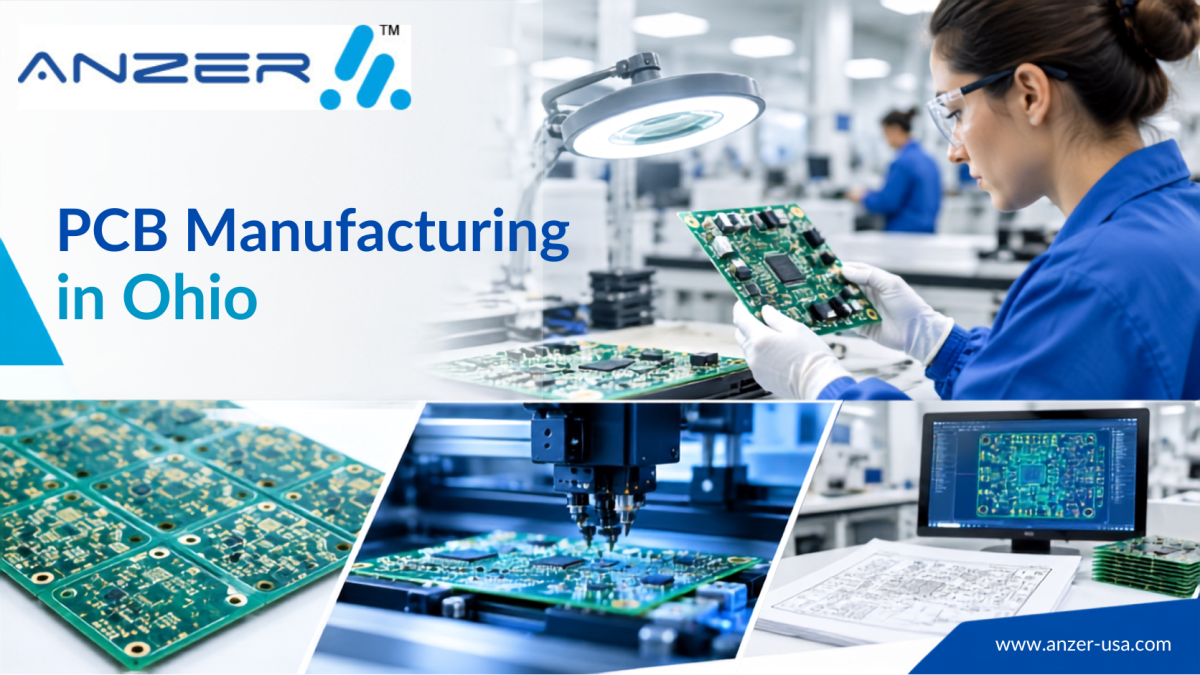
PCB Manufacturing Ohio: What OEM Buyers Should Evaluate Before Choosing a Manufacturer
If you are searching for PCB manufacturing in Ohio, the important question is not simply whether a supplier can produce a circuit board. OEM buyers need to evaluate the complete manufacturing path, including PCB design, fabrication, DFM, component sourcing, SMT and through-hole assembly, inspection, testing, traceability, and the transition from prototype to production.
ANZER provides PCB manufacturing services and electronic contract manufacturing from its facility in Akron, Ohio. Its capabilities extend from PCB design and fabrication through PCB assembly services, testing, prototyping, box build, wire harness assembly, coating, potting, and production support.
For OEMs, this matters because the bare PCB is only one part of the manufacturing process. The quality of the finished electronic assembly depends on how the board, components, assembly process, inspection criteria, testing requirements, documentation, and production controls work together.
What Does PCB Manufacturing in Ohio Include?
PCB manufacturing can refer to different stages depending on the supplier.
At the board level, PCB fabrication involves producing the physical printed circuit board according to the engineering design and fabrication requirements.
At the assembly level, components are installed onto the fabricated board using SMT, THT, or mixed-technology processes.
For an OEM, the manufacturing chain can look like:
PCB design → DFM review → PCB fabrication → component sourcing → SMT/THT assembly → inspection → electrical testing → coating or potting when required → system integration → final inspection
This distinction is important when evaluating an Ohio PCB manufacturer.
A company that only supplies bare boards is different from an electronic contract manufacturer that can manage fabrication, assembly, testing, and additional manufacturing operations.
PCB Fabrication Options OEMs Should Define
The PCB construction should be established before requesting a manufacturing quotation.
Depending on the application, the required board construction may include:
| PCB requirement | Examples |
|---|---|
| Board construction | Rigid, flexible, rigid-flex |
| Layer configuration | Single, double, multilayer |
| Base material | FR-4 and other specified materials |
| Surface finish | ENIG, HASL, OSP, gold finishes |
| Copper requirements | Defined by electrical and mechanical requirements |
| Vias | Based on the controlled PCB design |
| Component technology | SMT, THT, mixed technology |
| Environmental protection | Conformal coating or potting |
| Testing | ICT, flying probe, functional testing |
| Identification | Serialization and labeling |
ANZER’s verified PCB manufacturing capabilities include FR-4, multilayer, rigid, flex, and rigid-flex boards, with multiple surface-finish options.
For OEM buyers, the fabrication specification should come from the controlled engineering documentation and application requirements rather than from a generic supplier recommendation.
Why DFM Matters Before PCB Manufacturing
One of the most important steps in PCB manufacturing is reviewing the design before production begins.
Design for Manufacturability, or DFM, evaluates whether a PCB design can be manufactured consistently using the intended production processes.
A design can be electrically correct and still create manufacturing problems.
Potential issues can involve:
- Component clearances
- Trace geometry
- Pad design
- Board construction
- Component availability
- Assembly access
- Testing access
- Thermal considerations
- PCB fabrication requirements
- Manufacturing documentation
ANZER provides electronic design for manufacturability support to help identify manufacturing considerations before production.
For an OEM, the practical lesson is straightforward:
Do the manufacturability review before the board reaches production.
Finding a design problem during fabrication or assembly is generally more disruptive than identifying it during engineering review.
PCB Manufacturing and PCB Assembly Are Not the Same
The terms are often used interchangeably, but they describe different stages.
PCB fabrication
Fabrication produces the physical printed circuit board.
PCB assembly
Assembly places electronic components onto the fabricated board.
This can include:
- SMT component placement
- Through-hole component insertion
- Reflow soldering
- Wave soldering
- Hand soldering
- AOI
- X-ray inspection
- ICT
- Flying probe testing
- Functional testing
- Burn-in testing
ANZER supports SMT, THT, and mixed-technology PCB assembly, with inspection and testing capabilities that can be incorporated according to product requirements. Buyers can review its PCB assembly capabilities when determining whether they need fabrication only or a complete manufacturing relationship.
SMT, THT, or Mixed-Technology PCB Assembly?
Modern electronic products frequently combine different component technologies.
SMT Assembly
Surface Mount Technology places components directly onto PCB pads.
SMT is widely used where component density and automated placement are important.
Through-Hole Assembly
Through-hole components use leads that pass through holes in the PCB.
THT remains useful for components and applications where mechanical strength or specific component construction makes through-hole assembly appropriate.
Mixed Technology
Many OEM products combine SMT and THT components.
ANZER supports SMT, THT, and mixed-technology assembly. Its SMT production equipment capabilities support automated electronic assembly processes.
The manufacturing process should be selected according to the product’s electrical, mechanical, thermal, reliability, and production requirements.
Inspection Should Be Built Into the Manufacturing Strategy
A PCB manufacturing program should define how the finished assembly will be inspected.
Different inspection methods answer different questions.
| Inspection / test | Primary purpose |
|---|---|
| AOI | Automated visual inspection of component placement and solder joints |
| X-ray | Inspection of hidden solder joints and structures such as BGA connections |
| ICT | Electrical checks including opens, shorts, and component values |
| Flying probe | Electrical testing without a traditional dedicated fixture |
| Functional testing | Evaluates operation under defined product conditions |
| Burn-in | Applies controlled thermal/electrical stress where specified |
ANZER lists AOI, X-ray, ICT, flying probe, functional testing, and burn-in among its manufacturing and testing capabilities.
Its IPC quality and total quality management information provides additional context for buyers evaluating electronics manufacturing quality requirements.
The right test strategy depends on the product.
An OEM should not simply ask:
“Do you test the boards?”
A better question is:
“Which inspection and testing methods are appropriate for this assembly, and what manufacturing documentation will define acceptance?”
IPC Standards and PCB Manufacturing
IPC standards provide a common framework for electronics design, fabrication, assembly, and acceptance.
For OEM buyers, the applicable IPC requirements should be identified in the product’s controlled engineering and purchasing documentation.
ANZER manufactures to IPC Class 2 and Class 3 requirements. Its workforce is IPC trained/certified, and CEO Jay Mendpara holds IPC-A-610 Certified Trainer credentials.
Buyers evaluating workmanship requirements can review ANZER’s IPC total quality management approach.
This distinction becomes particularly important when the product has higher reliability requirements.
PCB Manufacturing for Medical and Aerospace Electronics
PCB manufacturing requirements can change significantly depending on the application.
Medical and aerospace OEMs may require stronger controls around:
- Documentation
- Traceability
- Process control
- Inspection
- Testing
- Workmanship
- Supplier qualification
- Change control
- Environmental protection
ANZER holds ISO 13485:2016 certification for medical device quality management and AS9100D certification for aerospace applications.
For medical OEMs, medical electronics assembly is relevant when the manufacturing requirement extends beyond bare-board fabrication.
For aerospace programs, aerospace electronics assembly provides a relevant manufacturing pathway.
Certification should not be treated as the only supplier-selection criterion. OEM buyers should also examine the manufacturer’s inspection processes, traceability capabilities, documentation, testing strategy, and ability to meet product-specific requirements.
Why Traceability Matters
Traceability becomes particularly important when an OEM needs to understand what happened during manufacturing.
Depending on the program, traceability may involve information associated with:
- Components
- PCB assemblies
- Production lots
- Serial numbers
- Inspection
- Testing
- Manufacturing documentation
- Product revisions
ANZER supports serialization, labeling, packaging, and manufacturing traceability as part of its electronic manufacturing capabilities.
For regulated or higher-reliability products, buyers should establish traceability requirements before issuing the RFQ.
Prototype PCB Manufacturing in Ohio
Prototype production is often where manufacturing problems first become visible.
The prototype stage provides an opportunity to evaluate:
- PCB design
- Component availability
- Assembly process
- DFM/DFA issues
- Test strategy
- Documentation
- Mechanical integration
- Engineering changes
ANZER operates a dedicated prototype production line and supports prototype builds without a minimum order quantity.
The prototype process can include DFM/DFA review, component sourcing, fabrication, SMT/THT assembly, testing, and engineering feedback before the next iteration.
A strong prototype process should not simply produce a board.
It should generate manufacturing feedback that helps the engineering team improve the product before larger production commitments.
From PCB Prototype to Production
Changing suppliers after prototyping can create additional manufacturing risk.
The new manufacturer may need to learn:
- Assembly requirements
- Component sourcing
- Test procedures
- Documentation
- Work instructions
- DFM decisions
- Product-specific manufacturing details
When the same manufacturing partner can support prototype, pre-production, and production, the engineering transition can be more straightforward.
The important question for an OEM is not simply:
“Can you build my prototype?”
It is:
“Can you support this product through the next manufacturing stage?”
When PCB Manufacturing Becomes Part of a Larger Box Build
Some products require considerably more than a populated circuit board.
The finished product may include:
- PCBAs
- Wire harnesses
- Cable assemblies
- Mechanical enclosures
- Connectors
- Displays
- Sensors
- Brackets
- Other mechanical hardware
This is where box build assembly becomes relevant.
ANZER provides box build assembly services, along with PCB assembly, wire harness and cable assembly, testing, coating, potting, serialization, and packaging.
For OEMs, combining related manufacturing operations within one supplier relationship can reduce the number of manufacturing interfaces that have to be coordinated.
Conformal Coating and Potting
Some electronic products require additional environmental protection.
Conformal coating applies a protective layer over the circuit assembly.
Potting encapsulates the assembly in a protective material.
These processes can be relevant when electronics require protection against application-specific environmental exposure.
ANZER performs conformal coating and potting in-house under controlled environments.
The correct coating or potting specification should be determined by the product’s engineering and environmental requirements.
Why Ohio Manufacturing Can Matter to OEM Buyers
Location should not be the only reason to select an EMS provider.
However, for OEMs located in Ohio or elsewhere in the United States, domestic manufacturing can simplify certain aspects of supplier interaction.
Potential considerations include:
- Direct communication with the manufacturing team
- Engineering collaboration
- Domestic production requirements
- Supply-chain considerations
- Reduced distance between OEM and manufacturing facility
- Coordination during product changes
- Made in USA sourcing requirements
ANZER manufactures at its Akron, Ohio facility and identifies its manufacturing as Made in USA.
For more information about the company and its Ohio manufacturing operation, buyers can review ANZER’s company background.
What to Send an Ohio PCB Manufacturer for an RFQ
A good RFQ package allows the manufacturer to evaluate the project accurately.
Where applicable, prepare:
- PCB fabrication files
- Gerber or equivalent fabrication data
- Pick-and-place files
- Bill of Materials
- Assembly drawings
- Schematics
- PCB drawings
- Component specifications
- Revision information
- Approved manufacturer information
- Test requirements
- Inspection requirements
- Programming requirements
- Coating or potting requirements
- Packaging requirements
- Expected production volumes
- Prototype requirements
- Quality standards
- Traceability requirements
For regulated products, include the applicable quality and documentation requirements as early as possible.
A complete manufacturing package reduces ambiguity during quotation and production planning.
PCB Manufacturing Ohio Buyer Checklist
Before selecting a manufacturer, ask:
Manufacturing Capability
- Can the supplier support my PCB construction?
- Can it handle SMT, THT, or mixed technology?
- Can it support prototype and production?
- Can it support the required testing?
Engineering
- Is DFM review available?
- Can the manufacturer identify BOM and sourcing risks?
- Can engineering changes be managed through production?
ANZER’s custom electronic design solutions can be relevant when engineering support is part of the manufacturing requirement.
Quality
- Which IPC requirements apply?
- Does the supplier have certifications relevant to my industry?
- What inspection methods are available?
- How is nonconforming product handled?
Traceability
- Can components and assemblies be serialized?
- What manufacturing records are retained?
- Can test results be associated with the finished assembly?
Production
- Can the supplier support pre-production builds?
- Can the same supplier transition the product into production?
- Are additional services such as wire harness, coating, potting, or box build required?
Sourcing
- Who manages component procurement?
- How are obsolete, unavailable, or substituted components handled?
- Can the manufacturer work with approved supplier lists?
Location
- Is domestic manufacturing required?
- Does the manufacturing location fit your supply-chain requirements?
- How important is direct engineering communication?
Why a Full-Service Electronics Manufacturer Can Be Useful
For some OEMs, buying bare PCBs from one supplier, components from another, assembly from a third, testing from another, and box build from another creates additional coordination points.
A full-service electronic contract manufacturer can potentially manage multiple stages within one manufacturing relationship.
ANZER’s verified service portfolio covers design and engineering, PCB fabrication, component sourcing, PCB assembly, prototyping, pre-production, testing, wire harnesses, box builds, conformal coating, potting, and packaging.
The right decision depends on the product and manufacturing requirements. A full-service model is not automatically better for every project, but it can be valuable when the OEM wants one manufacturing partner across multiple stages.
ANZER’s PCB Manufacturing Capabilities in Ohio
ANZER is an Akron, Ohio-based electronic contract manufacturer with a manufacturing history dating to 1991 through its WRC legacy.
Verified capabilities include:
- PCB fabrication
- PCB design and layout
- DFM and DFA
- SMT assembly
- Through-hole assembly
- Mixed-technology assembly
- PCB prototyping
- Pre-production builds
- AOI
- X-ray inspection
- ICT
- Flying probe testing
- Functional testing
- Burn-in testing
- Conformal coating
- Potting
- Wire harness and cable assembly
- Box build assembly
- Component sourcing
- Serialization and labeling
ANZER has completed more than 4,000 projects and served more than 200 customers across more than 10 industries.
The company maintains ISO 9001:2015, ISO 13485:2016, and AS9100D certifications and supports IPC Class 2 and Class 3 manufacturing requirements.
For Ohio OEMs evaluating a PCB manufacturing partner, the relevant question is whether the supplier’s capabilities, quality requirements, testing strategy, documentation, and production model match the product.
Frequently Asked Questions
What is PCB manufacturing?
PCB manufacturing generally refers to producing printed circuit boards. In broader manufacturing discussions, it can also refer to the surrounding process that includes fabrication and PCB assembly. Buyers should clarify whether they need bare-board fabrication, PCB assembly, or complete electronic manufacturing.
Where can I find PCB manufacturing in Ohio?
ANZER provides PCB fabrication and electronics manufacturing services from its facility in Akron, Ohio. Its capabilities extend beyond PCB fabrication to PCB assembly, testing, prototyping, wire harnesses, box builds, coating, and potting.
Does PCB manufacturing include PCB assembly?
Not necessarily. PCB fabrication produces the board itself, while PCB assembly installs electronic components onto that board. Some electronic manufacturers provide both capabilities.
Can PCB manufacturing support prototypes?
Yes. Prototype manufacturing is an important part of product development. ANZER has a dedicated prototype production line and supports prototype, pre-production, and production builds.
What should I provide when requesting a PCB manufacturing quote?
A typical RFQ package should include PCB manufacturing data, BOM, assembly files where applicable, drawings, revision information, test requirements, quality requirements, production quantities, and special requirements such as coating, potting, serialization, or packaging.
Conclusion
Choosing PCB manufacturing in Ohio should involve more than comparing board prices.
OEM buyers should evaluate the complete manufacturing path: PCB fabrication, DFM, component sourcing, SMT and THT assembly, inspection, testing, traceability, prototype support, production transition, and additional integration requirements.
For products that require a broader manufacturing relationship, ANZER provides PCB fabrication and assembly alongside engineering, prototyping, testing, wire harness, box build, coating, potting, and other electronic manufacturing services from its Akron, Ohio facility.
If you are preparing a new PCB manufacturing project, provide the manufacturer with a complete engineering and RFQ package so the board, assembly, quality, testing, and production requirements can be evaluated together.