SMT Production Equipment

Equipment

ANZER’s investment in the latest production equipment is vital to our efficiency, cost-effectiveness, and value improvement. We consider new assets to provide quality electronic assembly results and timely and consistent electronic manufacturing services. It is an ongoing process to enhance our throughput with the latest advancements in tools and automation. The more accurate the equipment, the more precise the final electronic assembly. Our newest acquisitions consist of the following.

MYCRONIC MY300LX™: Pick-and-Place Machine

MYCRONIC MY300LX™: Pick-and-Place Machine

  • Improved Production Efficiency in SMT Assembly
  • Enhanced Throughput/Component Placement Accuracy
  • State-of-the-Art Fine-Pitch Precision
  • Increased Utilization of Miniature Components
  • Electronic Manufacturing Services Enhancement
CYBER OPTICS QX500-L: Automated Optical Inspection (AOI)

CYBER OPTICS QX500-L: Automated Optical Inspection (AOI)

  • Confirms Component Orientation
  • Lowers Human Visual Inspection Requirement
  • Fast Inspection with SIM (Strobed Inspection Module)
  • SMT Prototypes Utilize AOI
EKRA XPTR5: Automatic Inspection Stencil Printer

EKRA XPTR5: Automatic Inspection Stencil Printer

  • Advanced Solder Paste Inspection (SPI) Capabilities
  • Improved Electronic Manufacturing Services
  • SMT Assembly Exactness
  • High Precision Alignment & Repeatability
  • Quick Product Changeover in < 5 Minutes
VITRONICS XPM2: Reflow Soldering System

VITRONICS XPM2: Reflow Soldering System

  • Top and Bottom Convection Heating and Cooling
  • Electronic Assembly Consistency
  • High Mass Quick Response Aluminum Heater
  • Industry Leading Thermal Performance for Uniformity and Consistency
  • Repeatability of SMT prototype and SMT Assembly

Equipment Blog

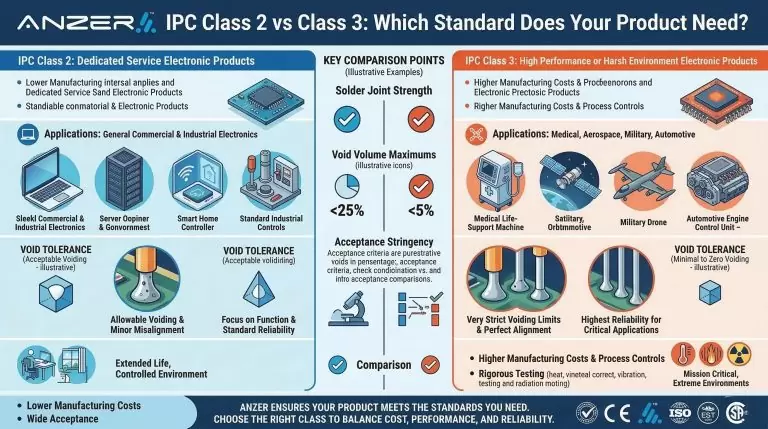
IPC Class 2 vs Class 3: Which Standard Does Your Product Need?
by Jay Mendpara

IPC Class 2 vs Class 3: Which Standard Does Your Product Need?

IPC Class 2 covers general consumer electronics with moderate reliability needs. IPC Class 3 applies to high-reliability aerospace, medical, and military electronics where failure is unacceptable. Class 3 has stricter acceptance criteria for solder joints, component placement, and defects – allowing zero cosmetic imperfections that...
ESD Control in Manufacturing: Preventing Static Damage
by Jay Mendpara

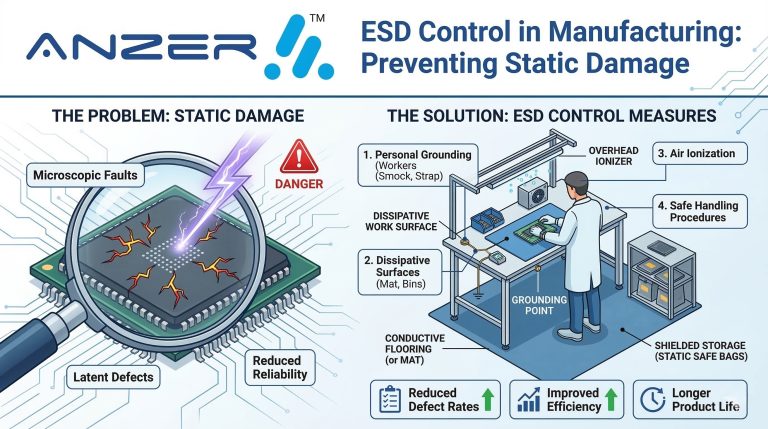
ESD Control in Manufacturing: Preventing Static Damage

TL;DR: Electrostatic Discharge (ESD) causes invisible damage to sensitive electronic components, resulting in immediate failures or latent defects that fail in the field. Industry data shows 30-40% of component failures stem from ESD damage. Prevention requires a comprehensive ESD control program following ANSI/ESD S20.20 standards...

HMI Display Integration Techniques for Custom Electronics -Anzer
by Jay Mendpara

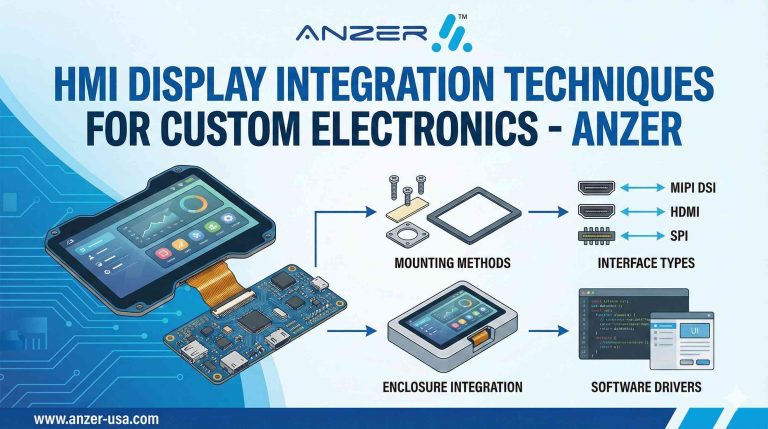
HMI Display Integration Techniques for Custom Electronics -Anzer

Welcome to the world of custom electronics. In this place, having the right interface can really make a big difference. A Human-Machine Interface (HMI) display connects your user and your product. Now, people want easy and quick touch screen interactions when they use a device....