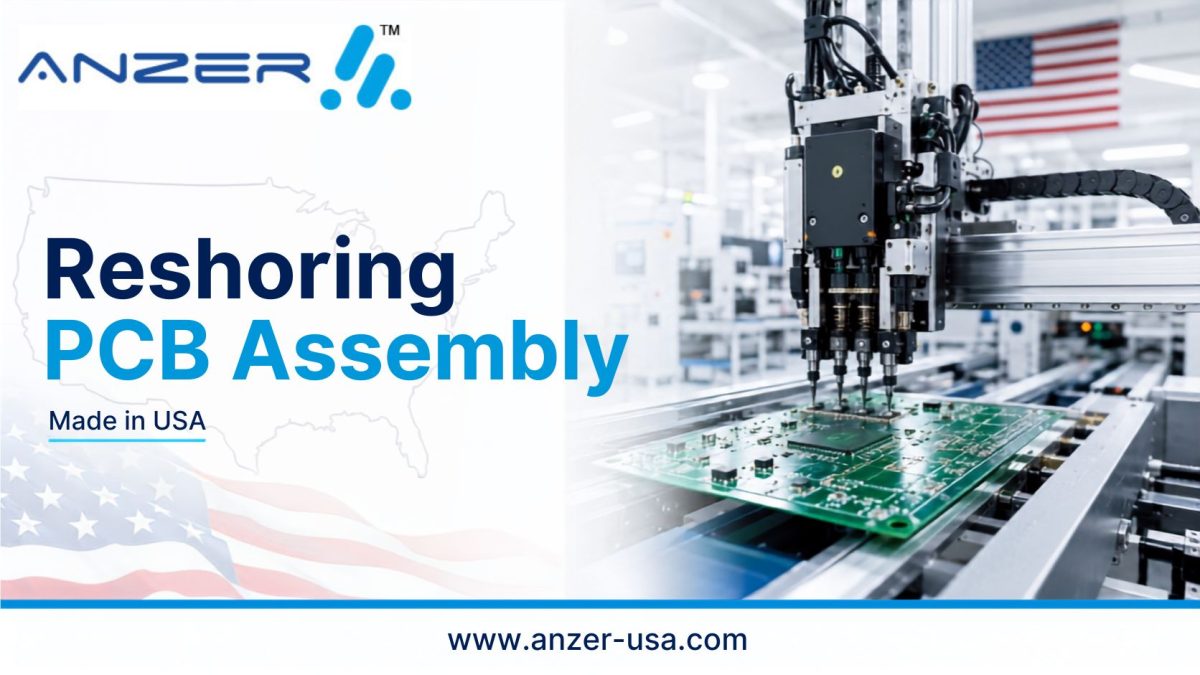
Reshoring PCB Assembly: Why US Manufacturers Are Bringing Electronics Production Home
For decades, the math seemed straightforward: move PCB assembly offshore, cut labor costs, and scale. That math no longer holds.
Supply chain failures, trade policy shifts, and the hard lessons of 2020 through 2022 have pushed procurement managers and OEM engineering teams to reassess where their electronics get built. Reshoring PCB assembly is no longer a political talking point. It is a sourcing strategy backed by cost analysis, risk data, and regulatory pressure, and US-based electronic contract manufacturers are seeing the results in their order pipelines.
What Is Reshoring in Electronics Manufacturing?
Reshoring means returning production that was previously offshored, typically to Asia, back to the United States. In electronics manufacturing, this most often applies to PCB assembly, box build assembly, and wire harness production.
The Reshoring Initiative, which tracks US manufacturing job announcements, has documented a sustained rise in reshoring and foreign direct investment (FDI) announcements since 2021, with electronics and semiconductors among the fastest-growing categories (Reshoring Initiative, 2024 Annual Report).
The CHIPS and Science Act, signed into law in August 2022, committed $52 billion to domestic semiconductor and advanced electronics manufacturing. While the legislation targets semiconductor fabrication primarily, its downstream effect on PCB assembly demand is real. More chips built in the US means more circuit boards need to be assembled in the US.
For OEM buyers, the conversation has shifted from “how do we reduce per-unit cost” to “how do we reduce total landed cost, including risk.”
The Real Cost of Offshore PCB Assembly
Low per-unit pricing is the entry point of the offshore pitch. It rarely survives contact with the full cost picture.
Consider what procurement teams actually absorb when sourcing PCB assembly from overseas.
Shipping and logistics costs have remained elevated and unpredictable since the freight disruptions of 2021. Ocean freight rates, while off their peak, carry volatility that long production cycles cannot easily accommodate.
Lead time inflation compounds the problem. Offshore PCB assembly typically runs 8 to 14 weeks from order to delivery. For US-based OEMs managing just-in-time schedules or responding to demand changes, that lead time creates inventory risk and missed revenue opportunities.
Quality failure costs are rarely factored into the original RFQ. IPC-A-610 is the international standard for acceptability of electronic assemblies. Not all offshore providers apply IPC standards consistently. A non-conforming batch caught at incoming inspection after a 12-week lead time is a production crisis, not a line item.
Intellectual property exposure is a persistent concern in high-precision manufacturing, especially for aerospace, medical, and defense-adjacent applications.
US-based PCB assembly removes most of these variables. With a domestic electronic contract manufacturer, buyers get shorter lead times, direct communication, IPC-certified inspection, and legal recourse under US commercial law.
Tariffs, Trade Policy, and the New Manufacturing Math
Section 301 tariffs on Chinese electronics goods, introduced in 2018 and expanded since, have materially changed the landed cost of offshore PCB assembly for US buyers. Components, fully assembled boards, and subassemblies sourced from China carry tariff rates that have eroded the per-unit labor savings that made offshoring attractive in the first place.
Further tariff adjustments affecting a broad range of electronics imports in 2025 have added additional pressure. OEM procurement teams that once modeled offshore PCB assembly as a clear cost win are now revisiting those models.
For any buyer using a China-based EMS provider as a primary supplier, the risk is not just cost. It is supply continuity. A single trade policy change, port disruption, or geopolitical event can halt a production line with no domestic alternative ready to absorb the volume.
US-based electronic contract manufacturers operating under Made in USA production sidestep this risk category entirely. No import tariffs, no customs clearance delays, no geopolitical exposure on domestically produced assemblies.
What to Look for in a US-Based PCB Assembly Partner
Not all US-based EMS providers carry the same capabilities. When evaluating reshoring options, procurement teams should apply a structured checklist.
Quality certification stack. ISO 9001:2015 is the baseline for quality management. For medical electronics, ISO 13485:2016 is mandatory. For aerospace, AS9100/AS9001:2016 is non-negotiable. An EMS provider without the relevant sector certification cannot safely build to your application’s compliance requirements.
IPC-certified inspection. IPC-A-610 acceptance criteria is the industry benchmark for PCB workmanship. Confirm that your EMS partner has certified IPC inspectors on staff, not just familiarity with the standard.
Prototype and pre-production capability. Many offshore providers require minimum order quantities that make prototype builds impractical. US-based EMS partners with a dedicated prototype line allow engineers to validate designs before committing to full production volumes.
Design for Manufacturability (DFM) support. DFM analysis upstream prevents assembly defects downstream. A provider that reviews Gerber files and flags design issues before production starts saves rework time and cost across the entire program.
Environmental compliance documentation. RoHS compliance and REACH compliance are required for products entering European markets. Confirm these with documentation, not a checkbox.
Diversity certifications. MBE (Minority Business Enterprise) and WBE (Women’s Business Enterprise) certifications provide procurement advantages for government contracts and diversity-tracked supplier programs. These are uncommon at the EMS provider level and represent sourcing value beyond technical capability alone.
Why Ohio Has Become a Center for US Electronics Manufacturing
Ohio’s manufacturing base has served industrial, aerospace, and automotive sectors for well over a century. The state’s position in the Midwest manufacturing corridor gives electronics manufacturers practical, logistical advantages that West Coast or Southeast options do not always match.
Ohio sits within one-day truck delivery distance of roughly 60% of the US population. For OEM customers managing assembly-to-delivery timelines, that geographic position compresses the distribution leg significantly.
The technical workforce is established. Ohio’s engineering and skilled trades pipeline, fed by universities and community college systems across the state, produces workers familiar with precision assembly, quality management systems, and regulated production environments.
The Ohio aerospace and medical device industries create sustained, local demand for PCB assembly and box build services. An EMS provider embedded in this regional industrial ecosystem understands the application requirements of buyers in those verticals, not in theory but through decades of direct production experience.
ANZER USA: 33 Years of Made in USA PCB Assembly
ANZER USA, based in Akron, Ohio, has operated as an American electronic contract manufacturer since the 1990s. With over 33 years of experience, more than 4,000 completed projects, and over 200 customers served across 10-plus industries, ANZER represents what sustained domestic manufacturing looks like in practice.
The certification stack covers the full range of regulated industries. ISO 9001:2015 for general quality management. ISO 13485:2016 for medical electronics assembly. AS9100/AS9001:2016 for aerospace. IPC-certified inspection is applied across PCB assembly and box build production. All products are RoHS and REACH compliant.
Services span PCB assembly (SMT and through-hole), full contract manufacturing, box build assembly, wire and cable harness production, conformal coating, potting, prototype builds, and pre-production pilot runs. ANZER holds both MBE and WBE certifications, a combination that is rare in the US EMS market and carries direct value for buyers with diversity sourcing requirements or government contract compliance obligations.
There are no minimum order quantity requirements. Prototype builds, pilot runs, and full production volumes are all supported within the same facility.
For OEM buyers evaluating reshoring PCB assembly from offshore providers, ANZER offers the compliance infrastructure, sector certifications, and three-decade production track record that a regulated electronics program requires.
Frequently Asked Questions
What does reshoring PCB assembly mean for lead times? Domestic PCB assembly typically reduces lead times to 2 to 6 weeks, compared to 8 to 14 weeks for offshore builds. The reduction applies to both standard production and prototype runs, which is particularly valuable during new product development and design validation phases.
Is Made in USA PCB assembly more expensive than offshore? Per-unit labor cost is higher, but total landed cost is often comparable or lower when Section 301 tariffs, freight, customs clearance, quality failure costs, and inventory carrying costs are included in the model. Many OEM buyers find reshoring PCB assembly is cost-neutral or cost-positive within 12 to 18 months of the transition.
Do I need an ISO 13485-certified EMS provider for medical device PCB assembly? Yes. ISO 13485:2016 certification is the accepted quality management standard for medical device manufacturers and their supply chain partners. Sourcing medical electronics assembly from a non-certified provider creates regulatory and liability exposure that no quality agreement can fully offset.
What is IPC-A-610 and why does it matter for PCB assembly quality? IPC-A-610 is the IPC standard that defines acceptability criteria for electronic assemblies, covering solder joint quality, component placement, cleanliness, and workmanship. An EMS provider with certified IPC inspectors applies this standard systematically across every production lot, which reduces field failure rates and supports traceability requirements.
Can an EMS provider handle both prototypes and production volumes? It depends on the provider. ANZER operates a dedicated prototype line alongside standard production capacity, with no minimum order quantity requirements. That structure allows engineering teams to move from prototype build to pre-production pilot to full production with a single manufacturing partner and consistent process documentation throughout.
Ready to discuss reshoring your PCB assembly program to a US-based manufacturer?
ANZER USA works with procurement managers and engineering teams across aerospace, medical, automotive, industrial automation, and agriculture sectors. ISO 9001:2015, ISO 13485:2016, and AS9100 quality systems are in place for regulated applications.
Get a Quote or reach the ANZER team directly at 330-733-6662 or [email protected].