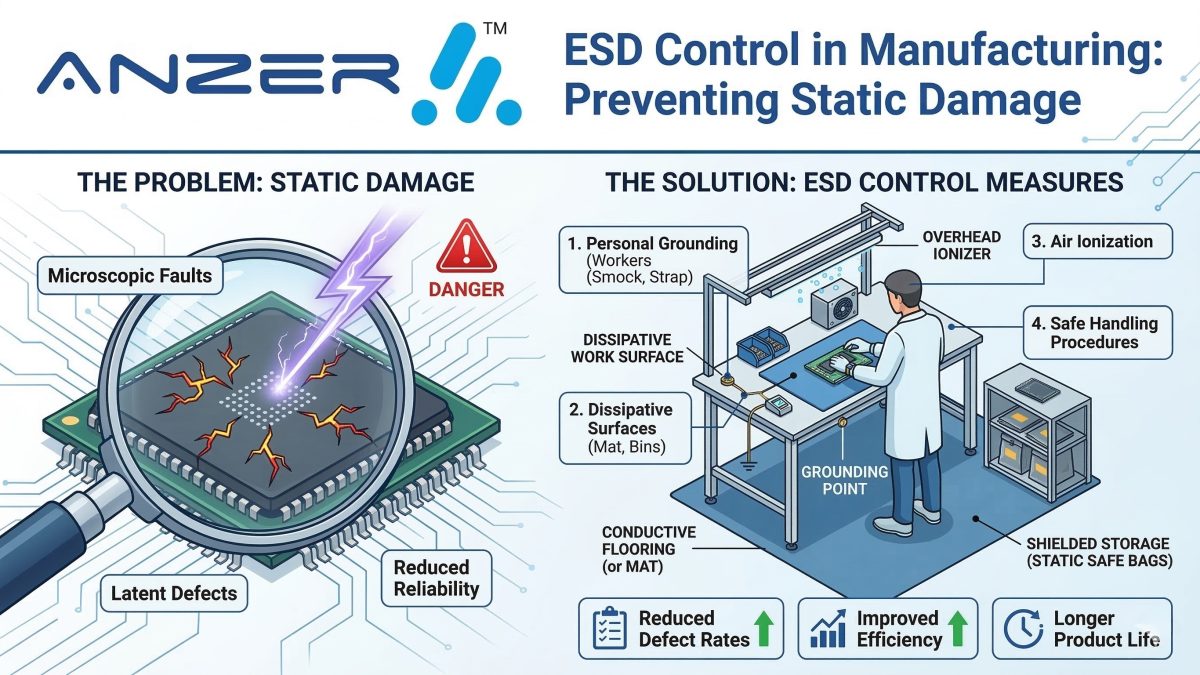
ESD Control in Manufacturing: Preventing Static Damage
TL;DR: Electrostatic Discharge (ESD) causes invisible damage to sensitive electronic components, resulting in immediate failures or latent defects that fail in the field. Industry data shows 30-40% of component failures stem from ESD damage. Prevention requires a comprehensive ESD control program following ANSI/ESD S20.20 standards – including grounded workstations, wrist straps, ESD-safe flooring, ionizers, and trained personnel. Human bodies can generate 2,000-35,000 volts of static electricity, while sensitive ICs fail at 10-100 volts. Proper ESD controls cost $500-$2,000 per workstation but prevent 5-10% yield losses and $50-$500 per damaged board. For aerospace and medical manufacturing, ESD programs aren’t optional – they’re certification requirements.
You assemble a batch of circuit boards. Everything looks perfect during testing. Three weeks later, customer returns start arriving. Intermittent failures. Random resets. Components that stop working under thermal stress.
Root cause? Electrostatic discharge damage that happened during assembly – invisible at the time, catastrophic in the field.
I’m Jay Mendpara, CEO of Anzer USA and an IPC-certified trainer with over 20 years overseeing manufacturing operations on the factory floor. In that time, I’ve seen ESD damage destroy yields, trigger recalls, and cost manufacturers hundreds of thousands of dollars. I’ve also seen proper ESD control programs eliminate these losses completely.
This guide explains what ESD damage actually is, why it’s invisible to most inspection methods, and how to implement factory floor controls that protect sensitive components from the moment they arrive until the moment they ship.
Table of Contents
What Is Electrostatic Discharge (ESD)?
Electrostatic discharge is the sudden flow of electricity between two objects at different electrical potentials, typically caused by static electricity buildup on materials or human bodies. When this discharge flows through sensitive electronic components, it can cause immediate catastrophic failure or latent damage that degrades component performance over time.
Think about walking across a carpet and touching a doorknob – you feel a shock. That shock represents thousands of volts discharging through your finger. When the same discharge flows through a microprocessor or power management IC rated for 3.3 volts, it destroys internal structures instantly.
The problem is invisibility. Unlike mechanical damage (bent leads, cracked components) or thermal damage (burned areas, discoloration), ESD damage is microscopic. It melts tiny junctions inside semiconductors, creates micro-cracks in dielectric layers, and weakens bond wires – none of which are visible to the naked eye or standard optical inspection.
Industry research shows that 30-40% of all component failures in electronics manufacturing are attributed to ESD damage. Some failures are immediate – the component is dead on arrival at test. But most ESD damage is latent – the component passes testing but fails prematurely in the field when exposed to thermal cycling, voltage stress, or extended operation.
At Anzer’s PCB assembly facility, we handle thousands of sensitive components daily. Without rigorous ESD controls, our yields would plummet and our customers would face field failures. Our ANSI/ESD S20.20 certified ESD control program is as critical as our soldering equipment.
How ESD Damage Happens: The Hidden Threat
ESD damage occurs from three primary sources on the factory floor:
Human Body Model (HBM)
Humans are excellent static electricity generators. Walking across a floor, sliding materials across a bench, even removing a sweater can generate static charges.
Typical static voltages generated by common activities:
- Walking across vinyl floor (10-20% humidity): 12,000-35,000 volts
- Walking across synthetic carpet: 15,000-35,000 volts
- Handling plastic bags or foam: 5,000-20,000 volts
- Sliding components across non-ESD surfaces: 2,000-10,000 volts
You don’t feel static discharge until it exceeds approximately 3,000 volts. But sensitive components fail at much lower voltages:
- Modern microprocessors and FPGAs: 10-50 volts
- Power management ICs and analog circuits: 50-100 volts
- Flash memory and RAM: 100-200 volts
- Discrete transistors and small-signal diodes: 100-300 volts
This means you can destroy dozens of components without ever feeling a shock. One ungrounded operator handling ICs at a workbench can damage 5-10% of components before assembly even begins.
Charged Device Model (CDM)
Components themselves can accumulate static charge during shipping, handling, or automated assembly. When a charged component contacts a grounded surface, current flows through internal structures.
CDM events are extremely fast (less than 1 nanosecond) and extremely damaging. Modern high-speed ICs with fine-geometry transistors are particularly vulnerable. A component charged to just 50 volts can self-destruct when placed on a grounded PCB.
This is why components arrive in anti-static packaging. Opening that packaging on an ungrounded workbench immediately exposes components to CDM risk.
Field-Induced Model (FIM)
Strong electric fields near charged materials can induce failures without physical contact. A component placed near a charged insulator (plastic bins, vinyl gloves, Styrofoam) can experience internal damage from field coupling.
FIM is the most overlooked ESD threat. I’ve seen manufacturing lines with perfect grounding but plastic component bins sitting directly on workbenches. The bins accumulate charge from friction. Components inside experience field stress continuously. Yield suffers mysteriously until someone measures the electrostatic field and discovers 10,000 volts 3 inches above the bench.
The Cost of ESD Damage
Let’s put numbers to the problem.
Direct Costs:
- Immediate component failures during test: $5-$100 per component depending on complexity
- Board-level rework to replace damaged components: $50-$200 per board in labor
- Scrap boards with multiple damaged components: $200-$500+ per board
- Yield loss without ESD controls: 5-10% typical
Hidden Costs:
- Latent failures in the field: $500-$5,000 per field failure including logistics, diagnosis, replacement, and customer downtime
- Warranty claims from premature failures: 2-5x the direct replacement cost when you include administrative overhead
- Reputation damage from unreliable products: impossible to quantify but potentially business-ending
Real Example from Our Factory Floor: Before implementing our comprehensive ESD program in 2018, we experienced 8-12% rework rates on a high-density aerospace board with sensitive microprocessors. We couldn’t identify root cause – boards passed initial test, failed during burn-in or environmental stress screening. After implementing full ESD controls (grounded workstations, ionizers, humidity control, training), rework rates dropped to 2-4%. The improvement saved approximately $85,000 annually on that one product line.
The investment to achieve this? Approximately $15,000 for 8 workstation upgrades plus $3,000/year in training and audits. ROI paid back in 10 weeks.
Compare that to manufacturers who skip ESD controls and accept 5-10% yield loss. On $1 million in annual production, that’s $50,000-$100,000 in lost margin – every year.
ANSI/ESD S20.20: The Industry Standard
ANSI/ESD S20.20 is the primary standard for developing, implementing, and maintaining an ESD control program in manufacturing environments. It defines requirements for workstations, personnel grounding, packaging, facility auditing, and training.
Understanding ANSI/ESD S20.20 is critical for aerospace and medical manufacturers. AS9100 and ISO 13485 certifications require demonstrated ESD control programs. You cannot hold these certifications without proving compliance.
Here are the key requirements:
Workstation Grounding
Requirement: All work surfaces, chairs, and carts in the ESD Protected Area (EPA) must be grounded through a verified path to earth ground.
Implementation at Anzer:
- ESD-dissipative table mats (surface resistance 10^6 to 10^9 ohms) on all benches
- Ground cords from each mat to a verified ground point (tested daily)
- ESD-safe chairs with conductive casters and seat fabric
- Mobile carts with grounded shelves for component transport
Personnel Grounding
Requirement: All personnel handling ESD-sensitive items must be grounded through wrist straps or heel grounders.
Implementation at Anzer:
- Wrist straps with 1-megohm current-limiting resistors (prevents shock hazard while maintaining ESD path)
- Continuous monitors that alarm if wrist strap connection fails
- Heel grounders for personnel who need mobility (less reliable than wrist straps, used only when necessary)
- Operator training on proper wrist strap wear and daily testing
Ionization
Requirement: Ionizers must be used to neutralize static charge on insulative materials that cannot be grounded.
Implementation at Anzer:
- Overhead ionizing air blowers at each workstation
- Ionization balance tested weekly (±50 volts maximum offset)
- Ionizers positioned to cover entire work area, especially near non-conductive tools
Environmental Controls
Requirement: Humidity should be maintained at 30-70% relative humidity. Temperature between 60-90°F.
Implementation at Anzer:
- HVAC system maintains 40-50% RH year-round
- Continuous monitoring with alarms if humidity drops below 30%
- Higher humidity reduces static generation significantly (at 50% RH, static voltage is 5-10x lower than at 10% RH)
ESD Packaging and Handling
Requirement: All ESD-sensitive items must be stored and transported in approved ESD-protective packaging.
Implementation at Anzer:
- Components remain in manufacturer’s anti-static packaging until use
- Pink poly bags (static-dissipative) for general ESD items
- Metallized shielding bags for very sensitive ICs and assemblies
- Conductive totes and bins for internal transport
- NO Styrofoam, plastic bubble wrap, or vinyl gloves in the EPA
Building an Effective ESD Control Program
ANSI/ESD S20.20 compliance isn’t about buying equipment – it’s about implementing a complete program with training, auditing, and continuous improvement.
Step 1: Assess ESD Sensitivity
Not all components require the same protection. Classify your components by ESD sensitivity:
- Class 0: <50 volts (most sensitive – advanced ICs, high-speed digital)
- Class 1: 50-500 volts (standard digital logic, many analog ICs)
- Class 2: 500-2,000 volts (power transistors, some discrete components)
- Class 3: 2,000-4,000 volts (most passive components – resistors, capacitors, inductors)
Your ESD program design depends on the most sensitive components you handle. If you’re assembling boards with Class 0 devices, your controls must be extremely rigorous.
Step 2: Define the ESD Protected Area (EPA)
The EPA is the zone where ESD controls are mandatory. Clearly mark EPA boundaries with floor markings and signage. Inside the EPA:
- All personnel must be grounded
- All surfaces must be ESD-safe
- All materials must be in ESD packaging
- All tools must be ESD-rated
Outside the EPA, normal operations continue. But components cannot enter or leave the EPA without proper ESD packaging.
At Anzer, our entire assembly floor is designated EPA. Components enter in manufacturer packaging, are handled at grounded workstations, assembled onto boards within the EPA, and exit in metallized shielding bags. There’s zero opportunity for unprotected handling.
Step 3: Personnel Training and Certification
This is where most programs fail. Operators don’t understand why ESD matters because damage is invisible.
Our training approach:
- Visual demonstrations showing ESD voltage generation (use an electrostatic fieldmeter to measure body voltage – operators are shocked when they see 15,000 volts)
- Explain component sensitivity with real examples (“this $85 microprocessor dies at 25 volts”)
- Show latent failure examples – components that passed test but failed after thermal cycling due to ESD damage
- Practice proper grounding, packaging, and handling procedures
- Quarterly refresher training and annual certification testing
As an IPC-certified trainer, I emphasize that ESD training isn’t a one-time checkbox. It’s ongoing awareness. New employees receive training before handling components. All employees receive refreshers quarterly.
Step 4: Implement Daily Verification
Equipment degrades. Wrist straps fail. Ionizers drift out of balance. Daily verification catches problems before they cause damage.
Daily checks performed by each operator:
- Wrist strap continuity test (using commercial tester or built-in workstation monitor)
- Visual inspection of mat grounding cords
- Ionizer balance verification (weekly for most installations)
Monthly checks performed by quality team:
- Surface resistance of all mats and floors (verify they remain in dissipative range)
- Grounding system resistance verification (should be <1 megohm to earth ground)
- Humidity monitoring system calibration
Annual checks performed by third-party or certified personnel:
- Complete system audit per ANSI/ESD S20.20 Section 6 (Compliance Verification)
- Documentation review of all test records
- Workstation physical inspection and electrical testing
Step 5: Continuous Improvement and Root Cause Analysis
When ESD-related failures occur, investigate immediately. Don’t assume it’s “just a bad component.”
At Anzer, we track every component failure during test. If we see patterns – same part number failing repeatedly, failures concentrated on one assembly shift, failures after specific assembly operations – we investigate for ESD root cause.
One investigation revealed that operators were occasionally removing their wrist straps during breaks but forgetting to reconnect when returning. We implemented workstation monitors that prevent equipment operation if the wrist strap is disconnected. ESD-related failures dropped to near zero.
The Anzer ESD Control Program
Here’s how we maintain ANSI/ESD S20.20 compliance across 33+ years of manufacturing excellence:
Facility Infrastructure:
- 100% ESD-protective flooring in assembly areas (conductive tile, 10^4 to 10^6 ohms surface resistance)
- Common ground point system verified annually by certified ESD technician
- HVAC maintains 40-50% RH year-round with continuous monitoring
- Overhead ionizers at all workstations, tested weekly for balance
Workstation Configuration:
- ESD mats grounded through verified continuous monitors
- Dual wrist strap connectors (operator + equipment technician)
- Ionizing air blowers positioned for full area coverage
- ESD-safe hand tools (ESD-rated tweezers, cutters, dispensers)
- Only approved materials allowed (no paper, cardboard, Styrofoam, vinyl)
Personnel Training:
- Initial 2-hour ESD training for all manufacturing personnel
- Quarterly refresher sessions
- Annual re-certification testing
- New-hire training before handling any components
- IPC-certified trainers conducting all ESD instruction
Packaging and Transport:
- Components remain in manufacturer anti-static packaging until kitting
- Pink poly bags for general components during kitting
- Metallized shielding bags for all finished assemblies
- Conductive bins and totes for all internal material movement
- Labels indicating ESD-sensitive contents on all packages
Verification and Auditing:
- Daily operator verification of wrist straps and grounding
- Weekly ionizer balance testing
- Monthly surface resistance testing of all mats and floors
- Quarterly internal ESD audits by quality team
- Annual third-party ANSI/ESD S20.20 compliance audit
The result? Our ESD-related failures are less than 0.5% of total production – 10-20x better than industry averages. Our aerospace and medical customers audit our ESD program regularly. We consistently pass with zero findings.
ESD Control: Non-Negotiable for Quality Manufacturing
Electrostatic discharge is the silent killer of electronics manufacturing. You can’t see it. You can’t feel it (until it’s too late). And it destroys yields, creates field failures, and costs manufacturers millions in losses.
But ESD damage is completely preventable. A comprehensive program following ANSI/ESD S20.20 standards – grounded workstations, trained personnel, proper packaging, daily verification, and continuous auditing – eliminates 95%+ of ESD-related failures.
The investment is modest: $500-$2,000 per workstation for equipment, $1,000-$5,000 annually for training and auditing. The return is massive: 5-10% yield improvement, elimination of latent field failures, and certification compliance for aerospace and medical customers.
If you’re an OEM evaluating contract manufacturers, ask about their ESD control program. Can they show you their ANSI/ESD S20.20 certification? Do they have daily verification records? Are their operators trained and certified? Can they demonstrate their grounding system integrity?
At Anzer USA, ESD control isn’t an afterthought – it’s fundamental to how we manufacture. Our certified program, trained personnel, and verified infrastructure ensure that every component we handle is protected from static damage from the moment it arrives until it ships to your customers.
If your product contains sensitive electronics – especially for aerospace, medical, or other high-reliability applications – let’s discuss how our ESD control program protects your components and your reputation.
Frequently Asked Questions About ESD Control in Manufacturing
Q: How can you tell if a component has been damaged by ESD?
A: ESD damage is usually invisible to visual inspection and even optical microscopy. The damage occurs at the microscopic level – melted junctions, broken bond wires, cracked dielectric layers inside the component package. Some ESD failures are catastrophic (component completely dead), which are detectable during functional testing. But 60-70% of ESD damage is latent – the component passes initial testing but fails prematurely in the field under thermal stress, voltage transients, or extended operation. Detection requires advanced techniques like Scanning Acoustic Microscopy (SAM) or electrical signature analysis comparing damaged components to known-good samples. Prevention through proper ESD controls is 100x more cost-effective than attempting to detect ESD damage after it occurs.
Q: Do all electronic components need ESD protection?
A: No. Passive components like standard resistors, ceramic capacitors, and inductors are generally ESD-insensitive (Class 3, withstanding >2,000 volts). However, all active components (semiconductors) require ESD protection, with sensitivity varying by technology: modern microprocessors and FPGAs are Class 0 (fail at <50 volts), standard digital logic is Class 1 (50-500 volts), and power transistors are typically Class 2 (500-2,000 volts). Even if a board contains mostly passive components, if it has ANY sensitive ICs, the entire assembly process must occur in an ESD Protected Area (EPA) to protect those devices. One unprotected handling event can damage the most sensitive component on the board.
Q: What’s the difference between anti-static, static-dissipative, and conductive materials?
A: These terms describe different levels of electrical resistance and ESD protection: Anti-static materials (10^11 to 10^12 ohms surface resistance) prevent static charge generation but don’t provide grounding – used for general packaging that won’t contact sensitive components directly. Static-dissipative materials (10^6 to 10^11 ohms) slowly drain static charge to ground – ideal for work surfaces, mats, and packaging that contacts components (pink poly bags, ESD mats). Conductive materials (10^3 to 10^6 ohms) provide direct path to ground – used for metallized shielding bags for very sensitive components and grounding straps. ANSI/ESD S20.20 requires static-dissipative or conductive materials in the EPA, never insulators like regular plastic or Styrofoam.
Q: How often do wrist straps and other ESD equipment need to be tested?
A: ANSI/ESD S20.20 requires daily verification of wrist straps before use – operators should test their wrist strap using a commercial tester or built-in workstation monitor every day before handling components. Work surface mats and flooring should be tested monthly for surface resistance to verify they remain in the dissipative range (10^6 to 10^9 ohms for mats). Ionizers require weekly balance testing to ensure they’re neutralizing charge without adding excess positive or negative ions (balance should be ±50 volts maximum). Annual comprehensive audits by certified personnel verify the entire ESD control program. Equipment that fails testing must be replaced immediately – a broken wrist strap provides zero protection even if the operator is wearing it.
Q: Can you implement an effective ESD program without ANSI/ESD S20.20 certification?
A: You can implement ESD controls without formal certification, but certification provides third-party verification that your program meets industry standards. For commercial electronics, an internal ESD program following ANSI/ESD S20.20 guidelines may be sufficient. However, aerospace (AS9100) and medical device (ISO 13485) manufacturing typically require documented ANSI/ESD S20.20 certification as part of quality system compliance. Certification involves implementing all required controls (grounding, ionization, training, packaging), documenting procedures, conducting internal audits, and passing third-party verification. Cost is typically $3,000-$8,000 for initial certification plus $1,000-$3,000 annually for surveillance audits. Without certification, you must convince customers your program is equivalent during their audits – certification eliminates this burden.