PCB Component Traceability: Tracking Every Component Lot
TL;DR: PCB component traceability is the ability to track every electronic component from original manufacturer to finished product, linking component lot codes to specific assemblies and serial numbers. It’s mandatory for aerospace (AS9100) and medical (ISO 13485) manufacturing. Complete traceability enables rapid defect isolation, supports recalls, prevents counterfeit components, and satisfies regulatory requirements. Systems capture manufacturer lot codes, date codes, receiving inspection data, and installation records – linking each component to its final assembly location. The investment prevents costly recalls: poor traceability can cost $50K-$500K per incident, while proper systems cost $5K-$20K to implement.
A component fails in the field. Your customer needs answers immediately.
Which lot was it from? When was it manufactured? What other assemblies used components from that same lot? Can you recall only the affected units instead of every unit you’ve shipped in the past year?
Without complete traceability, you’re facing a full product recall. With it, you isolate the problem to 47 units instead of 4,700.
I’m Jay Mendpara, CEO of Anzer USA with over 20 years overseeing manufacturing operations for aerospace and medical electronics. Our AS9100:2016 and ISO 13485:2016 certifications require complete component traceability from receiving dock to field installation. I’ve seen traceability systems prevent million-dollar recalls and watched their absence destroy companies.
This guide explains what component traceability actually means, why it’s non-negotiable for regulated industries, and how to implement systems that satisfy auditors while remaining practical for production teams.
Table of Contents
What Is PCB Component Traceability?
PCB component traceability is a quality management system that captures and maintains a complete record of every component’s origin, lot code, date code, receiving inspection data, and installation location – linking each individual component to the specific assembly serial number where it was installed. The goal is bidirectional visibility: from any component lot, identify which assemblies contain it; from any assembly serial number, identify every component lot used in its manufacture.
Think of it as a genealogy for electronics. Every resistor, capacitor, integrated circuit, and connector has a family tree. You know its manufacturer, when it was made, when you received it, how it tested, and exactly which products contain it.
This isn’t about tracking generic part numbers like “10kΩ resistor.” It’s about tracking specific manufacturing lots. A single part number might have 20 different lots in your inventory – manufactured on different dates, from different production runs, potentially with different material batches. Traceability tracks each lot independently.
For aerospace and medical manufacturing, this level of detail is mandatory. AS9100 Section 8.5.2 requires documented traceability. ISO 13485 Section 7.5.3 demands traceability for medical devices. These aren’t suggestions – they’re certification requirements that auditors verify during surveillance audits.
At Anzer’s manufacturing facility,we process approximately 500 unique component lot codes per month. Every lot receives a unique internal identifier linked to manufacturer lot/date codes, Certificate of Conformance (C of C), and receiving inspection results. When we install components on a board, our Manufacturing Execution System (MES) records which lots were used on which serial numbers.
Why Component Traceability Matters
The value becomes obvious when something goes wrong.
Defect Isolation and Targeted Recalls
A medical device customer discovered an anomaly in field units. Three devices showed intermittent failures in the power supply circuit. Without traceability, the safe response is to recall every unit manufactured in the timeframe – potentially thousands of devices at $500K+ cost.
With our traceability system, we identified the root cause in 4 hours. The three failing units all used capacitors from manufacturer lot L2401B. We queried our database: which other assemblies used that lot? Answer: 44 units total. The customer recalled 44 units instead of 4,400. Total cost: $22,000 instead of $2.2 million.
Industry data shows that poor traceability increases recall costs by 10-50x. A targeted recall of 50 units costs $5,000-$25,000. A full product recall of 5,000 units costs $500K-$2M when you include logistics, field service, replacement units, and customer downtime.
Counterfeit Component Prevention
Counterfeit components are a multi-billion dollar problem in electronics. Unauthorized remarked parts, recycled components sold as new, and completely fake semiconductors enter supply chains regularly. The aerospace and defense industries estimate 5-10% of components from unauthorized distributors are counterfeit.
Traceability prevents 95% of counterfeits from reaching production. Here’s how it works:
- Authorized Distributor Verification: Every component lot includes Certificate of Conformance from the manufacturer or authorized distributor.
- Lot Code Validation: Receiving inspection verifies manufacturer lot codes match C of C documentation.
- Date Code Analysis: Date codes are checked for consistency with manufacturing dates claimed in paperwork.
- Physical Inspection: Components with suspect markings or packaging are quarantined for detailed analysis.
One aerospace customer brought us a batch of “military-grade” microcontrollers from an unauthorized source. The paperwork looked legitimate. Our receiving inspection caught inconsistencies in date code formatting. Independent testing revealed remarked commercial parts. If those components had reached production, the entire lot of avionics assemblies would have been scrapped – a $350,000 loss.
Traceability created an audit trail proving we caught the counterfeit at receiving. The customer recovered costs from the unauthorized distributor.
Regulatory Compliance
AS9100 and ISO 13485 aren’t optional standards for aerospace and medical manufacturers – they’re market entry requirements. Both demand component traceability with specific documentation.
AS9100 Traceability Requirements (Aerospace):
- Unique identification for all components affecting product safety or performance
- Traceability from component lot to finished product serial number
- Retention of traceability records for product lifetime plus 10 years minimum
- Documented receiving inspection with C of C and test data correlation
- First Article Inspection (FAI) documentation linking specific component lots to qualification builds
ISO 13485 Traceability Requirements (Medical Devices):
- Traceability for all components, materials, and manufacturing aids used in product
- Unique Device Identification (UDI) linking finished devices to component genealogy
- Retention of traceability records for product lifetime plus 7 years (longer for implantable devices)
- Documented component acceptance criteria with objective evidence
- Supplier qualification records proving component sources are controlled
Without complete traceability, you cannot hold these certifications. Without these certifications, you cannot manufacture for aerospace or medical customers.
At Anzer’s AS9100 operations, we maintain traceability records back to 2012 when we transitioned from Western Reserve Controls. Every component lot ever used is documented. Every assembly serial number links to its component genealogy. When aerospace customers audit our systems, we demonstrate full compliance in minutes.
How Component Traceability Systems Work
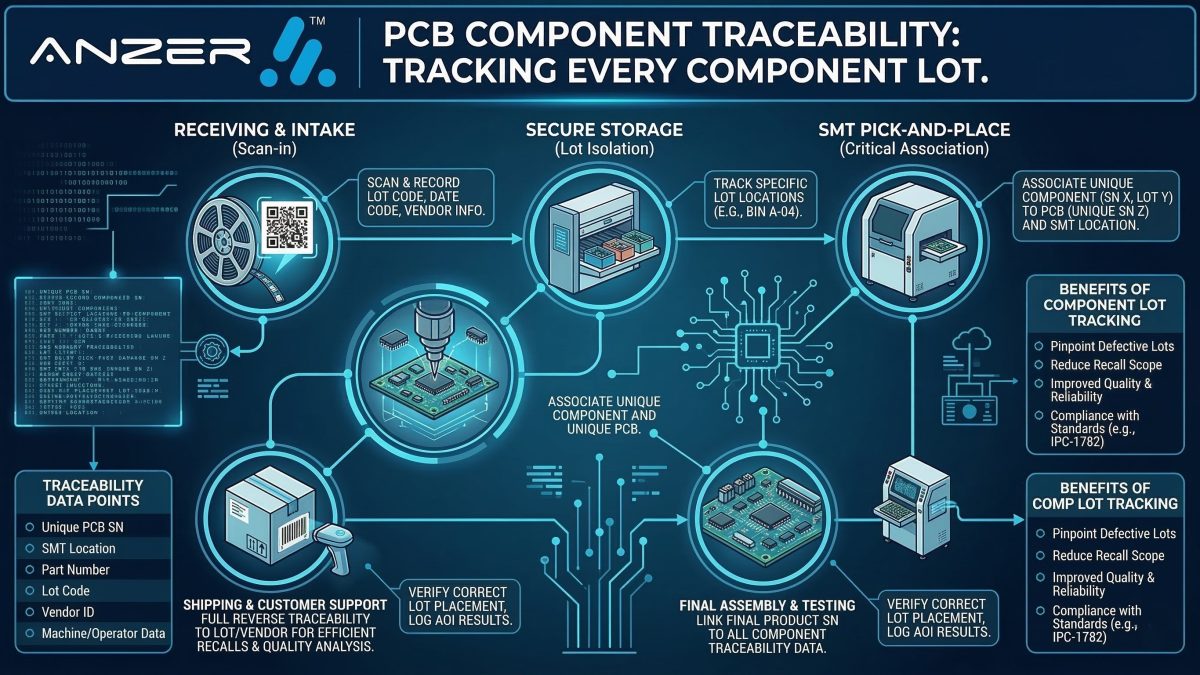
Effective traceability requires three elements: data capture at receiving, data association during production, and data retrieval for analysis.
Step 1: Receiving Inspection and Data Capture
Every component shipment triggers a receiving inspection workflow:
Physical Inspection: Components are examined for damage, proper packaging, and correct part numbers. Date codes and lot codes are recorded photographically.
Documentation Verification: Certificate of Conformance is cross-checked against purchase order. Manufacturer, lot code, date code, quantity, and test data must match between paperwork and physical components.
Lot Code Assignment: Our internal Material Resource Planning (MRP) system assigns a unique lot identifier. Example: resistor part number RES-0805-10K might receive internal lot ID “LOT-2025-0342.” This internal ID links to manufacturer lot code “L2501A” and date code “2501” (week 01, year 2025).
Database Entry: All data enters our traceability database: part number, manufacturer lot/date codes, internal lot ID, quantity received, C of C document reference, receiving inspection results, and shelf-life information (for moisture-sensitive devices).
Label Generation: Barcoded labels print automatically with internal lot ID. These labels go on component reels, trays, or tubes. Production operators scan these labels during kitting.
This might sound like overhead. But receiving inspection typically adds 15-30 minutes per shipment. For a $5,000 component order, that’s $20-40 in labor. The first prevented recall saves 100x that investment.
Step 2: Production Kitting and Installation Tracking
When a production order releases, our MES generates a kit list showing which component lots should be used. Here’s where traceability happens in real-time:
Barcode Scanning at Kitting: Material handlers scan component lot barcodes when building kits. The system records which lots were issued to which work order and which assembly serial numbers.
Operator Confirmation: Assembly operators scan their badge, the work order barcode, and the assembly serial number before starting. This creates a digital link: Operator ID + Serial Number + Work Order.
Installation Verification: For critical components (microprocessors, power management ICs, safety circuits), operators scan component lot barcodes during installation. High-resolution cameras capture images showing component lot codes in-place on the PCB.
Automated Optical Inspection (AOI) Integration: Our AOI systems capture images of every component marking. These images become part of the permanent record, providing visual confirmation of lot codes.
Final Documentation: When the assembly passes the final test, our system generates a Traceability Matrix – a document listing every component lot used in that specific serial number. This matrix accompanies the product to the customer.
For complex box builds with 2,000+ components, full traceability seems daunting. Automated systems it adds approximately 5-10 minutes per assembly. That’s $5-15 in labor for protection against $50K-$500K recalls.
Step 3: Data Retrieval and Analysis
The traceability system must answer two questions instantly:
Forward Traceability: “Which assemblies contain components from lot L2401B?”
- Query the database by manufacturer lot code or internal lot ID
- System returns every serial number that used components from that lot
- Typical query time: 5-30 seconds for 10,000+ assembly records
Backward Traceability: “Which component lots were used in serial number SN-2025-1847?”
- Query the database by assembly serial number
- System returns complete Traceability Matrix with all component lots
- Typical query time: 3-10 seconds
These queries run during customer audits, field failure investigations, and recall events. Speed matters. A manual search through paper records might take 4-8 hours per serial number. Digital systems return answers in seconds.
One automotive customer experienced field failures in three units out of 3,500 shipped. They needed component traceability for all three within 24 hours to determine if a supplier defect caused the problem. Our system generated complete traceability reports in 90 seconds. Root cause analysis proved the issue was unrelated to components (it was a software bug). Without fast traceability, they would have assumed a component defect and recalled all 3,500 units.
Traceability System Implementation: Cost vs. Value
Many OEMs resist implementing traceability because they assume it’s expensive and complex. The reality is different.
Typical Implementation Costs:
- Small manufacturer (500-2,000 assemblies/year): $5,000-$10,000 for MES integration
- Medium manufacturer (2,000-10,000 assemblies/year): $10,000-$20,000 for barcode systems and database
- Large manufacturer (10,000+ assemblies/year): $20,000-$50,000 for fully automated systems with AOI integration
Ongoing Operating Costs:
- Receiving inspection time: +15-30 minutes per shipment
- Production tracking time: +5-10 minutes per assembly
- Database maintenance: 2-4 hours/month for data backup and system updates
Value Delivered:
- Prevented recalls: $50K-$500K per incident avoided
- Counterfeit prevention: 95% reduction in unauthorized components reaching production
- Regulatory compliance: Required for AS9100, ISO 13485 certification (no certification = no customers)
- Customer confidence: Traceability reports demonstrate quality commitment during audits
The ROI is overwhelming. A single prevented recall pays for the entire system 10-50x over.
At Anzer, we implemented our current traceability system in 2019 at approximately $18,000 total cost. Since then, it has prevented at least four potential recalls (conservative estimate: $200K+ in avoided costs) and passed 15+ customer audits with zero findings related to traceability.
| Requirement | AS9100 (Aerospace) | ISO 13485 (Medical Devices) |
|---|---|---|
| Component Lot Tracking | Mandatory for safety/performance critical components | Mandatory for ALL components and materials |
| Record Retention | Product lifetime + 10 years minimum | Product lifetime + 7 years (longer for implants) |
| Supplier Documentation | C of C required from authorized distributors | C of C + supplier qualification records required |
| Unique Identification | Serial numbers for assemblies, lot codes for components | UDI (Unique Device Identifier) + component lots |
| First Article Documentation | FAI with component lot linkage required | Design History File with component traceability |
| Counterfeit Prevention | Mandatory with documented inspection | Required with risk-based supplier controls |
| Audit Frequency | Annual surveillance + 3-year recertification | Annual surveillance + 3-year recertification |
| Database Query Speed | Customer requirement (typically <1 minute) | FDA may request immediate traceability during inspections |
| Traceability Matrix | Required for First Article, optional for production | Required for EVERY device shipped |
The Anzer Approach: Practical Traceability
Here’s how we make traceability work without overwhelming production teams:
Barcode Everything: Every component lot, every work order, every serial number gets a barcode. Scanning is faster and more accurate than manual data entry.
Automate Data Capture: Cameras, AOI systems, and test equipment automatically capture lot codes. Operators verify but don’t manually enter.
Real-Time Dashboards: Production supervisors see traceability gaps in real-time. If an operator forgets to scan a lot code, the system flags it immediately – not three weeks later during an audit.
Training Integration: Our IPC-certified training includes traceability as a core competency. New operators learn the “why” behind scanning lot codes, not just the “how.”
Customer Portal Access: Aerospace and medical customers can query our traceability database directly through a secure portal. They don’t need to call and wait for reports – they run queries themselves.
Continuous Improvement Loop: Every traceability gap discovered in audits or field failures feeds back to process improvements. We’ve reduced traceability errors by 95% since 2019 through systematic root cause analysis.
As a CEO who’s overseen 33+ years of electronic contract manufacturing (including our time as Western Reserve Controls), I can state confidently: traceability is not optional overhead – it’s the foundation of quality manufacturing. It proves you know what you built, how you built it, and what materials went into it. Without traceability, you’re guessing.
Traceability: The Non-Negotiable Quality Foundation
Component traceability isn’t a luxury feature for premium manufacturers. It’s the baseline requirement for anyone serving aerospace, medical, automotive, or other regulated industries.
The investment is modest – $5K-$20K for most manufacturers. The operating overhead is minimal – minutes per assembly. The value is massive – prevented recalls, regulatory compliance, counterfeit protection, and customer confidence.
If you’re an OEM evaluating contract manufacturers, ask about their traceability systems. Can they show you a Traceability Matrix from a production build? Can they query their database in real-time during your audit? Do they have AS9100 or ISO 13485 certification proving their systems work?
At Anzer USA, component traceability is integrated into every step of our manufacturing process. From receiving inspection to final shipment, we track every lot. Our AS9100:2016 and ISO 13485:2016 certifications prove we meet the highest traceability standards in the industry.
If your product requires proven traceability – whether for regulatory compliance, quality assurance, or customer confidence – let’s discuss how our systems can support your manufacturing requirements.
Frequently Asked Questions About PCB Component Traceability
Q: How long do you need to retain component traceability records?
A: Record retention depends on your industry and certification. AS9100 (aerospace) requires traceability records for the product’s lifetime plus a minimum of 10 years. ISO 13485 (medical devices) requires product lifetime plus 7 years for most devices, with longer retention for implantable devices (often 25+ years). Automotive (IATF 16949) typically requires 15 years minimum. Defense/military contracts often specify lifetime plus 20 years. Even if not required by regulation, best practice is permanent retention – digital storage is inexpensive and prevents future gaps if retention requirements change.
Q: What’s the difference between serialization and lot traceability?
A: Lot traceability tracks component manufacturing lots (one lot might contain 5,000 components) while serialization assigns unique identifiers to individual finished assemblies. Both work together: lot traceability tells you which component lots went into production during a timeframe; serialization tells you which specific finished units received those components. For example, resistor lot “L2401B” might be used in serial numbers SN-2025-1001 through SN-2025-1150. Lot traceability is component-focused; serialization is assembly-focused. Complete traceability links both – from any component lot, identify which serial numbers contain it, and from any serial number, identify all component lots used.
Q: Can you implement component traceability without expensive MES systems?
A: Yes, though manual systems have limitations. Small manufacturers can use spreadsheet-based tracking with barcode scanners ($2,000-$5,000 investment). Each component lot gets a barcoded label at receiving. During production, operators scan lot barcodes and enter assembly serial numbers into a spreadsheet. The database is searchable but requires manual queries. This satisfies basic AS9100/ISO 13485 requirements. Limitations: higher error rates from manual entry, slower query times, difficulty scaling beyond 1,000 assemblies/year. For medium-to-large production, dedicated MES or ERP systems ($10,000-$50,000) provide automated tracking, real-time visibility, and audit-ready reports. Choose based on production volume and complexity.
Q: What happens if you discover a traceability gap during an audit?
A: Traceability gaps are serious findings in AS9100 and ISO 13485 audits. If you cannot trace a component lot to specific serial numbers (or vice versa), auditors issue a Major Nonconformance. Consequences include: corrective action plans with root cause analysis, potential suspension of certification until gaps are closed, customer notifications if affected products shipped, and possible recall of products with incomplete traceability. Prevention is critical: real-time traceability verification during production catches gaps before products ship. At Anzer, our MES prevents assemblies from passing final inspection if any component lot scans are missing – forcing immediate resolution rather than discovering gaps months later.
Q: How does component traceability help prevent counterfeit components?
A: Traceability creates a documented chain of custody from component manufacturer to installed product. Counterfeit prevention works through multiple verification steps: (1) Certificates of Conformance from authorized distributors are matched to component lot codes at receiving inspection; (2) Date codes and lot codes are photographed and verified against manufacturer formatting standards; (3) Physical inspection catches remarked, recycled, or improperly packaged parts; (4) Components from unauthorized sources are quarantined and tested independently. The traceability database creates an audit trail proving every component came from verified sources. Industry data shows traceability systems prevent 95% of counterfeits from reaching production. Without traceability, counterfeit detection relies on random sampling – catching only 20-30% of unauthorized components.