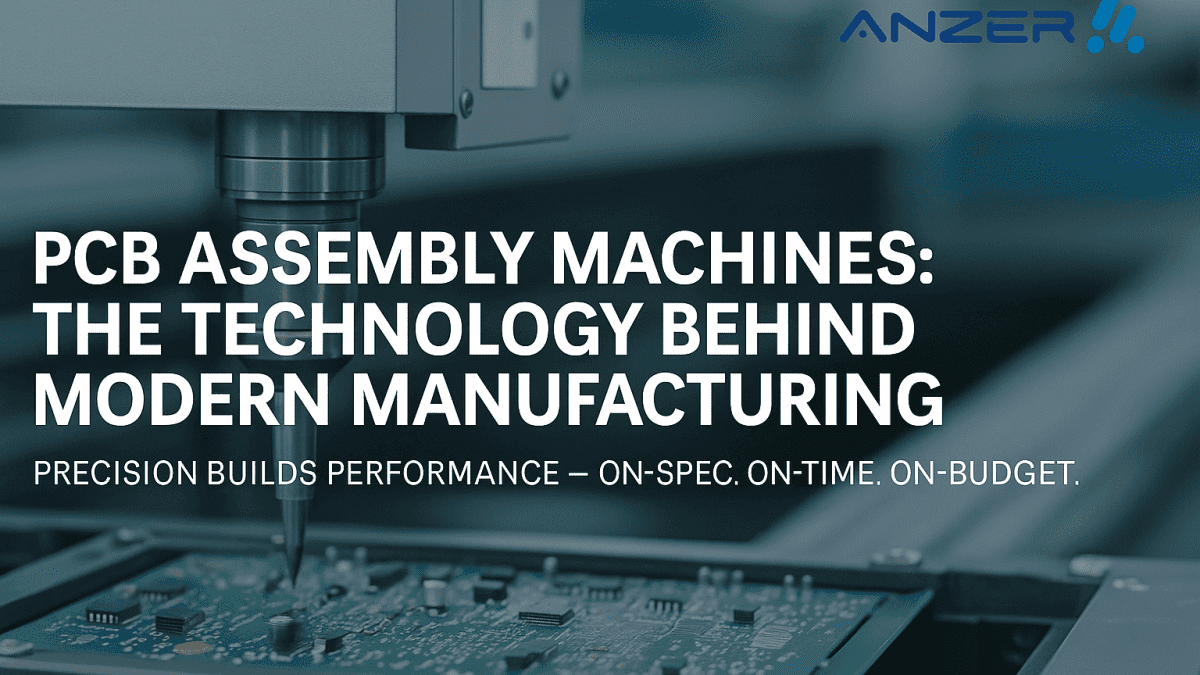
PCB Assembly Machines: The Technology Behind Modern Manufacturing
In today’s fast-paced electronics industry, precision and speed define success. What once took hours under a soldering iron is now completed in seconds by highly intelligent, automated systems.
At ANZER, we’ve seen PCB assembly evolve from manual craftsmanship to a sophisticated, data-driven process powered by cutting-edge machinery – each piece of equipment playing a critical role in achieving on-spec, on-time, and on-budget results.
Here’s a look inside the technology that drives modern PCB assembly and why the right machines matter as much as the design itself.
Table of Contents
The Evolution of PCB Assembly
The PCB assembly floor has transformed dramatically over the past three decades. Early processes relied on hand placement, manual soldering, and inspection under magnifiers.
Today, automation dominates every stage – from component placement to final testing – enabling consistent quality and repeatable accuracy across thousands of boards.
At ANZER, this evolution reflects our own journey: from early through-hole soldering lines to a state-of-the-art SMT (Surface Mount Technology) facility equipped with high-speed pick-and-place machines, precision reflow ovens, and advanced optical inspection systems.
1. Surface Mount Technology (SMT) – The Backbone of Speed and Precision
SMT machines are the workhorses of modern PCB manufacturing.
Our high-speed pick-and-place systems place components with precision measured in microns, guided by computer vision and alignment software.
Each reel of resistors, capacitors, and ICs feeds into automated placement heads that can handle thousands of components per hour – with accuracy that manual assembly could never match.
This speed not only shortens production time but also ensures consistent quality across prototypes and large-scale runs.
2. Reflow Soldering – Where the Connections Come to Life
Once components are placed, the boards pass through reflow ovens where solder paste melts, flows, and solidifies – creating reliable electrical connections.
ANZER’s advanced reflow systems maintain precise thermal profiles to ensure optimal solder joints without damaging sensitive components.
Different zones in the oven control ramp-up, soak, and cooling stages – achieving perfect solder joints every time, regardless of board complexity.
3. Automated Optical Inspection (AOI) – Quality, Verified
Modern manufacturing demands zero defects.
That’s where AOI systems come in – inspecting every solder joint, component alignment, and polarity marking in seconds.
ANZER uses AOI to catch even the smallest issues before they leave the production floor. High-resolution cameras and pattern-recognition algorithms compare each board against a digital “golden reference,” ensuring every assembly meets exact specifications.
This layer of verification is essential, especially for aerospace, medical, and industrial applications where failure is not an option.
4. Selective Soldering and Through-Hole Support
While SMT dominates, through-hole assembly remains critical for high-current or mechanical-strength components.
Our selective soldering systems automate this process too – precisely directing solder only where needed.
This ensures clean joints and protects heat-sensitive nearby parts, a major improvement over traditional wave soldering.
At ANZER, combining SMT and through-hole automation allows us to deliver complete hybrid assemblies without compromising quality or efficiency.
5. Conformal Coating, Potting, and Environmental Protection
Electronics don’t always live in perfect conditions. Some must perform in harsh, humid, or high-vibration environments.
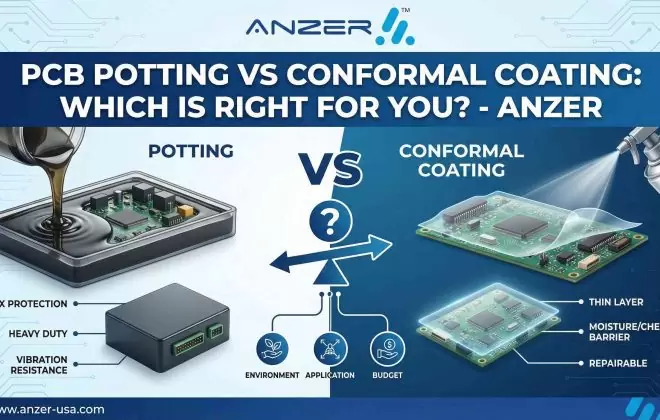
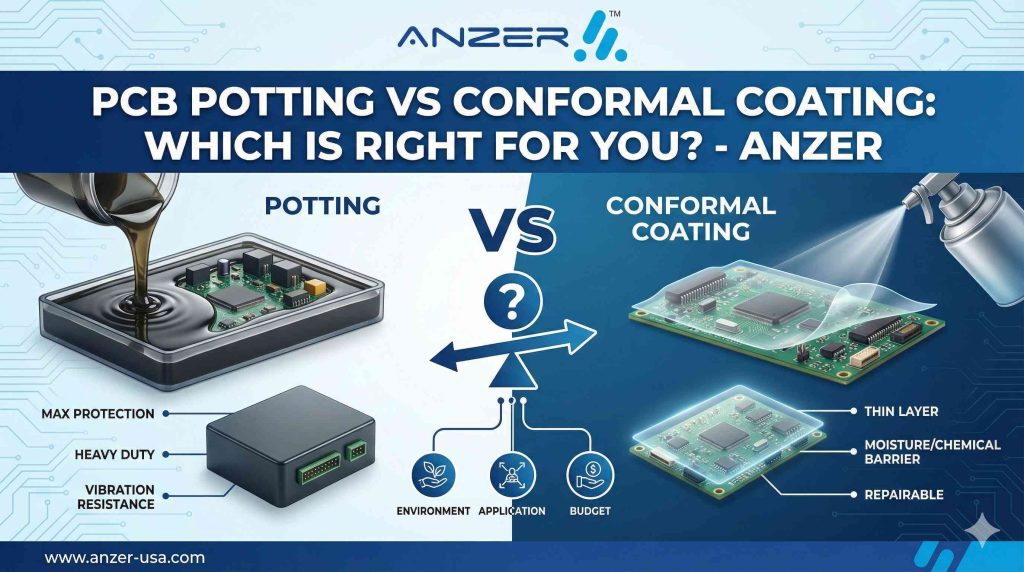
That’s why ANZER integrates in-house conformal coating and potting equipment – applying protective layers that shield circuits from moisture, dust, and stress.
These processes, performed under controlled environments, extend product life and reliability – especially for aerospace, medical, and industrial customers.
6. The Human Element Behind the Machines
Automation drives consistency, but expertise drives excellence.
Behind every ANZER assembly line is a team of IPC-certified technicians and engineers monitoring parameters, validating processes, and ensuring every project meets strict certification standards – including AS9100D, ISO 13485, and ISO 9001.
In other words, machines bring precision; people ensure perfection.
Why Technology Matters in PCB Manufacturing
Modern electronics demand more than a functional build – they require speed, repeatability, and traceable quality.
By investing in cutting-edge assembly machines and process control systems, ANZER ensures:
- Shorter production cycles
- Higher yields and lower defect rates
- Consistent quality across every batch
- Scalable capacity from prototypes to volume
This combination of technology and experience is what makes ANZER a trusted electronics manufacturing partner across industries – from aerospace to medical devices, automotive, industrial automation, and beyond.
Conclusion: Precision Powered by Technology
Every PCB tells a story of design, innovation, and execution.
At ANZER, that story is written by advanced machinery and guided by decades of engineering experience.
From pick-and-place accuracy to automated inspection and protective finishing, every step reflects our commitment to build it right – every time.
When your product depends on precision, performance, and reliability, the technology behind your manufacturer matters.
Work With ANZER
ANZER is a U.S.-based electronics design and contract manufacturing company located in Akron, Ohio.
With over 33 years of experience and 4,000+ successful projects, we specialize in PCB assembly (SMT & through-hole), wire harnesses, box builds, coating, potting, and prototyping – all backed by AS9100D, ISO 13485, and ISO 9001 certifications.
Learn more about our PCB assembly capabilities or contact us today to discuss your next build.