PCB Assembly Components: What Goes Into a Reliable Circuit Board
At Anzer, we offer the best PCB assembly services in Ohio, USA. Our modern facilities and skilled team guarantee top-notch quality for your printed circuit board needs.
Making reliable circuit boards means picking and putting together the right parts carefully. We know how key these parts are for the board’s performance and lasting power.
Our know-how in finding and assembling these vital parts lets us create circuit boards that exceed high standards.
Table of Contents
Key Takeaways
- Critical components are essential for reliable circuit boards.
- Expertise in sourcing and assembly ensures high-quality products.
- State-of-the-art facilities support the production of complex circuit boards.
- Reliable circuit boards are key for many industries, like electronics and manufacturing.
- Anzer’s team is experienced in delivering top-notch PCB assembly services.
The Critical Role of Circuit Boards in Modern Electronics
Circuit boards are key in today’s electronics, serving as the base for all devices. They are known as Printed Circuit Boards (PCBs). These boards hold components and connect them, making devices work.
How PCBs Form the Foundation of Electronic Devices
PCBs are vital for making complex, small, and reliable devices. They offer a solid base for mounting and linking components. Reliable circuit boards are essential for a device’s performance and longevity.

The Evolution of PCB Technology
PCB technology has grown a lot over time, thanks to new materials and manufacturing methods. Today, PCBs are used in many fields, from gadgets to space technology. This progress has led to faster, smaller, and more advanced devices, changing our lives.
The need for top-notch PCBs will keep rising. This will push the limits of PCB design and making even further.
Essential PCB Assembly Components and Their Functions
The quality of a circuit board depends on its components. PCB assembly components are key to electronic devices. Choosing the right components is vital for the circuit’s performance.
Understanding Component Categories
PCB components fall into two main groups: active and passive. Active components, like integrated circuits (ICs) and transistors, control current flow. Passive components, including resistors, capacitors, and inductors, help active components work.
How Components Work Together
Components on a PCB work together for electronic functions. For example, resistors control current, capacitors store energy, and ICs process signals. This teamwork ensures the device’s reliability and efficiency.
Component Selection Criteria for Reliability
Choosing the right components is key for reliability. Quality, PCB material compatibility, and environmental tolerance are important. Evaluating these factors helps ensure the device’s long-term reliability.
| Component Category | Examples | Function |
|---|---|---|
| Active Components | ICs, Transistors | Control electrical current |
| Passive Components | Resistors, Capacitors, Inductors | Support active components |
Knowing about PCB assembly components and their roles helps us create reliable PCBs. These can meet various application needs.
Active Components: Powering Circuit Functionality
In the world of electronics, active components are key. They power circuit functionality. These parts are vital for modern devices to work.
Integrated Circuits (ICs) and Microprocessors
Integrated Circuits (ICs) are small, flat pieces of semiconductor material. They hold many electronic circuits. Microprocessors, a type of IC, are the brains of modern electronics. They execute instructions and process data. ICs have changed electronics by making them smaller and more functional.
Transistors: Switching and Amplification
Transistors are essential for electronics. They act as switches and amplifiers. They control current flow, making complex logic gates and amplifying weak signals. Transistors are very versatile and key in modern electronics.
Diodes: Controlling Current Direction
Diodes control current direction in circuits. They work like one-way valves. This lets current flow in one direction but not the other. Diodes protect circuits from voltage spikes and ensure they work right.
Knowing how to use these components helps us create advanced electronic systems. These systems power our modern world.
Passive Components: The Unsung Heroes of PCB Assembly
Active components get a lot of attention, but passive ones are just as important. They include resistors, capacitors, and inductors. These parts are key to how well electronic devices work.
Resistors: Current Limitation and Voltage Division
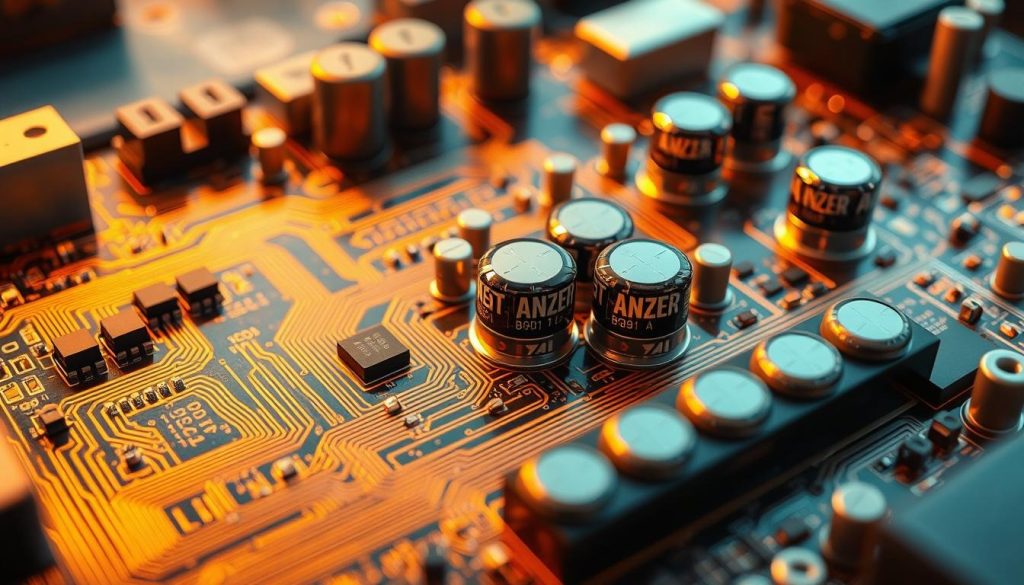
Resistors help control the current in circuits. They add the right amount of resistance. This makes sure other parts work right.
“The Art of Electronics” by Paul Horowitz and Winfield Hill, ‘Resistors are the most basic and widely used electronic component.’
Capacitors: Energy Storage and Signal Filtering
Capacitors store energy and filter signals. They help keep power supply voltages steady. They also prevent signal interference.
Inductors and Transformers: Magnetic Energy Storage
Inductors store energy in a magnetic field. They’re used for filtering and matching impedance. Transformers, made of inductors, transfer energy between circuits.
| Component | Function | Applications |
|---|---|---|
| Resistors | Current limitation, voltage division | Signal conditioning, voltage regulation |
| Capacitors | Energy storage, signal filtering | Power supply smoothing, signal coupling |
| Inductors | Magnetic energy storage | Filtering, impedance matching |
In conclusion, passive components are essential for PCB assemblies. Knowing their roles helps us make better electronic devices.
Connectors and Interconnects: Creating Reliable Pathways
In the world of PCB assembly, connectors and interconnects are key. They help create paths between components. This lets signals and power move freely, making sure the PCB works right.
There are many types of connectors and interconnects in PCB assembly. Header pins and socket types are favorites for linking components to the PCB. A recent report shows header pins have grown 15% in a year. This is because they’re reliable and easy to use.
Header Pins and Socket Types
Header pins connect components to the PCB. Socket types keep these pins in place securely. The right choice depends on the job and the component.
Edge Connectors and Board-to-Board Solutions
Edge connectors link PCBs to other boards or devices. Board-to-board solutions, like mezzanine connectors, connect multiple PCBs. This makes systems more dense.
Cable Assemblies and Wire Harnesses
Cable assemblies and wire harnesses link PCBs to other parts or devices. They make connections easier and cut down on mistakes.
Choosing the right connectors and interconnects is vital. It ensures PCB assemblies are reliable and perform well.
Surface Mount vs. Through-Hole Technology: Choosing the Right Approach
We look at the differences between Surface Mount and Through-Hole Technologies. This helps us pick the best method for making PCBs. Both are key in today’s electronics world, and knowing their strengths is vital for great designs and production.
SMT Components: Advantages and Applications
Surface Mount Technology (SMT) has big benefits. It makes components smaller, packs more into a smaller space, and boosts electrical performance. SMT is perfect for high-speed uses and is common in today’s gadgets because of its small size and high efficiency.
Through-Hole Components: When Traditional Works Best
Through-Hole Technology (THT) is great for things needing strong mechanical support and handling high power. It’s used for parts like connectors and big capacitors because of its durability and simple assembly.
Hybrid Assembly Strategies for Optimal Performance
Often, mixing SMT and THT is the smartest choice. This way, makers can get the best of both worlds. They get top-notch performance, reliability, and value in their PCBs.
The PCB Assembly Process: From Design to Finished Board
Turning a PCB design into a working prototype takes several key steps. We’ll walk you through the important stages that make a circuit board reliable and functional.
Preparing the PCB for Component Mounting
Before we start mounting components, we prepare the PCB. This means applying solder paste to the pads where components will go. The solder paste is key because it helps with soldering by providing the needed solder material.
Component Placement Techniques and Equipment
Placing components is a precise task that needs special tools. We use pick-and-place machines to place components accurately on the PCB. These machines are set up with the layout data from the PCB design files.
- High-speed placement for small components
- Precision placement for larger or more complex components
Soldering Methods for Different Component Types
Each component needs its own soldering method. We use various techniques to make sure connections are reliable.
Reflow Soldering Process
Reflow soldering is for surface mount components. The PCB is heated to melt the solder paste, securing the components.
Wave Soldering Applications
Wave soldering is for through-hole components. The PCB is moved over a wave of molten solder, soldering the components in place.
Selective and Hand Soldering Techniques
For complex or sensitive components, we use selective or hand soldering. These methods offer more control and are often used for prototypes or small batches.
By mastering these steps, we ensure our PCB assemblies are of the highest quality and reliability.
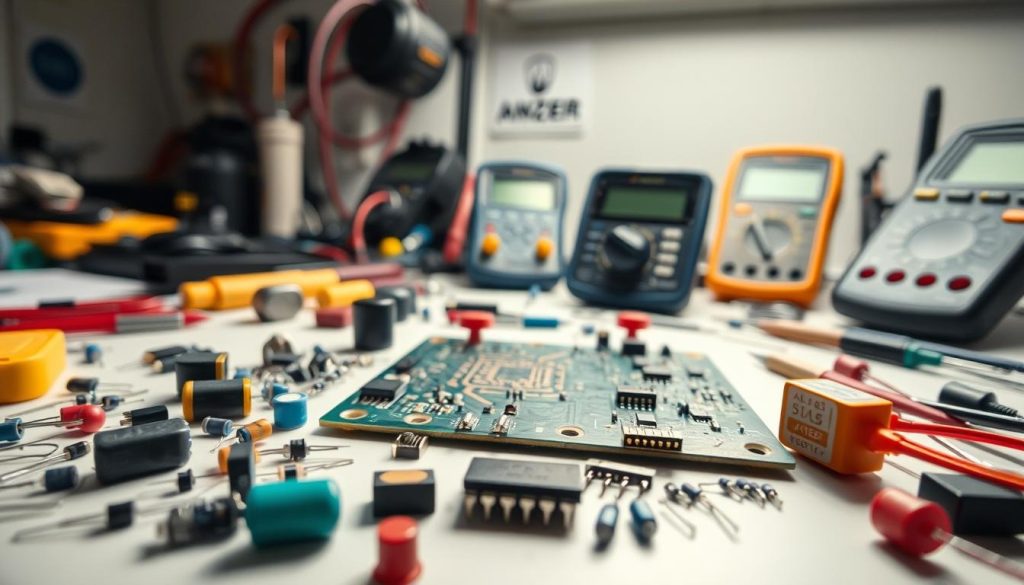
Quality Control Measures in Professional PCB Assembly
Ensuring the reliability of PCB assemblies is key. Quality control is vital for this. At our facility, we have a detailed quality control process. This ensures our products are of the highest quality.
Automated Optical Inspection (AOI) Systems
Our AOI systems find defects in PCB assemblies. They look for misaligned components, solder bridges, and not enough solder. High-resolution cameras inspect the PCBs from different angles. This makes sure every component is in the right place and soldered correctly.
X-ray Inspection for BGA and Hidden Connections
We use X-ray inspection for complex PCBs with BGA components or hidden connections. This method checks the integrity of these critical joints without damaging the assembly. It’s a non-destructive test.
In-Circuit and Functional Testing Protocols
We also do in-circuit and functional testing. These tests check if our PCB assemblies meet the required specs. In-circuit testing makes sure components are installed right and work as they should. Functional testing checks the assembly’s overall performance.
| Quality Control Measure | Description | Benefits |
|---|---|---|
| AOI Systems | Detect defects in PCB assemblies | Reduces human error, increases inspection speed |
| X-ray Inspection | Inspect internal structure of BGA components | Non-destructive, detects hidden defects |
| In-Circuit Testing | Verify component installation and function | Ensures correct component installation, reduces rework |
These quality control measures ensure our PCB assemblies are top-notch. Our commitment to quality is strong. We aim to meet and exceed our customers’ expectations.
Overcoming Common PCB Assembly Challenges
Effective PCB assembly needs careful planning and execution. We face many challenges, like soldering defects. These include component placement issues and thermal management concerns.
Troubleshooting Component Placement Issues
Component placement is key in PCB assembly. We use advanced machinery for accurate placement. But, issues like misaligned components and incorrect part placement can happen.
| Issue | Cause | Solution |
|---|---|---|
| Misaligned Components | Inaccurate machine calibration | Regular machine calibration and maintenance |
| Incorrect Part Placement | Human error or incorrect programming | Double-check programming and use automated optical inspection |
Addressing Soldering Defects and Rework Techniques
Soldering defects can harm PCB reliability. We fix these with rework techniques and better soldering processes. Common issues include solder bridges and cold solder joints.
- Solder Bridges: Excess solder connecting adjacent pins or pads.
- Insufficient Solder: Not enough solder for a reliable joint.
- Cold Solder Joints: Poor solder flow from inadequate heating.
Managing Thermal Considerations in Dense Designs
Thermal management is vital in dense PCB designs. We use thermal vias and heat sinks to manage heat. Careful component placement helps too.
By tackling these common challenges, we boost PCB reliability and performance. Our focus on quality and improvement helps us overcome these issues.
Specialized PCB Assembly Components for Advanced Applications
Specialized components are key for advanced PCB assembly. They let devices work at higher frequencies and manage power better. These parts are made for complex electronic systems, ensuring they work well and last long.
High-Frequency and RF Components
High-frequency and RF components are vital for things like phones, radar, and fast data. They include RF amplifiers and high-frequency filters. These parts handle high-frequency signals well, with little loss or distortion.
Power Management and Regulation Components
Good power management is key in today’s gadgets. Parts like voltage regulators, power MOSFETs, and DC-DC converters are important. They help manage power, cut down energy loss, and boost system efficiency.
Microcontrollers and Specialized Processors
Microcontrollers and specialized processors are the heart of many modern devices. These parts, including microprocessors and digital signal processors (DSPs), handle complex tasks. They let devices do many things.
Using these specialized components, advanced PCB assembly can reach new heights in performance, reliability, and efficiency.
Our Ohio-Based PCB Assembly Services and Capabilities
At Anzer, we’re proud to offer top-notch PCB assembly services in Ohio. We use our state-of-the-art facilities to ensure the highest quality.
Advanced Manufacturing Environment
Our Ohio facility is equipped with cutting-edge technology. This allows us to deliver high-reliability PCB assemblies. We keep a controlled environment for precision and consistency in every step.
Component Sourcing and Quality Control
We source components from trusted suppliers. We implement rigorous quality control measures to guarantee the integrity of every part. Our quality assurance process includes thorough inspections and testing to ensure compliance with industry standards.
From Prototyping to Production
Whether you’re developing a prototype or need full-scale production, we’re equipped to handle your needs. Our flexible manufacturing capabilities allow for efficient scaling. This ensures your project is completed on time and to your specifications.
| Service | Description | Benefits |
|---|---|---|
| Prototyping | Small-scale production for testing and validation | Reduces risk, allows for design iteration |
| Full-Scale Production | Large-scale manufacturing for commercial deployment | Increases efficiency, lowers cost per unit |
| Quality Assurance | Rigorous testing and inspection protocols | Ensures reliability, reduces defects |
Conclusion: Building Reliable Electronics Through Quality Assembly
The quality of PCB assembly components is key to making reliable electronics. Quality assembly and the right parts are the foundation of today’s devices. At Anzer, our Ohio-based services focus on top-notch components and advanced facilities for the best results.
Knowing how active and passive components, connectors, and interconnects work helps us build better PCBs. Our dedication to quality assembly and testing ensures our PCBs are reliable. This is true for both small prototypes and large-scale production.
Choosing quality PCB assembly components and methods is vital for making reliable electronics. As technology advances, the need for quality assembly will increase. This drives innovation and better performance in the electronics world. We’re committed to providing top-quality PCB assembly services for our clients.
FAQ
What is PCB assembly?
PCB assembly is the process of adding electronic components to a printed circuit board (PCB). This makes a functional electronic device. We use advanced equipment and techniques for high-quality assembly.
What types of PCB assembly services do you offer?
We provide various PCB assembly services. These include surface mount technology (SMT), through-hole technology (THT), and mixed-technology assembly. Our services are for industries like aerospace, automotive, medical, and consumer electronics.
What is the difference between surface mount and through-hole technology?
Surface mount technology mounts components directly on the PCB surface. Through-hole technology inserts components into holes in the PCB. We choose the method based on the project’s needs.
How do you ensure quality control in PCB assembly?
We use quality control measures like automated optical inspection (AOI) systems, X-ray inspection, and in-circuit testing. Our quality assurance ensures our PCB assemblies are reliable and perform well.
Can you handle large-scale PCB assembly production?
Yes, we can handle large-scale PCB assembly production. Our modern facilities and experienced team manage high-volume production efficiently. We maintain quality and reliability.
What is your lead time for PCB assembly services?
Our lead time for PCB assembly services depends on the project’s complexity and quantity. We work with clients to find the best lead time and ensure timely delivery.
Do you offer prototyping services for PCB assembly?
Yes, we offer prototyping services for PCB assembly. Our prototyping helps test and validate designs before full-scale production. It reduces errors and ensures optimal performance.
How do you source components for PCB assembly?
We source components from authorized distributors and manufacturers. This ensures authenticity and quality. Our component sourcing process includes rigorous vetting and inspection to meet specifications.
Why Choose Anzer as Your PCB Assembly Partner?
Quality is at the core of everything we do. Our printed circuit board assembly services adhere to stringent quality control standards, ensuring each product meets your specifications. We employ rigorous testing procedures to guarantee performance and durability and hold the following quality certifications:
- Expertise: With years of experience in the industry, our team brings unparalleled expertise to every project.
- State-of-the-Art Facilities: Our cutting-edge manufacturing facilities have the latest technology to handle even the most complex assemblies.
- Customer-Centric Approach: We work closely with every client to deliver precision PCB assembly services that meet exact needs.
Contact Us
Ready to start your PCB assembly project? Contact us today to learn more about our services and how we can assist you.