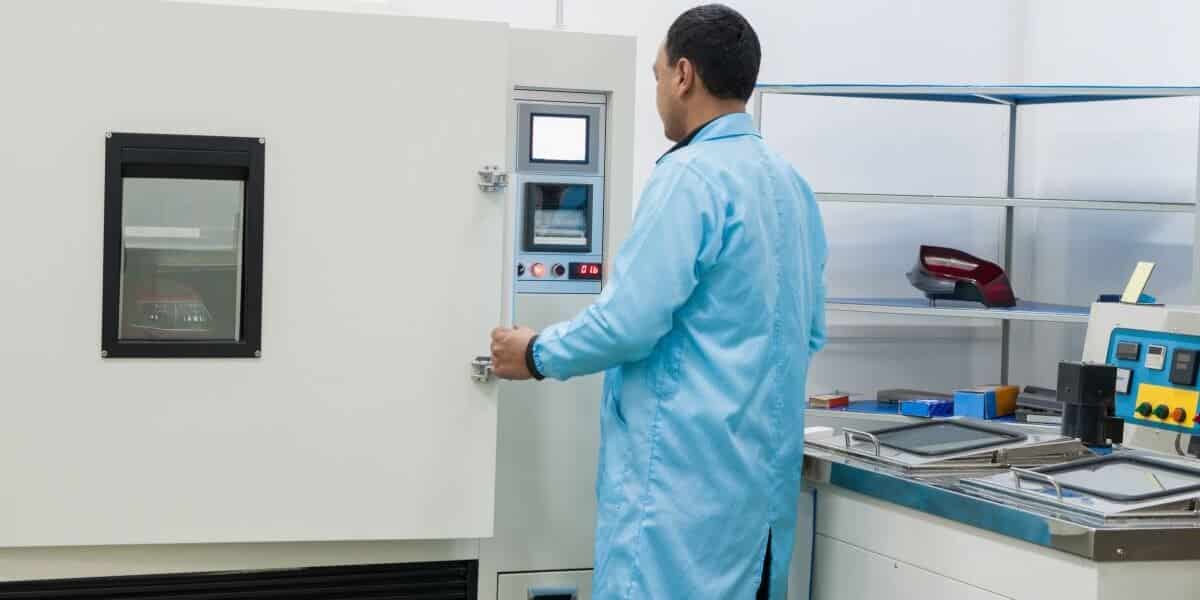
Highly Accelerated Life Testing (HALT): 7 Advantages for Electronic Assemblies
Highly Accelerated Life Testing, or HALT, is used to find weak points in an electronic product before those weaknesses become field failures. For PCB assemblies, embedded electronics, medical devices, aerospace electronics, industrial controls, and box build products, HALT can reveal thermal, vibration, component, solder joint, connector, enclosure, firmware, and functional weaknesses earlier in the development cycle.
HALT is not the same as a routine production test. The goal is not to “pass” a normal operating condition. The goal is to push a prototype beyond expected use conditions, find the failure mode, understand the root cause, and improve the design or manufacturing process before production.
At ANZER USA, this topic connects directly to how we think about quality: design review, manufacturability, IPC workmanship, inspection, functional testing, burn-in, documentation, and production readiness all need to work together.
What Is Highly Accelerated Life Testing?
Highly Accelerated Life Testing is a reliability discovery method used during product development. It exposes a product or assembly to progressively higher stress levels, often including:
- High temperature
- Low temperature
- Rapid thermal cycling
- Vibration
- Power cycling
- Voltage or frequency margining
- Combined thermal and vibration stress
- Functional monitoring during stress
For electronic assemblies, the most useful HALT result is not simply “the board failed.” The useful result is knowing why it failed.
A strong HALT process should answer questions such as:
- Did a solder joint crack under vibration?
- Did a component drift or fail under heat?
- Did a connector loosen under mechanical stress?
- Did firmware behave incorrectly during power cycling?
- Did the enclosure restrict airflow or create a thermal hot spot?
- Did the assembly fail because of the design, process, component selection, or test setup?
That is why HALT works best when design engineering, manufacturing engineering, quality, and test engineering review the findings together.
HALT vs HASS: What Buyers Should Know
HALT and HASS are often discussed together, but they serve different purposes.
| Method | Full Name | Typical Phase | Main Purpose | Buyer Takeaway |
|---|---|---|---|---|
| HALT | Highly Accelerated Life Testing | Development, prototype, design validation | Find design and process weaknesses by stressing the product beyond expected use | Use it before production decisions are locked |
| HASS | Highly Accelerated Stress Screening | Production | Screen manufactured units using stress limits informed by HALT | Use it only after design limits are understood |
| Burn-in | Burn-in testing | Pre-shipment or reliability screening | Operate the product under defined electrical and/or thermal stress | Useful for early-life weakness detection, but not a substitute for HALT |
| Environmental testing | Environmental qualification or validation | Development or compliance phase | Test against defined environmental conditions | Often more standards-driven than HALT |
The mistake is treating HALT like a generic compliance test. HALT should be treated as a learning process. If a prototype fails during HALT, that is not automatically bad. It may be exactly the information the engineering team needed before scaling the product.
7 Advantages of HALT for Electronic Assemblies
Finds weak points before production
The biggest advantage of HALT is early discovery. A design weakness found during prototype development is easier to correct than a weakness found after procurement, assembly, shipment, or field deployment.
For PCB assemblies, HALT may expose issues tied to:
- Component derating
- Thermal expansion mismatch
- Insufficient solder joint robustness
- Connector retention
- Mechanical support
- Enclosure ventilation
- Power supply margin
- Firmware response during stress
- Cable and harness routing
- Vibration-sensitive components
This is why HALT belongs near the prototype and pre-production stage, not after the product is already locked.
Improves design decisions with failure evidence
A normal functional test may show that the assembly works today. HALT helps reveal where the assembly may be weak under stress.
That difference matters for OEMs. If a product will operate in a hot enclosure, near vibration, in mobile equipment, in an aircraft-related assembly, near motors, near outdoor controls, or in a medical/industrial environment, the design needs evidence beyond a simple power-on test.
HALT can support better decisions on:
- Component selection
- PCB layout
- Mounting strategy
- Connector choice
- Thermal design
- Enclosure design
- Coating or potting requirements
- Cable strain relief
- Test coverage
When HALT findings are combined with electronic design for manufacturability, the buyer gets a clearer path from design intent to production reality.
Reveals process and assembly risks
Not every failure is a design failure. Some failures point to manufacturing or assembly risk.
For example:
- A marginal solder joint may fail earlier under vibration.
- A poorly supported component may crack or lift.
- A cable connection may loosen due to routing or strain.
- A thermal profile issue may contribute to weak solder formation.
- A cleaning, coating, or potting process may need review.
This is where HALT findings should feed back into manufacturing controls. At ANZER, related quality checkpoints may include AOI, X-ray inspection, ICT, flying probe testing, functional testing, burn-in, IPC-A-610 workmanship review, and controlled documentation.
A buyer should not ask only, “Can this assembly be built?” The better question is, “Can this assembly be built, tested, documented, and repeated with the same reliability intent?”
Supports better test strategy
HALT can expose what needs to be monitored in later test stages.
For example, if HALT shows that a voltage rail drops under a thermal transition, the production test strategy may need better functional monitoring. If a connector failure appears under vibration, mechanical inspection or harness routing requirements may need to be tightened. If a solder joint is sensitive to stress, assembly review and inspection coverage may need adjustment.
This connects HALT to Design for Testing. A good test strategy is not built only at the end of the project. It should be considered while the board, enclosure, firmware, and assembly process are still adjustable.
Reduces field-failure risk
HALT does not guarantee zero field failures. No test can honestly make that promise.
What HALT can do is reduce unknowns. It gives the engineering team a chance to find weak points earlier, correct root causes, and improve design margin before customers or end users experience the problem.
For regulated or high-reliability applications, this matters because field failures can create more than warranty cost. They can create documentation burden, corrective-action pressure, audit exposure, customer trust problems, and production disruption.
That is why HALT is especially relevant for buyers working in aerospace, medical, industrial automation, transportation-related electronics, rugged controls, and mission-sensitive assemblies.
Helps prototype teams avoid late redesign
Prototype teams often move fast. That speed is useful, but it creates risk if reliability testing waits until the design is already released.
HALT can help answer questions before a program moves into pre-production:
- Is the design margin wide enough?
- Are the selected components appropriate for the application?
- Is the PCB layout sensitive to heat or vibration?
- Does the enclosure create a thermal problem?
- Does the firmware recover correctly after stress events?
- Are any connectors, cables, or harnesses mechanically weak?
- Should conformal coating or potting be considered?
ANZER supports prototype-to-production work with DFM/DFA review, sourcing, SMT/THT assembly, ICT and functional testing, and engineering feedback. For projects requiring formal HALT, the output should be brought back into the design and manufacturing plan before production scaling.
Improves supplier and RFQ conversations
HALT findings make RFQ conversations more specific.
Instead of sending only a BOM and Gerber package, the buyer can communicate:
- Known stress risks
- Expected operating environment
- Thermal or vibration concerns
- Functional monitoring requirements
- Required inspection points
- Test coverage expectations
- Coating, potting, or enclosure requirements
- Documentation and traceability needs
- Prototype changes after HALT findings
This helps the EMS partner respond more accurately. It also reduces the risk of a quote that looks low but misses the real manufacturing and test requirements.
For a strong quote package, pair HALT findings with a complete BOM, drawings, assembly notes, test requirements, firmware instructions, acceptance criteria, and production volume expectations. For next steps, ANZER buyers can use the PCB assembly quote process or submit a project through Get Quote.
What HALT Can Reveal in PCB Assemblies
| Risk Area | Example Failure Mode | What the Team Should Review |
|---|---|---|
| Thermal design | Component drift, shutdown, cracked joints, hot spots | Component derating, thermal path, copper area, enclosure airflow |
| Vibration | Cracked solder joints, loose connectors, intermittent signals | Component support, connector retention, board mounting, harness routing |
| Power margin | Reset, brownout, unstable rails | Power supply design, voltage margining, load behavior |
| Assembly process | Weak solder joints or process-sensitive defects | Solder profile, IPC workmanship, AOI/X-ray/ICT coverage |
| Mechanical integration | Board flex, cable strain, enclosure interference | Box build fit, wire harness routing, fastening, strain relief |
| Firmware behavior | Failure to recover after cycling or stress | Recovery logic, watchdog behavior, logging, test scripts |
| Environmental exposure | Moisture, contamination, corrosion risk | Conformal coating, potting, cleaning, sealing strategy |
When Should OEMs Consider HALT?
HALT is most useful when the product has one or more of these conditions:
- New PCB design or major redesign
- New component technology
- New supplier or substitute component
- High field-reliability expectation
- Harsh temperature or vibration exposure
- Aerospace, medical, industrial, or transportation-related use
- High cost of failure
- Enclosure-level thermal or mechanical risk
- Prototype moving toward production
- Complex box build or harness integration
- Prior field failures or intermittent issues
HALT may not be necessary for every simple board. The decision should be based on product risk, operating environment, buyer requirements, cost of failure, and stage of development.
What to Prepare Before HALT
Before sending a product into HALT, the engineering team should define the test plan clearly.
Use this checklist:
| Item | Why It Matters |
|---|---|
| Product use environment | Helps identify relevant thermal, vibration, humidity, power, and mechanical stresses |
| DUT sample count | Determines how many units can be stressed, repaired, or sacrificed |
| Functional test plan | Defines what the product must do during stress |
| Failure definition | Prevents confusion when symptoms appear |
| Monitoring points | Captures voltage, current, signals, sensors, temperature, acceleration, or communication behavior |
| Test fixtures | Ensures vibration and thermal energy reach the product correctly |
| Repair and retest plan | Allows test, analyze, fix, and retest cycles |
| Documentation plan | Captures failure mode, root cause, corrective action, and design revision history |
| Manufacturing feedback loop | Ensures findings improve layout, process, inspection, and test requirements |
The most important part is the failure definition. If the team does not define what counts as a failure, HALT data can become difficult to interpret.
How HALT Fits With ANZER’s Manufacturing Quality Approach
ANZER should not treat HALT as an isolated lab event. For electronic assemblies, the real value comes when findings are connected back to manufacturability, inspection, test, and production documentation.
That connection may include:
- DFM/DFA review before assembly
- BOM review and component sourcing risk review
- SMT and through-hole assembly process control
- IPC-A-610 workmanship expectations
- AOI and X-ray inspection where applicable
- ICT, flying probe, and functional testing
- Burn-in testing when required
- Environmental testing considerations for aerospace and medical applications
- In-house conformal coating and potting when protection is specified
- Box build integration review for wiring, enclosure, strain relief, and final test
For buyers, the point is simple: reliability is not added at the end. It is built through design choices, assembly controls, testing strategy, documentation, and corrective action.
Common Buyer Mistakes With HALT
Avoid these mistakes:
- Treating HALT as a pass/fail certification test
- Running HALT too late, after the design is already frozen
- Testing without functional monitoring
- Using poor fixtures that do not transmit vibration or temperature properly
- Failing to document failure symptoms and root cause
- Fixing symptoms without correcting the design or process
- Ignoring manufacturing feedback after HALT
- Assuming burn-in replaces HALT
- Sending an EMS partner incomplete test requirements
- Not updating drawings, BOM, assembly notes, or acceptance criteria after findings
A strong HALT program should create practical changes, not just a test report.
Conclusion
Highly Accelerated Life Testing helps OEMs find weak points before production. For electronic assemblies, that can mean discovering thermal problems, vibration-sensitive solder joints, weak connectors, marginal components, firmware recovery issues, enclosure problems, or manufacturing-process risks while the design can still be improved.
If your PCB assembly, prototype, or box build product is moving toward production and reliability matters, bring the test strategy into the conversation early. ANZER USA can support the manufacturing side with DFM/DFA review, PCB assembly, inspection, functional testing, burn-in, documentation, and prototype-to-production support.
To discuss your next build, test requirements, or production-readiness package, contact ANZER USA or submit your project through the quote form.
FAQs
What does HALT mean in electronics?
HALT stands for Highly Accelerated Life Testing. In electronics, it is used during development to expose weak points in a PCB assembly or electronic product by applying stress conditions beyond expected normal use.
Is HALT the same as burn-in testing?
No. Burn-in usually operates a product under defined electrical and/or thermal stress to identify early-life failures. HALT is more aggressive and is used to find design and process limits during development.
Is HALT a pass/fail test?
HALT should not be treated as a simple pass/fail test. Its purpose is to find failure modes, analyze root causes, improve the design or process, and increase reliability margin.
When should a PCB assembly go through HALT?
HALT is worth considering when the product is new, high-risk, exposed to heat or vibration, used in regulated or harsh environments, or moving from prototype to production.
Can HALT prevent every field failure?
No test can prevent every field failure. HALT reduces unknowns by revealing weaknesses earlier, but reliability still depends on design quality, component selection, assembly controls, inspection, documentation, and production test strategy.


