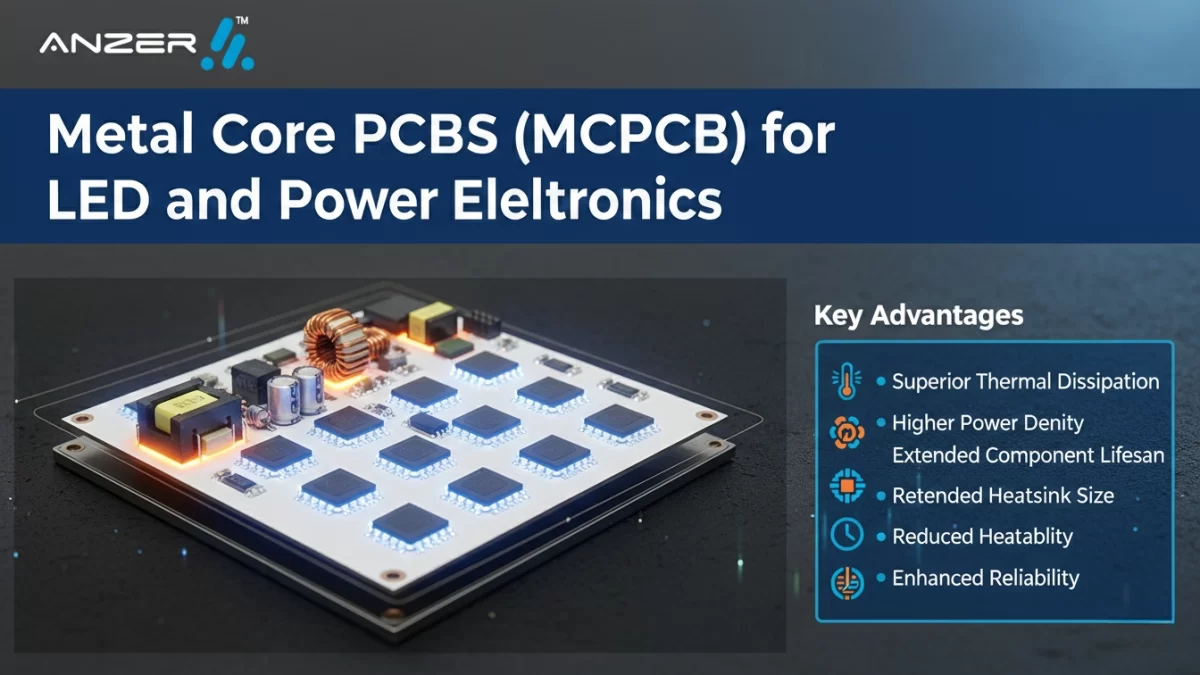
Metal Core PCBs (MCPCB) for LED and Power Electronics
Hello, innovators and electronics enthusiasts! This is Jay Mendpara, CEO of ANZER USA, coming to you from our headquarters in Akron, Ohio. With over two decades in the trenches of information technology, my MS in Computer Science, and my passion as an IPC-certified trainer, I’ve seen how the right PCB can light up quite literally entire industries. At ANZER, we’ve been at the forefront of PCB assembly and contract manufacturing for more than 33 years, completing over 4,000 projects for 200+ customers across diverse sectors.
Today, let’s shine a spotlight on Metal Core PCBs (MCPCBs), the unsung heroes powering LED lighting and high-power electronics. If you’re searching for “MCPCB for LED assembly Ohio” or “metal core PCB power electronics Akron,” you’ve hit the jackpot. I’ll walk you through what makes MCPCBs tick, their game-changing benefits, and design tips drawn from our real-world experience in Ohio’s thriving manufacturing scene. Whether you’re illuminating streets or driving electric vehicles, these boards keep things cool and efficient.
I vividly remember a project where a client’s LED driver overheated, dimming their entire prototype. Switching to an MCPCB turned that around, dissipating heat like a pro and boosting efficiency. In power-hungry apps, traditional FR-4 boards just can’t handle the thermal load without warping or failing. MCPCBs step in with a metal base usually aluminum or copper that acts as a built-in heatsink. Let’s dive deeper into why they’re essential for LED and power electronics.
Table of Contents
What Are Metal Core PCBs and How Do They Work?
At their core (pun intended), MCPCBs feature a thermally conductive metal layer sandwiched between the dielectric and copper circuits. Unlike standard PCBs, the metal substrate often 1-2mm thick aluminum pulls heat away from components, spreading it across the board and out to external cooling.
Key layers:
- Base Metal: Aluminum for cost-effectiveness and lightweight (thermal conductivity ~200 W/mK), or copper for superior performance (~400 W/mK) in extreme cases.
- Dielectric: A thin, thermally enhanced insulating layer (e.g., epoxy or ceramic-filled) that electrically isolates while conducting heat.
- Circuit Layer: Standard copper traces for your LEDs, transistors, or IGBTs.
This setup excels in high-heat scenarios. For LEDs, which convert only 20-30% of energy to light (the rest is heat), MCPCBs prevent junction temp spikes that reduce lifespan and output. In power electronics like inverters or motor drives they manage currents over 100A without hotspots.
In Ohio’s automotive and industrial hubs, from Toledo to Columbus, MCPCBs are fueling EV chargers and smart grids. At ANZER, we’ve integrated them into projects like high-power converters, ensuring reliability per IPC standards.
Benefits of MCPCBs for LED and Power Applications
Why choose MCPCB over traditional? It’s all about performance under pressure:
- Superior Thermal Management: Dissipates heat 5-10x better than FR-4, keeping components below 100°C even in dense layouts.
- Longevity and Efficiency: LEDs on MCPCBs can last 50,000+ hours with minimal lumen depreciation. Power circuits run cooler, slashing energy loss by 10-20%.
- Compact Design: No need for bulky external heatsinks, enabling slimmer profiles for wearables or automotive lighting.
- Durability: Withstands vibrations and thermal cycling ideal for Ohio’s harsh winters or aerospace vibrations.
- Cost-Effective: Initial investment pays off with fewer failures and easier assembly.
We’ve seen clients in Akron’s LED manufacturing scene cut rework by 30% after adopting MCPCBs. For power electronics, they enable higher power densities, perfect for renewable energy systems.
Design Guidelines for MCPCBs in LED and Power Electronics
Designing MCPCBs isn’t rocket science, but it requires finesse. Based on IPC-2152 and our training expertise, here are practical tips:
1. Material and Stackup Choices
- Select the Right Core: Aluminum for most LED apps (cost ~$0.50/cm²); copper for ultra-high power where budget allows.
- Dielectric Thickness: Keep it 50-100 microns for optimal heat transfer without sacrificing isolation (breakdown voltage >1kV).
- ANZER Tip: Use IMS (Insulated Metal Substrate) for single-sided designs – great for LED arrays.
2. Layout and Component Placement
- Thermal Vias and Pads: Place vias under hot components like LEDs or MOSFETs, filled with conductive epoxy for better flow.
- Trace Sizing: Wider traces (2-4 oz copper) handle high currents; calculate heat rise using tools like Saturn PCB.
- Spacing: Maintain 0.2-0.5mm gaps around power traces to avoid arcing.
- Pro Tip: Group heat sources and align with airflow paths something we optimized in our OSU RALPH medical project for efficient cooling.
3. Assembly and Testing Considerations
- Soldering: Use low-temp pastes to prevent dielectric damage; reflow at 220-250°C.
- Finishing: HASL or ENIG for solderability; add conformal coating for humidity resistance.
- Testing: Thermal imaging and cycling (2,000+ cycles) per IPC-TM-650 to verify performance.
- ANZER Insight: Our Akron facility uses AOI and X-ray for defect-free assembly, ensuring MCPCBs meet aerospace-grade reliability.
For LED specifics, aim for uniform heat distribution to avoid color shifts. In power electronics, focus on EMI shielding with ground planes.
ANZER USA’s Expertise in MCPCB Assembly for Ohio Businesses
At ANZER, we’re your go-to for MCPCB prototyping and production. Our certifications and local presence mean fast turns without overseas hassles. We’ve supported LED lighting for industrial automation and power modules for EVs, all U.S.-made.
In aerospace-adjacent apps (like Ohio’s NASA work), MCPCBs provide lightweight thermal solutions. For medical power supplies, they ensure stable operation in sterile environments.
Overcoming Challenges and Looking Forward
Challenges like higher costs or machining complexities? Mitigate with DFM reviews we offer them free. Future trends? Hybrid MCPCBs with embedded actives for even better integration.
Illuminate Your Project with ANZER USA
As Jay Mendpara, I’m excited to help Ohio innovators harness MCPCBs for brighter, more powerful electronics. If you’re in Akron or beyond searching “MCPCB assembly LED power electronics Ohio,” let’s team up. Visit us at 1147 Sweitzer Ave, Akron, or call 330-733-6662 for a free quote. Together, we’ll power the future – efficiently and reliably.